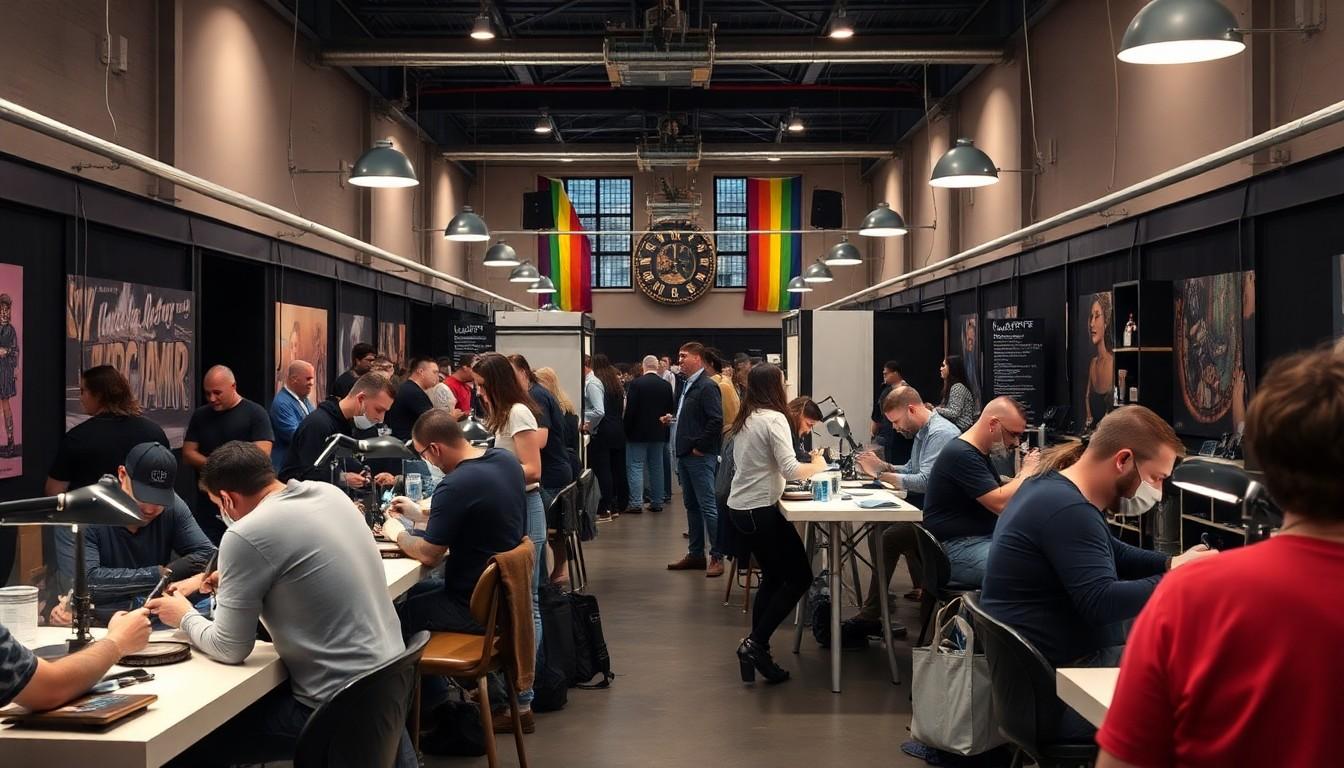
Tattoo artists and visitors gathered at De Hallen in Amsterdam for Queer Tattoo Fest, where people could get inked, join workshops and enjoy performances in a welcoming setting. The event puts LGBTQIA+ people at the centre of the room, offering a different feel from a conventional tattoo convention and a chance to meet artists from near and far.
Essential Takeaways
- A busy tattoo floor: Around 40 tattoo beds were set up at De Hallen Studios, with many occupied early on Saturday.
- More than tattooing: The programme included workshops, panels, performances and DJ sets.
- A welcoming focus: The festival centres the LGBTQIA+ community while welcoming friends, allies and other visitors.
- Artists travelled widely: Participants came from countries including Sweden and Germany, as well as the US and Guatemala.
- A personal choice: Some visitors booked an artist in advance, while others chose one after arriving.
At De Hallen, queer visitors are the norm
The clearest difference at Queer Tattoo Fest isn't a particular style of ink. It's the atmosphere. At De Hallen Studios, visitors could browse artists' work, settle into a tattoo chair and spend a few hours in a space where queer people weren't an exception.
The event's programme stretched beyond the tattoo stations, with workshops, panels, performances and DJs. Still, the beds were the main draw: about 40 were laid out across the large room, and many were already in use by early Saturday afternoon.
Choosing a tattoo artist on the day
Some visitors had arranged appointments online, but plenty made their choice after arriving. For Elisabeth Zweers, a look through Dublin artist Agnes Budka's portfolio was enough to settle on a fern tattoo for her upper arm. The design took roughly 90 minutes to two hours.
Zweers already had animal tattoos on her legs, including an octopus and a bee, but her arms were bare. She said she felt at home in the accepting atmosphere at the festival and enjoyed chatting with Budka during the session. A long appointment can feel less daunting when the conversation flows.
Why a queer-led tattoo space can feel different
Festival organiser Renée Spek also works at Club Frou Frou, an Amsterdam studio described as welcoming to FLINTA clients - women, lesbians, intersex, non-binary, trans and agender people. Its aim is to offer a safe, comfortable setting without shutting out others who support that approach.
That sense of ease matters in a tattoo chair, where a client is spending time in close contact with an artist and may be sharing personal parts of their identity. London tattooist Spencer said being tattooed by another queer person can help clients feel they don't need to hide or brace for judgement. It's a small distinction with a real effect on whether someone feels relaxed enough to be themselves.
From abstract florals to old-school ink
The designs at the festival ranged beyond familiar convention imagery. Rotterdam visitor Iso, who uses the pronouns die and hun, chose an abstract floral-style fern for their wrist, a change from the creature designs they already had.
The mix of styles reflects the freedom of a gathering where visitors can explore what suits them, rather than feeling nudged towards one familiar look. And with artists travelling from across Europe and further afield, the event also offers a chance to discover work that may not be on your local studio's wall.
A growing gathering, with room to belong
The first Queer Tattoo Fest drew an estimated 600 to 700 visitors, organisers said, and they expected around 800 to 900 at the next edition. Artists came from places including Sweden, Germany, New York and Guatemala, giving the Amsterdam event an international feel.
If you're considering a tattoo at a festival, take time to look through an artist's portfolio and discuss the design, placement and price before settling in. A welcoming atmosphere is important, but so are clear expectations and a design you'll still feel good about long after the music fades.
For many visitors, the best part may be simple: feeling at ease while choosing art to carry with them.
Source Reference Map
Story idea inspired by: [1]
Sources by paragraph: