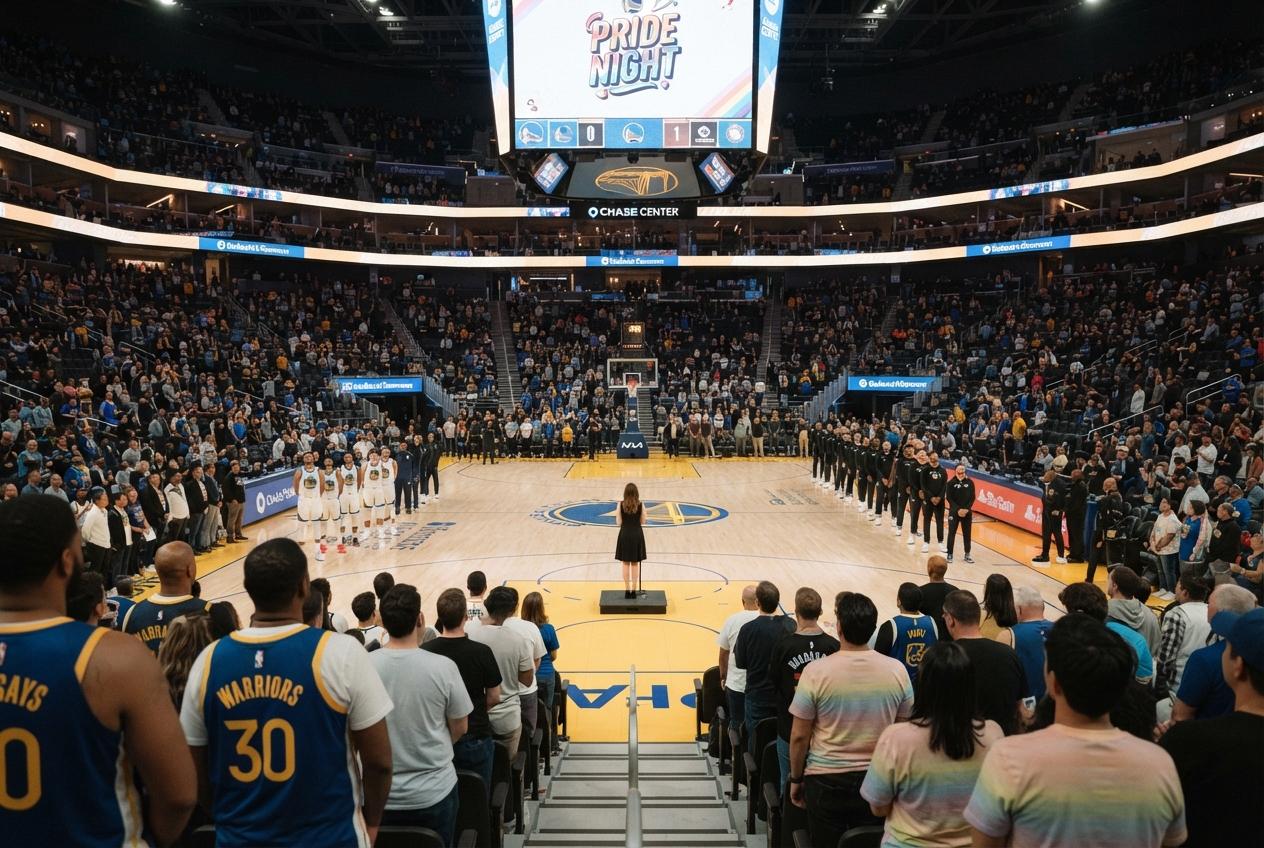
A rainbow flag briefly shared the spotlight with the Star-Spangled Banner at the Golden State Warriors’ Pride Night game in San Francisco. Singer Jason Brock’s performance on 5 November drew warm attention and online criticism, turning one extended note into a wider argument about LGBTQ inclusion, sporting traditions and who gets to feel represented.
One rainbow flag, one long note, plenty of reaction
As Jason Brock held the word “proudly” during the national anthem, he brought out a small Pride flag and waved it. The moment was striking in its simplicity: a familiar song, a flash of colour and a packed basketball arena with its own lively soundtrack. (Outsports; Yahoo Sports)
The performance took place before the Warriors played the Miami Heat on the team’s Pride Night. The Warriors are among the NBA teams to schedule Pride-themed events for the 2026-27 season, making the gesture part of a broader celebration rather than an isolated display. (NBA.com; Outsports)
Players’ expressions became part of the story
Clips of the anthem spread across social media, where some viewers focused on Warriors players who appeared to be smiling or laughing. Brock later said he hadn’t been watching them and cautioned against assuming their reactions were about the performance. (Outsports; Yahoo Sports)
That distinction matters. A brief reaction caught on camera can be easy to interpret, but it rarely tells the whole story. Brock’s response kept the focus on what he could speak to directly: his own experience of singing, not the players’ intentions. (Outsports; Yahoo Sports)
Pride Night puts inclusion in the arena
The Warriors’ event sits within a league-wide calendar of Pride Nights intended to welcome LGBTQ fans and recognise their place in basketball. Team theme nights also give supporters a reason to gather around shared interests, whether that means a special game-night atmosphere or simply seeing themselves acknowledged in the stands. (NBA.com; Outsports)
But visibility can attract pushback as well as support. Some online commenters described the flag as disrespectful, while others saw it as a straightforward expression of belonging. The clash shows how even a small gesture at a major sporting event can become a proxy for much larger arguments. (Outsports; Yahoo Sports; Breitbart)
A performer with years of stage experience
Brock is no stranger to high-pressure performances. He competed on the second season of The X Factor in 2012 and has a background in jazz and pop; the contest database also records his career in cabaret. (Outsports; Encore Index)
He has performed the anthem at other Bay Area sporting events, including a San Francisco Giants game in 2025 and a Pride Night game for the Golden State Valkyries. That experience helps explain why the Warriors appearance felt like a milestone, even for a singer accustomed to performing for large audiences. (Outsports; Encore Index)
Why a brief moment can resonate
For LGBTQ fans, representation at a game can be more than a themed evening. It can signal that the arena is a place where they’re welcome, while the mixed reaction online is a reminder that public visibility doesn’t guarantee agreement. Both realities can sit side by side.
The practical takeaway for fans is simple: a viral clip is only a fragment of an event. Brock himself said he hadn’t interpreted the players’ expressions as a response to his singing, a useful reminder to leave room for uncertainty before turning a few seconds of footage into a firm conclusion. (Outsports; Yahoo Sports)
A small flag made a big impression, and the conversation is likely to outlast the final buzzer.
Source Reference Map
Story idea inspired by: [1]
Sources by paragraph: