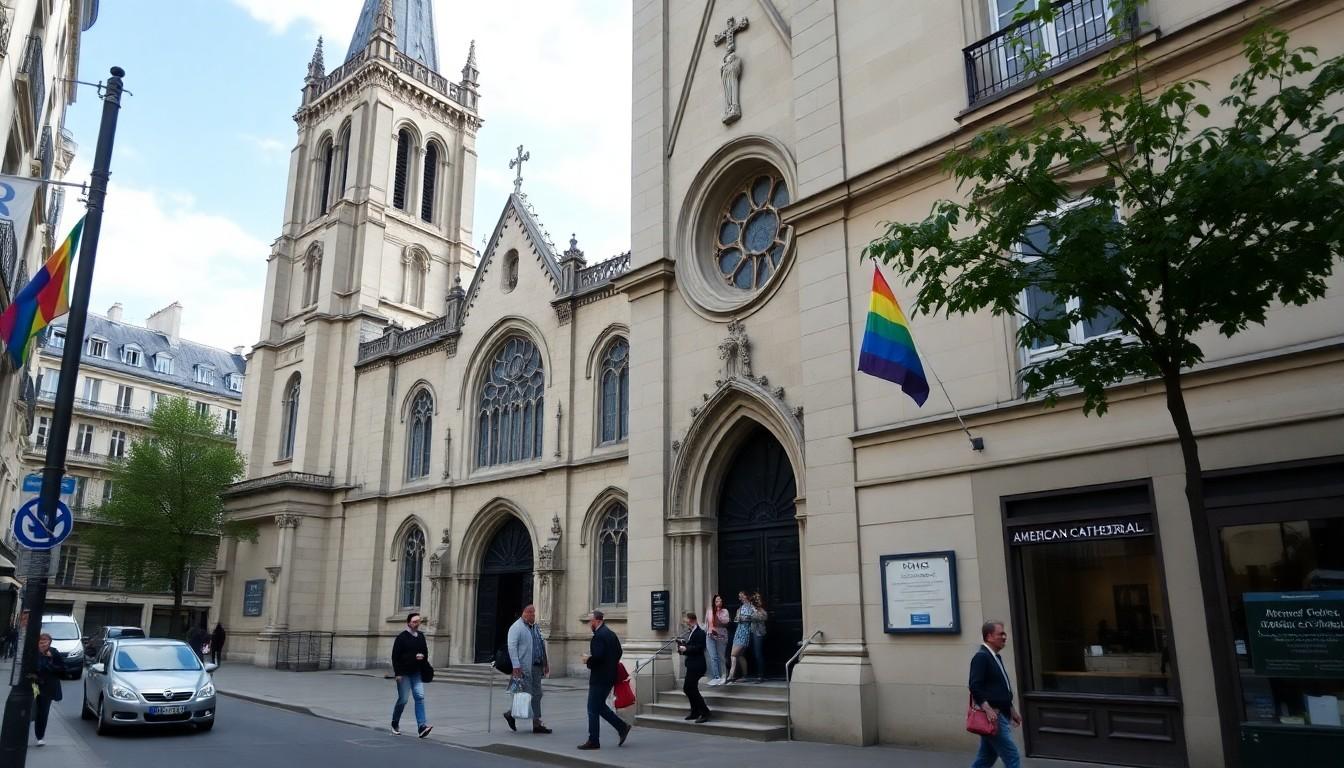
A welcoming church can make a powerful difference when people are searching for faith and belonging. In Paris, the American Cathedral’s Rainbow Ministry has turned public visibility into regular prayer, fellowship and new connections, showing how an LGBTQ-affirming congregation can offer a place where people don’t have to choose between their identity and their spirituality.
A visible welcome made all the difference
For years, the American Cathedral in Paris was welcoming to LGBTQ+ people, but that commitment wasn’t always easy for newcomers to see. The shift came in 2023, when the cathedral joined the Rainbow Initiative and began spelling out its welcome online in both French and English. The change gave people searching for an inclusive Christian church in Paris a clearer way to find the congregation and its support resources. (Episcopal News Service; the cathedral’s LGBTQ+ page)
That same year, the cathedral joined the Paris Pride March for the first time, carrying a Rainbow Initiative banner and sharing pamphlets, stickers and an affirming prayer. It’s a simple but striking sight: a church not just saying it welcomes LGBTQ+ people, but walking alongside them in public. (Episcopal News Service)
From refugee support to prayer and fellowship
The Rainbow Initiative grew out of a 2022 Episcopal Church resolution calling for support and advocacy for LGBTQ+ refugees and asylum-seekers. The initiative is now part of the Episcopal Migration Ministry’s Migration Response Network, which also works on issues affecting displaced LGBTQ+ people. (The Episcopal Church’s 2022 General Convention resolution; Episcopal News Service)
At the Paris cathedral, members considered how a small congregation could contribute. They settled on a need they could meet: making an affirming church visible and offering prayer. The ministry now gathers on Wednesdays for Evening Prayer, fellowship and Compline, a quiet end to the day that can also make room for new friendships. (Episcopal News Service; the cathedral’s LGBTQ+ page)
Why an affirming church matters in Paris
Legal protections don’t necessarily make every community feel welcoming. France promotes LGBTQ+ rights, but attitudes around gender and sexuality can still vary, making supportive spaces meaningful in everyday life as well as on paper. (French Ministry for Europe and Foreign Affairs; Episcopal News Service)
The cathedral’s public welcome has helped people find more than a weekly service. Some newcomers have joined its young adult fellowship, while others have become involved in wider community activities, including its Sandwich Ministry and Jazz Vespers. That broader connection matters: belonging tends to grow through ordinary moments, not just bold statements. (Episcopal News Service)
Finding faith without hiding who you are
For some members, the ministry has helped make a complicated search feel simpler. Tim Buffet-Delure, who moved back to Paris, said he had struggled to find a community that reflected his values before discovering the cathedral. He later took on leadership roles in the Rainbow and young adult ministries and was baptised. (Episcopal News Service)
Other members describe the difference between being merely tolerated and feeling fully accepted. At the cathedral, same-sex relationships can be acknowledged without fuss, and people can take part in church life openly. That kind of everyday ease may sound small, but it can be life-changing for someone used to keeping parts of themselves apart. (Episcopal News Service)
A small ministry with a wider reach
The ministry’s visibility keeps expanding, from the cathedral’s bilingual online resources to its presence at Pride and its own Instagram account. The wider Episcopal Rainbow Initiative also features in Pride Month and refugee-awareness work across Europe, giving local congregations a framework for showing support. (The cathedral’s LGBTQ+ page; Episcopal News Service)
And the effect isn’t only digital. People have found the cathedral through online searches, then gone on to explore worship, community and, for some, baptism or confirmation. A welcome is most convincing when people can see it, hear it and experience it for themselves. (Episcopal News Service)
A visible welcome can be the first step towards finding a community that feels like home.
Source Reference Map
Story idea inspired by: [1]
Sources by paragraph: