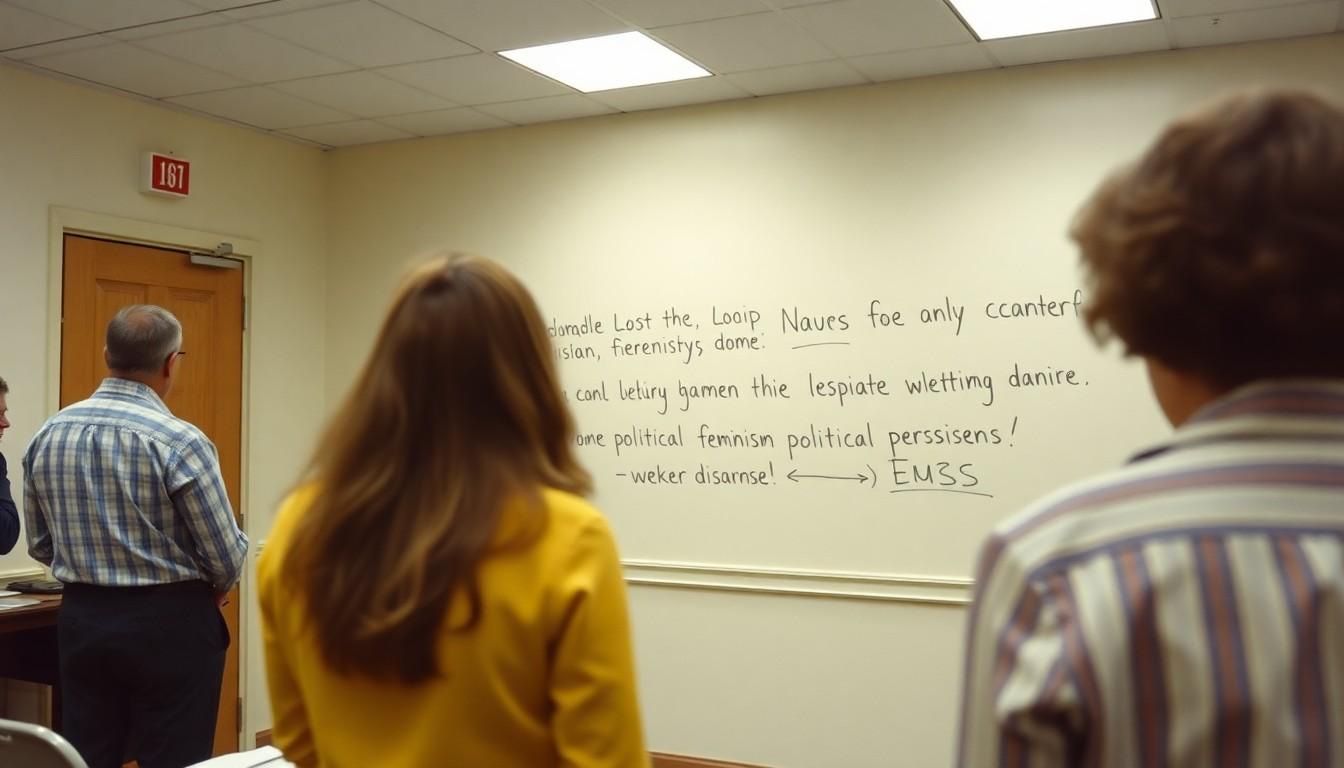
A bathroom wall at a 1972 lesbian feminist conference became an unexpected forum for a fierce debate about sex, identity and political resistance. The graffiti, photographed at Staten Island’s College of Staten Island, is now a starting point for a new book exploring how queer history holds contradictions that tidy stories of progress can miss.
A bathroom wall became a debate space
One message urged readers to “BE A LESBIAN”, with the word underlined five times. Nearby, another warned against getting caught in a “limiting sexual dogma”. A third argued that lesbianism could be a political challenge to patriarchy, whether or not it involved sex with women.
The exchange, captured by photographer Bettye Lane at a 1972 conference, was anything but settled. One writer pushed back against the idea that women should be politically committed to women while continuing to love men. The photograph preserves the argument mid-flow, with one message cut off before its thought is complete.
That unfinished quality is part of the appeal. Rather than offering a neat manifesto, the wall shows people working through what lesbian identity and political commitment might mean in practice.
Why this graffiti still matters
Wendy Mallette’s new book, Lesbian Feminist Killjoys: Sin, Queer Negativity, and Inherited Guilt, takes the photograph as a way into questions about queer politics and inherited history. Published by NYU Press, the book considers how lesbian feminist ideas have been criticised, simplified and sometimes treated as an easy target.
Mallette’s wider discussion centres on writers including Beverly Smith, Andrea Dworkin, Pat Parker and Jill Johnston. It examines how their thinking connected sex with power, racism, capitalism and colonialism, rather than treating sexuality as separate from the rest of social life.
That context makes the graffiti more than a colourful historical curiosity. Its writers were debating how private desire might become political, and whether a political identity could avoid becoming restrictive.
The politics of the public loo
Bathrooms have long held complicated roles in queer life. They can be places of privacy or vulnerability, but also spaces where people encounter one another beyond the conventions of more formal public settings.
Mallette connects the conference bathroom debate with Beverly Smith’s reflections on being a Black lesbian feminist. In Smith’s writing, a bathroom offered temporary shelter from the pressures of a heterosexual wedding and a place to think through painful feelings and social expectations.
The contrast matters. Stories of queer history are often told through a familiar arc of secrecy, coming out and eventual pride. The photograph suggests another kind of history: unfinished, intimate and shaped by the everyday places where people talked, argued and found room to think.
Queer history is rarely neat
The graffiti’s competing voices resist the temptation to sort the past into simple heroes and villains. One writer presents lesbianism as a direct political challenge; another worries that turning it into a rule could become its own constraint.
Mallette argues for taking such contradictions seriously, rather than using lesbian feminism as either a model to follow or a convenient symbol of what later movements have supposedly outgrown. The book also links debates about guilt and historical responsibility to contemporary disputes over anti-critical race theory, anti-DEI and anti-trans policies.
It’s a useful reminder that political movements aren’t tidy, internally consistent packages. Their arguments can reveal both the limits of a moment and the questions that remain unresolved.
What readers can take from the photograph
For anyone exploring queer history, the image is a reminder to look closely at the disagreements as well as the declarations. The surviving messages don’t tell us everything about who wrote them or how the argument ended, and the photograph cuts off part of one contribution.
That gap calls for curiosity, not guesswork. Read alongside Mallette’s book and the archival material connected with the history of lesbian feminism, the image offers a glimpse of people testing ideas in real time, without knowing which words would last.
And perhaps that’s what makes a bathroom wall such a revealing archive: it captures political thought before anyone has had a chance to tidy it up.
The 1972 graffiti shows queer politics in motion: passionate, unsettled and still worth discussing.
Source Reference Map
Story idea inspired by: [1]
Sources by paragraph:
- Paragraph 1: [2], [3]
- Paragraph 2: [2]
- Paragraph 3: [2]
- Paragraph 4: [2], [3]
- Paragraph 5: [3]
- Paragraph 6: [3]
- Paragraph 7: [2], [3]
- Paragraph 8: [2], [3]
- Paragraph 9: [3]
- Paragraph 10: [3]
- Paragraph 11: [2], [3]
- Paragraph 12: [3], [4]
- Paragraph 13: [3], [5]
- Paragraph 14: [3], [6]
- Paragraph 15: [3], [5], [7]
- Paragraph 16: [3]
- Paragraph 17: [2], [3]