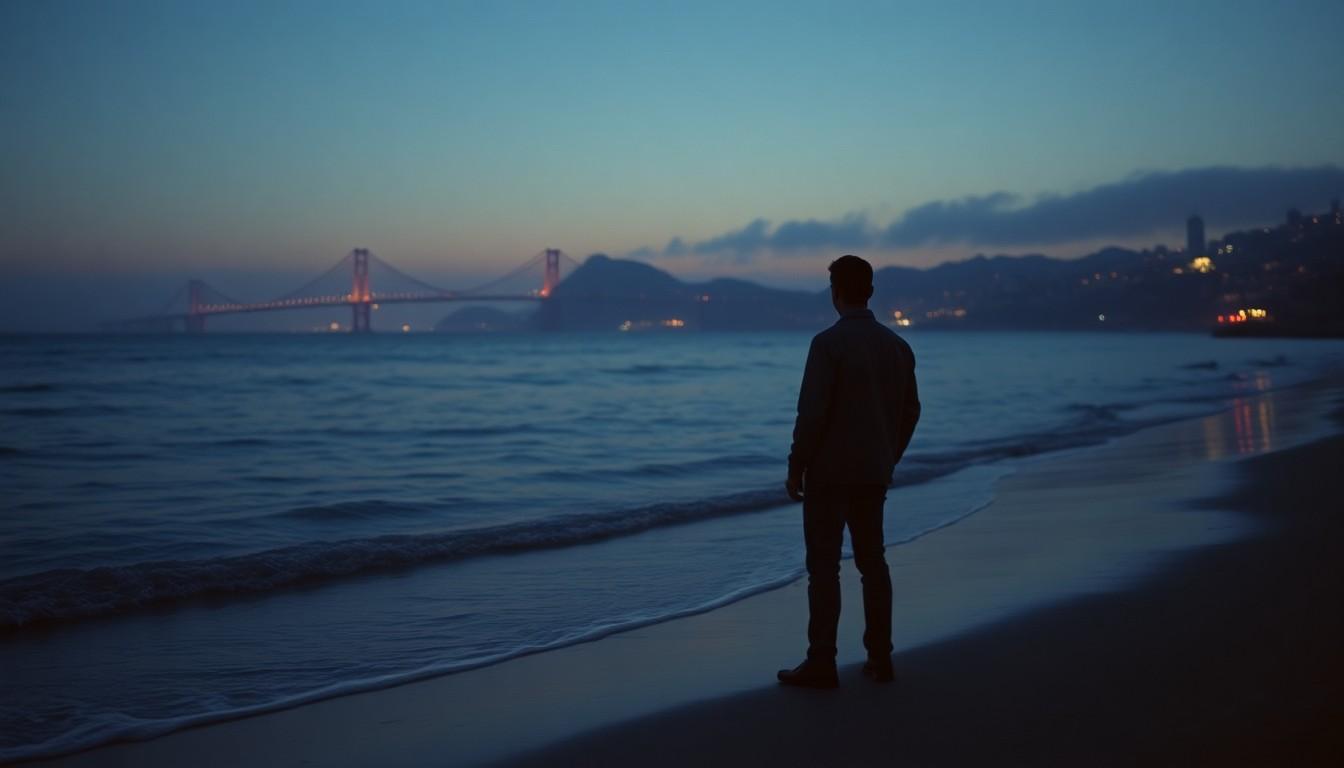
A mysterious killer, a beachside attraction and a city gripped by fear set the scene in Strangers on a Beach, a short film inspired by 1983 San Francisco. Blending queer romance with the shadowy mood of 1980s noir, it looks back at real grief and violence while asking how suspicion can distort the way people see one another.
Essential Takeaways
- A noir setting: The film takes place in 1983 San Francisco, where a killer is targeting gay men.
- A personal starting point: Its filmmaker says the story grew from concern about rising hate and violence against Jewish and queer communities.
- A darker history: The period was marked by the killings of Harvey Milk and George Moscone, the AIDS crisis and the crimes attributed to the Doodler.
- A queer perspective: The film reworks the era's erotic-thriller style around an openly queer narrative.
A beachside romance with danger in the background
At first, the premise has the snap of a classic noir: San Francisco, 1983, and a mysterious killer targeting gay men. But the story's immediate pull is more tender. Calvin wants to kiss a handsome stranger on the beach, even as danger hangs over the city.
That contrast gives Strangers on a Beach its charge. The setting promises shadowy intrigue, while the attraction between two men brings the story close to the everyday hopes and risks of queer life. The film's listing on Film Shortage frames it as a blend of romantic longing and menace. [2]
The history behind the film's 1980s setting
The filmmaker describes the project as personal, connecting its themes to rising violence against Jewish and queer communities. The story reaches back to a San Francisco still living with the assassinations of Mayor George Moscone and Supervisor Harvey Milk in 1978. [5] [7]
The city was also facing the AIDS crisis, while the Doodler case involved attacks on gay men and drew criticism over official and public silence. The San Francisco Police Department continues to publish updates on the cold-case investigation, a reminder that the story's real-world roots remain unresolved. [3] [4]
Why queer noir changes the familiar formula
The filmmaker draws on the dreamlike look of 1980s noir and erotic thrillers, but shifts the point of view. Rather than relying on queer subtext, the film centres a queer story and asks what happens when those usually left at the edges take control of the narrative. [2]
That choice matters because style can carry its own assumptions. A cheery musical montage, described by the filmmaker as a familiar device of the period, sets up a glossy surface for the film to puncture. Beneath it are fear, concealed identity and the risky habit of deciding too quickly who is safe. [2]
Suspicion can fracture a community
The film's central tension isn't only about finding a killer. The filmmaker says they were struck by the way fear led people to question whether friends and neighbours were allies or threats, turning suspicion inward as well as outward. [2]
That theme sits alongside the AIDS crisis, which became a defining public-health emergency in the early 1980s. HIV.gov's timeline charts how understanding and responses developed over time, adding context to a period when uncertainty and stigma shaped many people's lives. [6]
A short film with questions beyond the screen
Strangers on a Beach uses the past to explore a present-day concern: how fear can make people project danger onto one another. Its noir surface offers suspense, but the more lasting unease comes from the way characters and viewers alike may misread what they see. [2]
The film's maker hopes that confronting those distortions will prompt audiences to question their own assumptions. It's a useful reminder that a handsome stranger, or a wary neighbour, is never the whole story. [2]
A striking piece of queer noir, it invites viewers to look past the shadows and question what fear makes visible.
Source Reference Map
Story idea inspired by: [1]
Sources by paragraph: