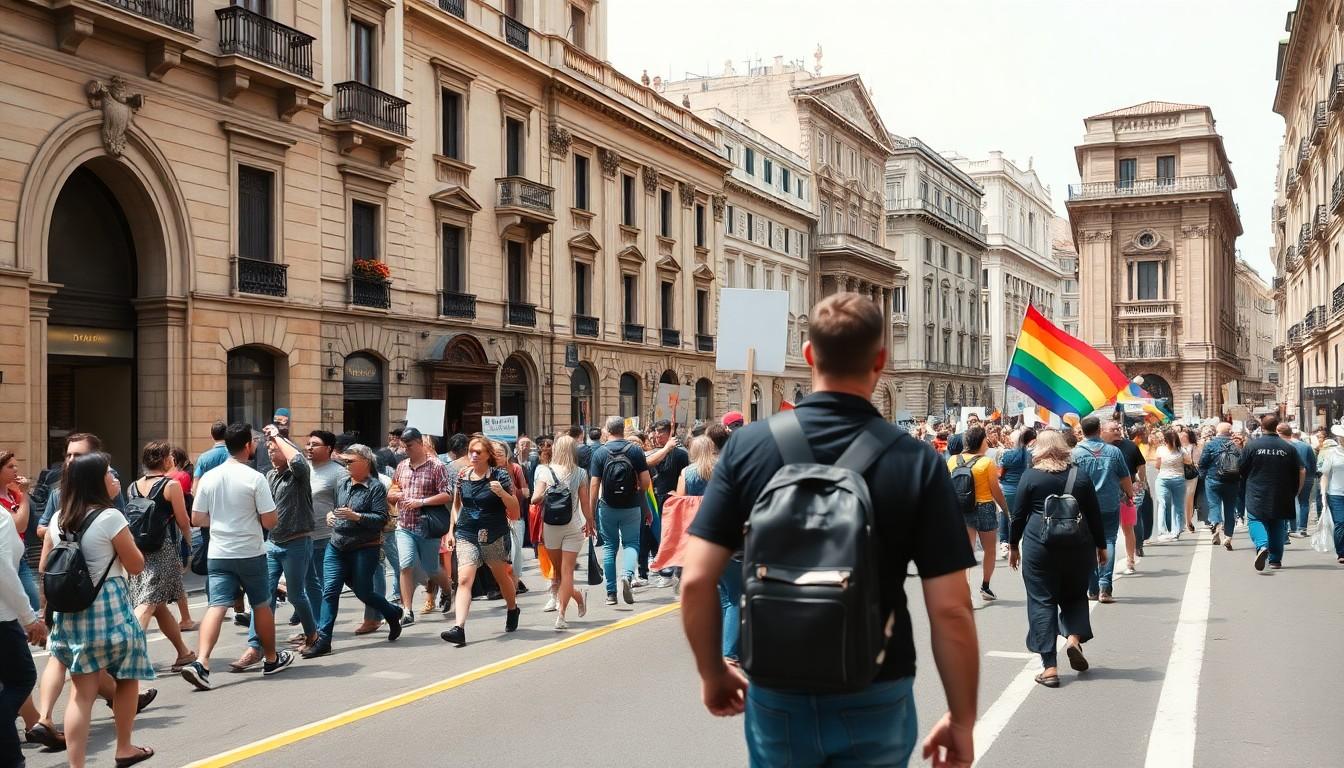
Young demonstrators filled Naples during a general strike, while activists gathered nearby to discuss the lives and rights of queer and trans sex workers. Together, the two events brought a shared question into view: who gets heard, protected and included in public debate? The conversations also turned to online transphobia and the support people need beyond the city centre.
Two forms of protest, one call to be heard
The general strike brought thousands of people onto Naples’ streets, with organisers estimating a crowd of around 20,000. The march moved from Piazza Garibaldi towards the port before ending at Piazza del Plebiscito, as protesters raised concerns about living costs, wages and the future.
At Palazzo Cavalcanti, meanwhile, activists and young people met to discuss discrimination and the working conditions of queer and trans sex workers. Some participants moved between the conference and the march, linking two different kinds of public participation: taking to the streets and making room for people whose experiences are often left out of the conversation.
Why queer and trans sex workers need visibility
The national meeting was promoted by Associazione Transessuale Napoli, MIT, Libellula and Euphoria Trans. It formed part of a two-day project focused on sharing experiences and discussing exploitation, discrimination, health and personal dignity.
The subject remains contested, including within LGBTQ+ networks. Questions around sex work, autonomy, exploitation and rights don't always have easy answers, but the organisers' stated aim was to create space for people directly affected to speak and be heard.
That matters particularly for people facing several barriers at once. Stigma around sex work can overlap with prejudice about gender identity, while limited access to services and support networks may make it harder to find help, especially outside major cities.
Online transphobia has offline consequences
Another strand of the meeting addressed digital abuse, including anti-trans language and hate speech on social media and other platforms. The discussion was part of S.T.O.N.E., a project focused on tackling online violence and discrimination against trans and non-binary people.
The harm doesn't necessarily stop at the screen. Hostile messages and targeted campaigns can affect wellbeing and a person's sense of safety, as well as their ability to take part in everyday social life without intimidation.
The project brought together around 40 participants aged 20 to 45 to exchange experiences and identify needs that can be overlooked, particularly where local organisations and support networks are scarce. It reflects a wider need to connect people with practical support, not just ask them to endure abuse quietly.
Local networks can make a real difference
Support is especially important in areas where associations are few and far between. WeWorld's POWER initiative, for instance, describes projects designed to strengthen skills and networks addressing gender-based violence, underlining how community connections can help people find routes to support.
Associazione Transessuale Napoli is among the organisations working on trans rights and support in the city. For people dealing with overlapping forms of exclusion, a trusted local contact can be a vital starting point, even when wider services remain difficult to navigate.
The conversation needs to travel beyond the conference room
By bringing the topic into a public meeting, organisers sought to take experiences that are often discussed only within specialist circles to a wider audience. That kind of visibility won't resolve disagreements overnight, but it can make it harder to ignore the needs of people most affected.
The day's events also offered a reminder that rights discussions aren't abstract. Whether someone is marching through the city or speaking in a meeting room, being able to participate and be taken seriously is part of the point.
Keep the conversation open, and make sure support reaches beyond the places where it is easiest to find.
Source Reference Map
Story idea inspired by: [1]
Sources by paragraph: