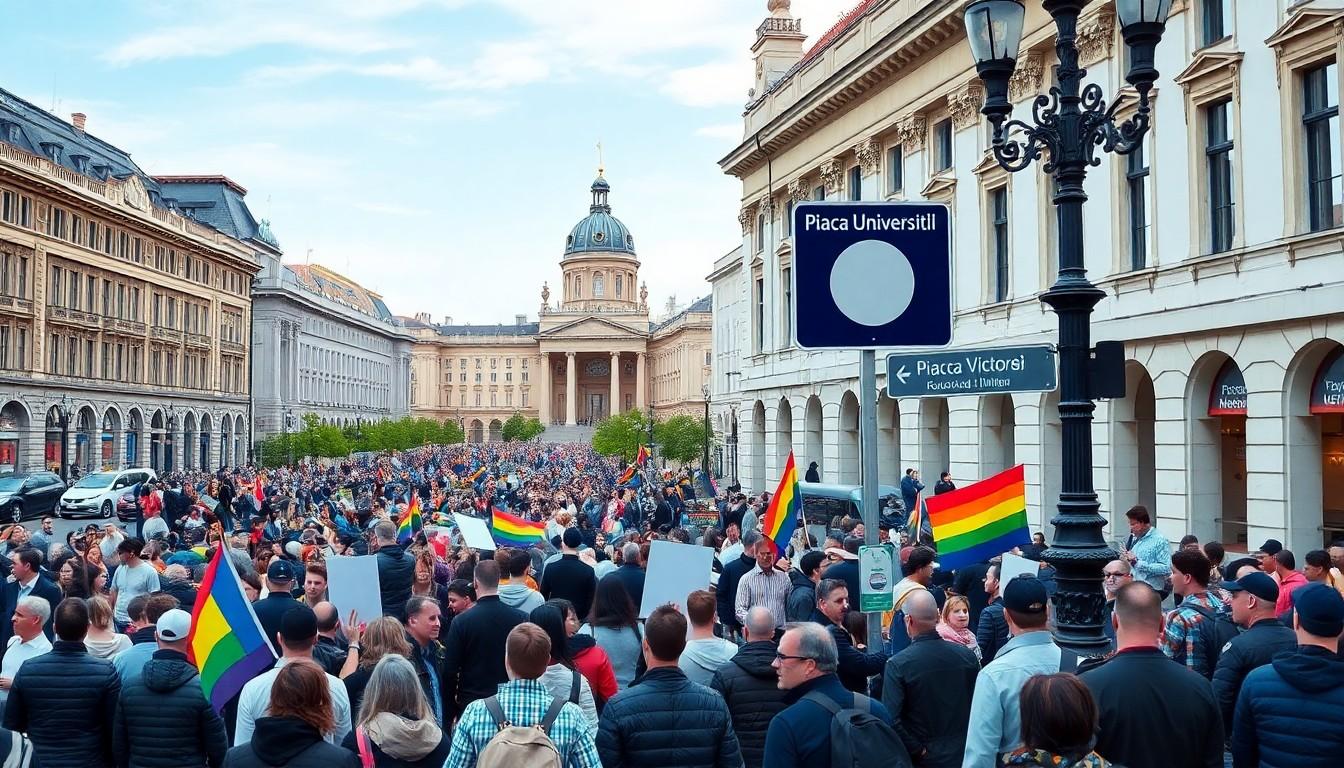
Supporters of civil partnerships are preparing to march through central Bucharest, calling for legal recognition of unmarried couples and stronger family protections. Organised by MozaiQ LGBT, the protest will begin at University Square before heading towards Victory Square, where speeches will underline why campaigners say Romania can no longer delay action.
Essential takeaways
- Protest route: Participants will gather at University Square and march towards Victory Square.
- Main demand: Organisers want legal recognition for unmarried couples, including same-sex partners.
- Practical impact: Campaigners point to hospital access, medical decisions and inheritance as everyday concerns.
- Official timetable: The gathering is scheduled for midday, with speeches and dispersal planned for the afternoon.
- Public safety: Bucharest Gendarmerie has urged calm behaviour, cooperation and respect for officers' instructions.
A march with a clear message
The protest's central demand is simple: civil partnership legislation now. MozaiQ LGBT is asking supporters to join a public demonstration in Bucharest, arguing that couples who share homes, finances and family lives shouldn't be treated as legal strangers. The campaign has been promoted as a matter of dignity as much as paperwork, according to MozaiQ's published event information.
Organisers say the issue affects hundreds of thousands of unmarried couples, many of whom are heterosexual, as well as LGBTQ+ families. Their argument is deliberately practical. When a partner is in hospital, faces a medical emergency or dies without formal protection, the absence of legal recognition can suddenly become painfully real.
From University Square to Victory Square
The gathering is due to start between noon and 1pm on the pavement outside the National Theatre in University Square. From there, demonstrators are expected to travel along Nicolae Balcescu Boulevard, Gheorghe Magheru Boulevard, Piata Romana and Lascar Catargiu Boulevard before reaching Victory Square.
The march is scheduled to use the first traffic lane, with speeches planned in the central area of Victory Square from 2.30pm. Organisers expect the event to finish with participants leaving the area by 3.30pm, a tightly arranged timetable that should help both demonstrators and other city residents plan their journeys. The route and schedule were also reported by G4Media.
For anyone attending, comfortable shoes, water and a fully charged phone are sensible basics. Bucharest marches can feel energetic and communal, but long stretches on open roads can be tiring, particularly if the weather turns warm or wet.
Why campaigners say civil partnership matters
MozaiQ says civil partnership would provide protections that married couples often take for granted. These include visiting a partner in hospital, having a say during a medical emergency, inheriting shared property and avoiding sudden housing insecurity after a partner's death.
The campaign also refers to court decisions involving Romania and European institutions, arguing that the country has a legal responsibility to create a form of recognition for couples outside marriage. Coverage by DCNews and G4Media has highlighted the wider dispute over how Romania should respond to those obligations.
That makes the protest about more than a symbolic label. A certificate might sound dry, but the rights attached to it can shape some of life's most frightening moments. The campaign's strongest point is that legal uncertainty tends to appear precisely when families are least able to fight it.
A broader argument about family life
The organisers say millions of Romanians support civil partnership, while more than 100,000 people have backed a related petition. Those figures are presented by the campaign rather than independently verified in the available reports, but they show how supporters are framing the issue: as a question affecting society beyond the LGBTQ+ community.
That broader appeal is important. Civil partnership is being presented as a possible legal route for couples who do not marry, whether because marriage is unavailable to them, doesn't suit their beliefs or simply isn't part of their plans. As MozaiQ's public profiles and campaign materials make clear, the organisation wants the discussion to include both equal treatment and everyday security.
The political frustration is obvious, too. Campaigners say petitions have been submitted and court rulings have been made, yet legislation remains unresolved. Their message to politicians is blunt: continued delay still has consequences for real households.
What attendees and motorists should know
The Bucharest Gendarmerie has asked participants and other citizens to follow officers' directions, avoid confrontations and report antisocial behaviour to the nearest patrol. Traffic may be affected along the route, so drivers would be wise to allow extra time or choose an alternative crossing through central Bucharest.
Those joining the march should stick to the agreed route, keep important medication and identification close at hand, and look after friends in the crowd. A visible meeting point can help if mobile signals become patchy or people get separated.
The protest is also part of a wider conversation about legal recognition, not just a single afternoon in the capital. Whether it leads to immediate political movement remains uncertain, but public pressure gives an otherwise technical issue a human face.
Civil partnership may sound like a legal detail, but for many couples it's the difference between being recognised and being left exposed.
Source Reference Map
Story idea inspired by: [1]
Sources by paragraph:
- Paragraph 1: [2], [3]
- Paragraph 2: [6], [7]
- Paragraph 3: [2], [5]
- Paragraph 4: [6], [7]
- Paragraph 5: [3], [4]
- Paragraph 6: [5], [6]
- Paragraph 7: [2], [4]
- Paragraph 8: [3], [5]
- Paragraph 9: [6], [7]
- Paragraph 10: [2], [3]
- Paragraph 11: [4], [6]
- Paragraph 12: [5], [7]
- Paragraph 13: [2], [6]
- Paragraph 14: [3], [7]
- Paragraph 15: [4], [5]
- Paragraph 16: [2], [6]
- Paragraph 17: [3], [7]
- Paragraph 18: [4], [6]