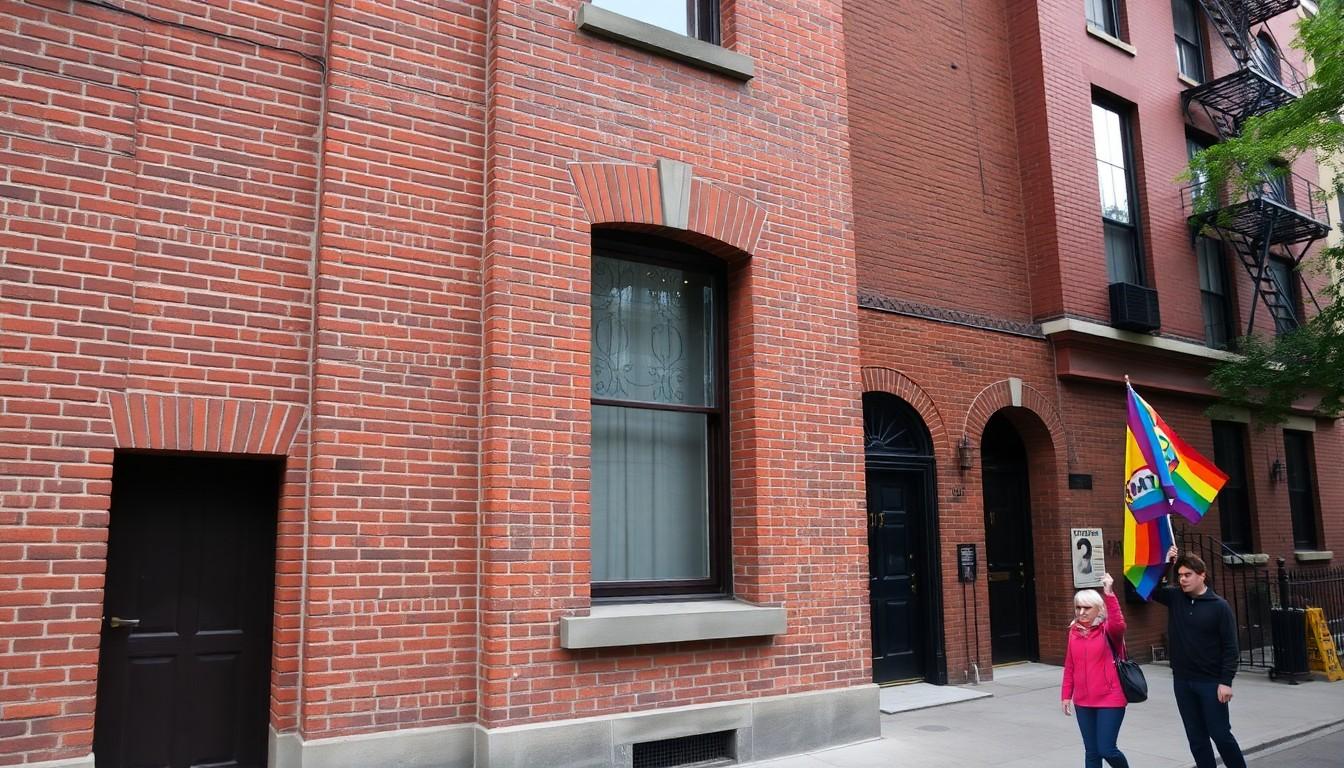
A seemingly modest window at New York’s Women’s House of Detention became an unlikely bridge between imprisoned women and the life of Greenwich Village. Its story reveals how architecture, visibility and protest helped transform a place built to enforce conformity into a landmark in LGBTQ+ history.
Essential Takeaways
- The building opened in 1932: New York’s Women’s House of Detention stood in Greenwich Village, close to Jefferson Market.
- The windows offered visibility: They allowed women inside to look and communicate beyond the prison walls.
- The location mattered: The jail sat in a neighbourhood that became a major centre of gay life and activism.
- The building held cultural weight: Its history connects incarceration, gender control, protest and queer public life.
- The legacy still resonates: A small architectural detail became part of a much larger story about belonging and resistance.
A prison designed to make women disappear
The Women’s House of Detention opened in 1932 with a distinctly controlling mission. It was intended to isolate women labelled disruptive or “wayward”, placing them behind an imposing structure in the middle of Greenwich Village. According to 99% Invisible, the institution was meant to make these women quiet, private and conventionally feminine.
Yet the building was never quite as sealed off as its purpose suggested. Special windows gave inmates a chance to see out, and for people on the street, a glimpse into the lives held inside. That visual connection may sound minor, but it carried a powerful charge: the women were not entirely hidden.
The jail's stone, institutional presence contrasted sharply with the neighbourhood around it. Historic accounts of the site describe a building embedded in a lively district, where markets, churches, bars and gathering places helped make Greenwich Village unusually open to people living outside mainstream expectations.
The window became a point of contact
A window is usually an ordinary piece of architecture. Here, though, it became a meeting point between two worlds. Women inside could watch the street, while passers-by could recognise that the building contained real people rather than an abstract category of offenders.
Historical accounts collected by OutHistory describe how the jail's position became especially significant for women who loved women. Its inmates could attract attention from the surrounding neighbourhood, while the streets offered a social world that was increasingly associated with lesbian and gay life.
There was a strange reversal at work. The prison had been created to impose privacy and control, but the window allowed visibility to leak through. As the Bowery Boys have noted in their history of Jefferson Market and the detention centre, the building became part of the social geography of Greenwich Village rather than remaining an isolated institution.
Why Greenwich Village changed the meaning of the building
The neighbourhood's reputation did not appear overnight, and the prison was only one part of a much larger story. Still, its location placed questions of gender, sexuality and public identity side by side. People living, working and gathering nearby could see the women inside, and the women inside could observe a community that offered a different idea of how life might be lived.
The effect was particularly striking because the jail represented official attempts to police femininity. The surrounding Village, meanwhile, became known for artistic freedom, bohemian culture and queer communities. As the New York City archival guide records, the detention centre's history is closely tied to the wider civic and social history of the area.
That tension gave the window an importance beyond its materials. It was not just glass and a frame, but a reminder that institutions can't fully control how people interpret a place. Sometimes the neighbourhood outside rewrites the meaning of the building within it.
A landmark in LGBTQ+ history, not just prison history
The Women’s House of Detention is often remembered through the lens of crime and punishment, but that view misses much of its cultural importance. Accounts gathered by OutHistory and the New York City administrative archives place the building within a broader history of lesbian life, queer visibility and activism.
The structure also became associated with protest. Its position near civic and cultural landmarks made it a visible target for demonstrations, especially as movements for gay rights and prison reform gained momentum. A building designed to silence women instead became part of a public conversation about whose lives deserved recognition.
This is where the story feels unexpectedly modern. Visibility can be uncomfortable, incomplete and even imposed, but it can also make denial harder. Once people outside the walls could see and hear those inside, the institution was no longer able to present itself as a purely private mechanism of control.
What this history teaches us about architecture
The most compelling lesson is that buildings rarely keep the meaning their designers intended. The Women’s House of Detention was planned as a tool of discipline, yet its windows helped connect inmates with one of New York’s most socially adventurous neighbourhoods.
The site has since disappeared, but its story survives through historical research, oral accounts and archival records. The New York City Archives and local historians continue to show how the prison fitted into the changing life of Greenwich Village, while 99% Invisible has helped bring the window itself into focus.
For anyone walking through the Village today, the lesson is easy to miss beneath the cafes, trees and busy pavements. But places have memories, and sometimes the smallest architectural feature carries the loudest echo.
A single window helped turn confinement into connection, and silence into part of a movement.
Source Reference Map
Story idea inspired by: [1]
Sources by paragraph:
- Paragraph 1: [2], [3]
- Paragraph 2: [4], [5]
- Paragraph 3: [6], [7]
- Paragraph 4: [2], [5]
- Paragraph 5: [3], [6]
- Paragraph 6: [4], [7]
- Paragraph 7: [5], [6]
- Paragraph 8: [2], [7]
- Paragraph 9: [3], [5]
- Paragraph 10: [4], [6]
- Paragraph 11: [2], [7]
- Paragraph 12: [3], [5]
- Paragraph 13: [4], [6]
- Paragraph 14: [2], [7]
- Paragraph 15: [3], [5]
- Paragraph 16: [4], [6]