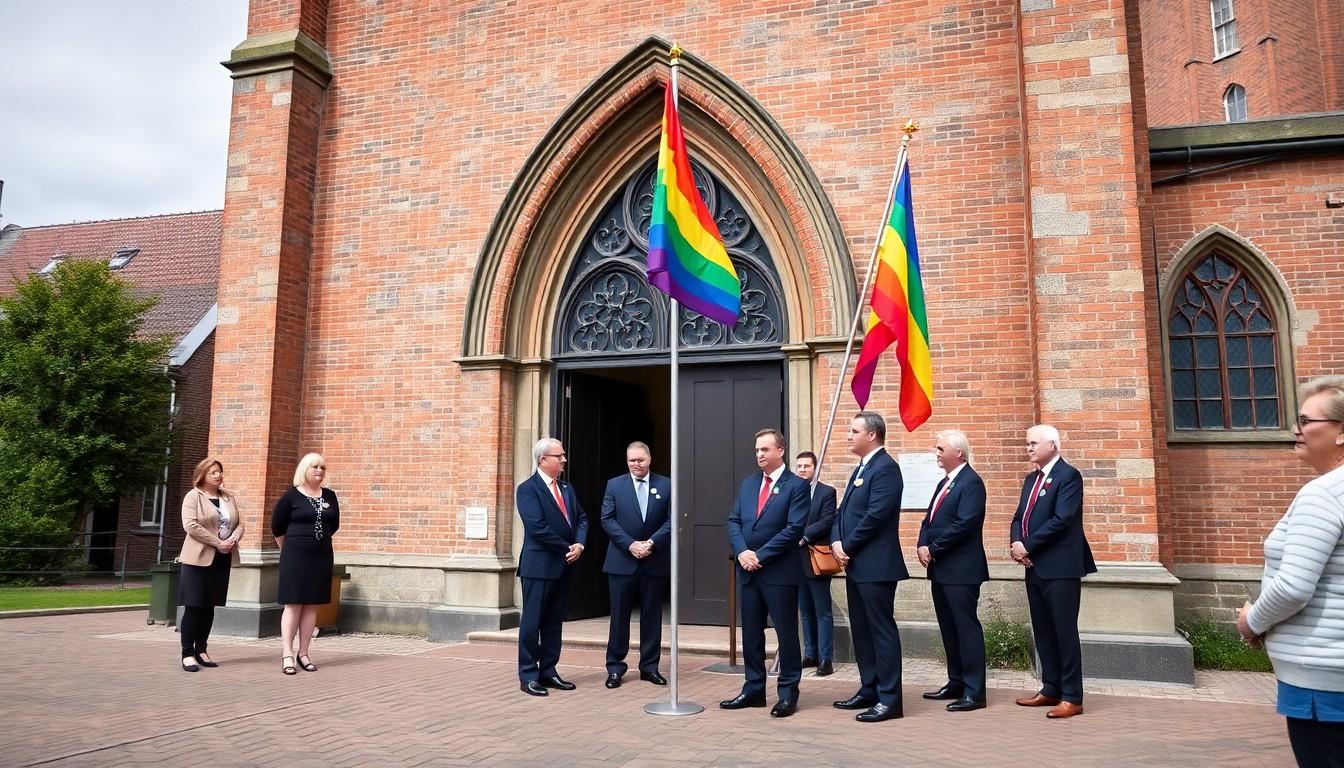
Residents in Oldebroek will see the rainbow flag raised outside the Kruiskerk on Coming Out Day, despite the council’s decision to stop flying it at the town hall. The ceremony brings together a local campaigner, the mayor and a government minister, turning a tense political issue into a visible gesture of welcome.
Essential Takeaways
- The flag will return temporarily: It’ll be raised at the Kruiskerk in Wezep during a public ceremony.
- The mayor will attend: Tanja Haseloop-Amsing says her presence reflects her personal responsibility to all residents.
- A local campaign sparked the event: Kjeld Mooi began distributing free rainbow flags after the council dropped its LGBT+ policy.
- The response has been significant: More than 200 flags have reportedly been ordered by residents.
- The wider issue is safety: Campaigners say the debate reaches far beyond symbolism, touching on visibility, acceptance and belonging.
A flag returns, even if not to the town hall
The rainbow flag will be raised in Oldebroek after all, but not on the municipal building. Instead, the ceremony will take place at the Kruiskerk, giving the familiar symbol a different setting and, perhaps, a more personal feel.
According to local reports, Mayor Tanja Haseloop-Amsing will attend, alongside State Secretary Claudia van Bruggen. The event follows a decision by the new conservative coalition to stop flying the flag at the town hall and abandon a broader plan focused on LGBT+ safety, resilience and social acceptance.
That makes Saturday’s ceremony more than a colourful photo opportunity. It’s a public reminder that local identity isn’t defined only by a coalition agreement.
How a small protest became a town-wide campaign
The story began with Kjeld Mooi, a 26-year-old Oldebroek resident who objected to the council’s decision. He initially considered placing a small newspaper advert, but the idea quickly grew into a larger public campaign.
Local coverage reports that Mooi then launched a free rainbow flag initiative through Oldebroek Vooruit. More than 200 flags have been requested, suggesting the issue has found a much broader audience than one campaigner alone.
That response matters because it turns an abstract council decision into something people can see from their windows and front gardens. A flag is simple, inexpensive and unmistakable, which is probably why it can carry so much emotional weight.
Why the mayor’s attendance matters
Haseloop-Amsing has said she must implement decisions made by the elected coalition, provided they remain within the law. But she has also made clear that complying with policy doesn’t require her to hide her personal views.
According to reports from Trouw and regional publications, the mayor sees the ceremony as an opportunity to build bridges rather than make a political declaration. She has stressed that she is the mayor of the entire municipality, not simply an extension of the governing parties.
That distinction is easy to overlook, but it’s central to the moment. Her attendance won’t reverse the coalition agreement, yet it does signal that official responsibility and personal conviction can exist in the same public space.
The argument is bigger than a piece of fabric
Mooi’s campaign has highlighted concerns from LGBT+ residents who say they still feel unable to be open about their relationships or identity. For some, ordinary gestures such as holding hands in public can carry the risk of abuse or unwanted attention.
Regional reporting on the council’s decision has also shown how quickly language around the flag can become hurtful. Describing it as incompatible with Christianity, for example, can feel like a direct judgement on people who already feel vulnerable.
The practical lesson is that symbolic politics rarely stays symbolic. A flag won’t solve harassment, loneliness or fear, but removing one can still send a powerful message about who feels recognised.
What happens after the ceremony?
The Saturday event may offer a calmer conversation, particularly because representatives of different parts of the community will be present. Yet the underlying disagreement remains: the municipality has stopped its formal rainbow flag policy, and the wider LGBT+ action plan has been dropped.
Local outlets have reported that some coalition representatives want to keep communication open with the community. Whether that becomes meaningful action will depend on what follows the ceremony, not just on the photographs taken during it.
For residents, the immediate choice is simpler. They can treat the flag as a political badge, or as a small public sign that neighbours deserve safety and respect. In a divided debate, that second reading may be the most useful one.
A visible gesture won’t settle every argument, but it can help someone feel less alone.
Source Reference Map
Story idea inspired by: [1]
Sources by paragraph: