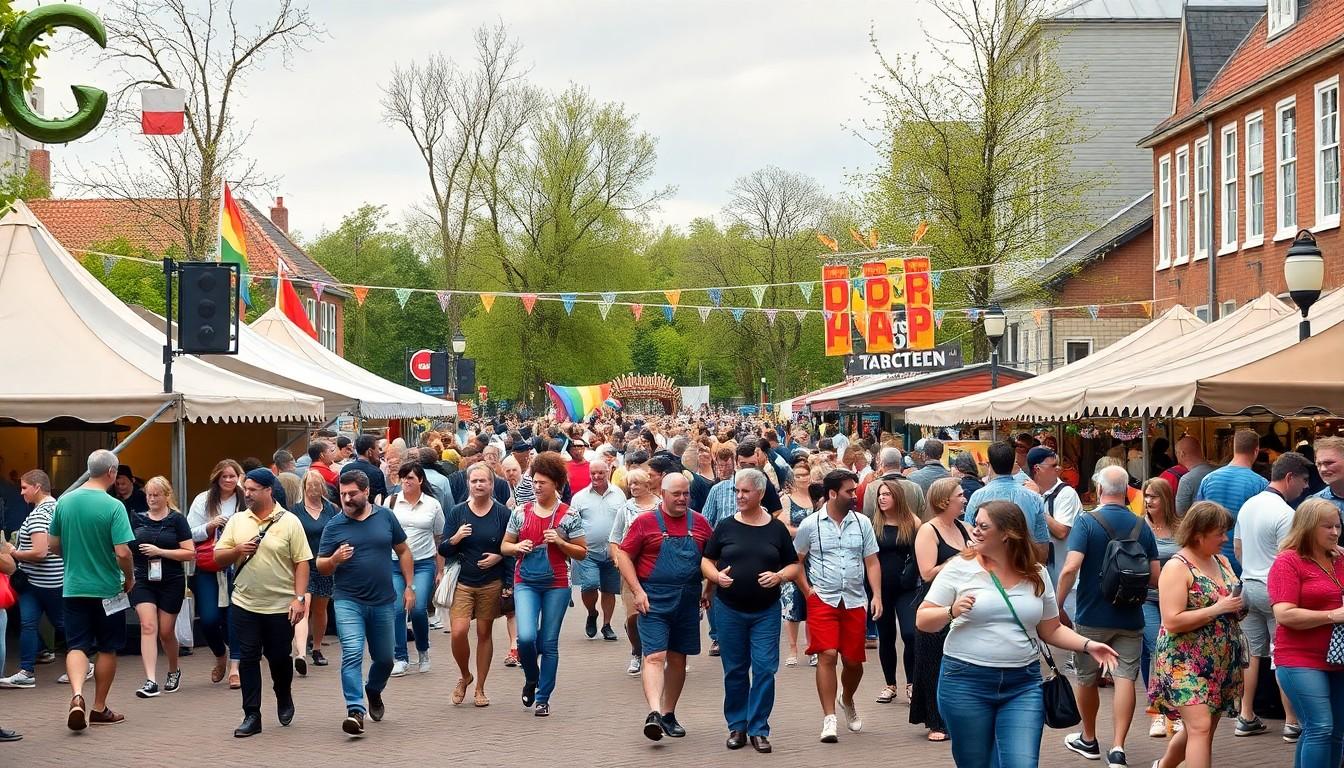
Organisers and supporters in Ede have found a cheerful way to challenge division: walk together beneath rainbow lights, then share a beer at the neighbouring Oktoberfest. The popular Pride Walk matters because it places LGBTQ+ visibility in everyday public life, while making room for faith, family, music and plenty of lederhosen too.
Essential Takeaways
- A visible evening event: Around 200 to 300 people joined the light-filled Pride Walk through Ede.
- Two events, one meeting point: The route began and ended beside an Oktoberfest, creating an unexpected but welcoming crossover.
- Identity is layered: Organisers stressed that sexuality is one part of a person, alongside family, faith, politics, culture and simple beer-loving fun.
- A gentle message: Speakers focused on acceptance and connection rather than confrontation or polarisation.
- An invitation to belong: The organisers aimed to encourage people who may still be watching from the sidelines.
A rainbow walk beside the beer tent
The most striking image from Ede is also the simplest: rainbow lights moving through the dark, with an Oktoberfest tent nearby playing Dutch singalong favourites. The Pride Walk attracted an estimated 200 to 300 participants, according to The Gelderlander, while people along the route waved, leaned from windows and called encouragement.
That public response matters. A march isn't only for those already confident enough to attend. It can also reach someone looking on quietly, wondering whether there might be a place for them. The event's organisers clearly understood that visibility works best when it feels human rather than staged.
The evening walk also gave the event a softer, almost cinematic quality. Umbrellas and flags glowed in the darkness, while the mixed crowd included people in smart jackets, casual shirts and colourful Hawaiian prints. There was no single way to look like a Pride supporter.
Why the Oktoberfest connection feels surprisingly natural
At first glance, a Pride Walk and a Bavarian-themed beer festival might seem like an odd pairing. Yet the organisers saw the overlap as the point. After the speeches and procession, visitors were invited to continue the evening with music, beer and costumes.
Esther van Vliet, one of the organisers, described herself as many things at once, including a woman, feminist, mother, lesbian and lover of beer and Austrian music. Her point was refreshingly straightforward: nobody is made up of just one label.
That idea gives the event its distinctive character. Pride doesn't have to exist in a sealed-off space, surrounded only by people who already agree. Sometimes it makes a stronger statement by stepping into the wider town and sharing a table, a song or a laugh.
A calmer alternative to culture-war shouting
The organisers' approach was deliberately resistant to polarisation. Rather than presenting the evening as a confrontation between opposing camps, speakers returned to familiar human needs: freedom, affection, safety and the wish to be accepted.
Jurrian van Waaij, who helps lead the Pride organisation, summed up the sentiment by saying that people ultimately want to love and be loved. It's not a flashy slogan, but that's perhaps why it lands. The message is broad enough to include people who may not share the same background, beliefs or vocabulary.
That doesn't make the concerns behind Pride any less serious. The event was prompted in part by worries about declining acceptance of LGBTQ+ people. But the tone suggested that connection can be a practical form of resistance, especially when it brings people together beyond their usual circles.
Faith, identity and the space between them
Ede's Pride programme also makes room for religious LGBTQ+ people, including a service open to people of all faiths. For organisers, that inclusion is important because queer people of faith can face exclusion from more than one direction.
The combination of faith and LGBTQ+ identity is often treated as a contradiction in public debate. The organisers instead presented it as one of the many realities that communities need to accommodate. That feels particularly relevant in a town where identity, belief and local tradition are all part of daily life.
A Pride event doesn't need to settle every theological argument to offer a welcome. Sometimes a door being open, a service being available and a person being treated with dignity are meaningful first steps.
What other Pride events can learn from Ede
The Ede model offers a useful lesson for organisers elsewhere: visibility doesn't always have to arrive with a megaphone. A well-lit walk, an inclusive invitation and a nearby community event can create contact without demanding that everyone arrive with the same politics or personality.
It also shows why practical details matter. An evening route needs good lighting, clear organisation and an atmosphere in which newcomers feel comfortable. The broader programme can then offer different ways to take part, whether that's walking, listening, attending a service or simply having a drink with friends.
With the Oktoberfest drawing around 300 visitors on one night and expecting a much larger crowd later in the weekend, the crossover had real reach. Most importantly, it made inclusion look ordinary in the best possible way: visible, sociable and part of the town's shared evening.
The bigger message is wonderfully simple
The organisers' most memorable idea may be that people are more than one aspect of themselves. In Ede, rainbow flags and lederhosen didn't cancel each other out; they shared the same streets and, eventually, the same celebration.
That doesn't erase the need for Pride. It shows what Pride can look like when it reaches beyond its familiar audience and invites the wider community in.
Sometimes the most powerful statement is simply making room for everyone.
Source Reference Map
Story idea inspired by: [1]
Sources by paragraph: