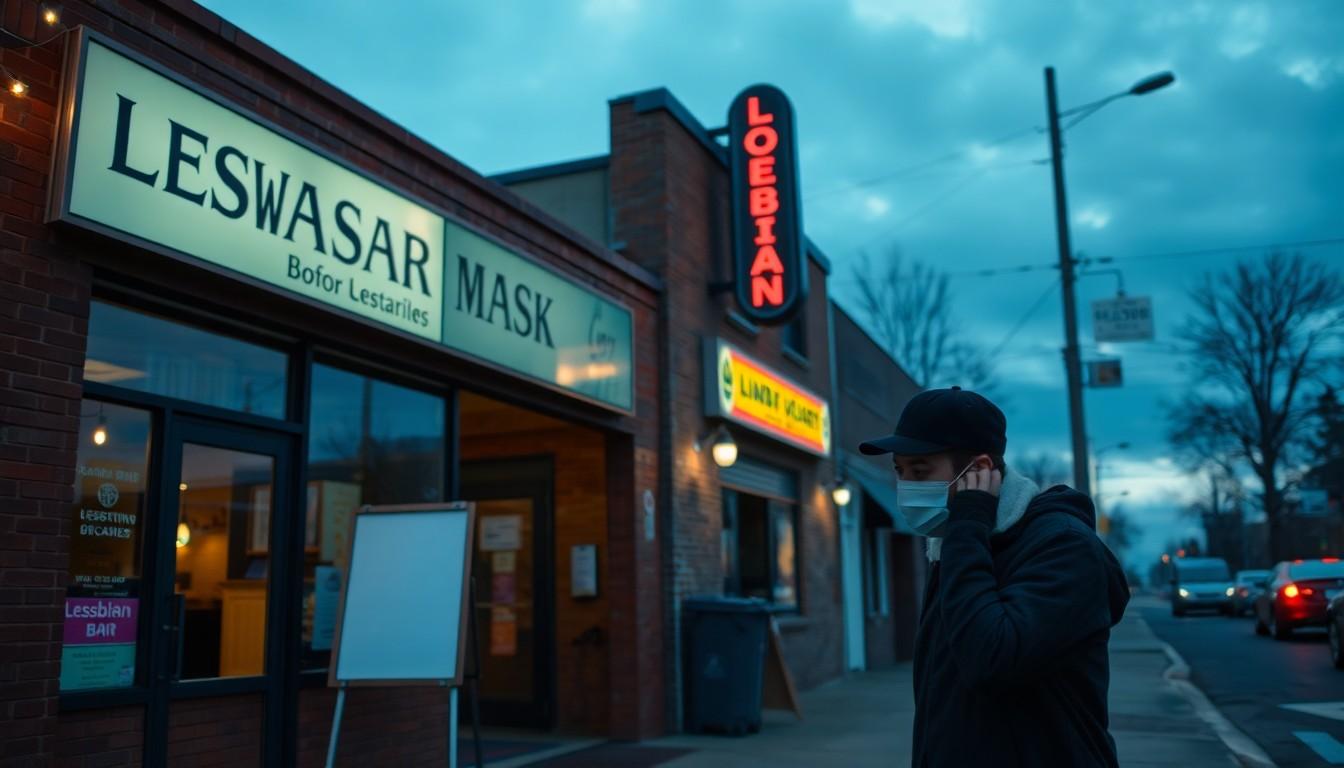
A Western Massachusetts lesbian bar has become an unlikely national talking point after changing its KN95 mask policy for one night a week. The Boston Globe’s colourful account sparked fierce debate over public health, queer spaces and media framing, while conservative commentators and LGBTQ+ readers argued over what the story really revealed.
Essential Takeaways
- The policy changed: The bar relaxed its KN95 mask requirement for one evening each week.
- The reaction was intense: The decision reportedly triggered arguments among customers and wider online backlash.
- The story went viral: Coverage drew attention well beyond Western Massachusetts.
- The debate is broader: Readers are weighing public health, accessibility, community trust and editorial judgement.
- The bar became the headline: For some observers, the sudden publicity may be as disruptive as the policy dispute itself.
A small policy change became a national story
The striking detail is how quickly a local rule turned into a culture-war flashpoint. A lesbian bar in Western Massachusetts had required KN95 masks, then introduced a weekly evening without the mandate. According to LGBTQ Nation, the change was linked to a difficult financial situation and mounting pressure on the venue.
For regulars, that isn't simply a health-policy footnote. A bar can be a refuge, a social lifeline and, for some visitors, one of the few places where they feel entirely at ease. Changing the rules may therefore feel personal, particularly when customers have competing needs around infection risk, social connection and economic survival.
The Boston Globe's report captured that tension in dramatic fashion, with a headline suggesting that the change had unleashed chaos. The resulting attention showed just how combustible stories about queer spaces and public health remain, even years after mask mandates disappeared from most everyday venues.
Why the Boston Globe article caused such a stir
The criticism has focused not only on the mask policy but also on the way the bar was portrayed. LGBTQ+ readers and commentators questioned whether the article treated a vulnerable community as an oddity, while others argued that the unusual policy was legitimate news because it affected the business and its customers.
National Review highlighted the article's most memorable lines, helping push the story further into conservative media circles. The Howie Carr Show also framed the report as difficult to believe, illustrating how quickly a local feature can be recast as evidence in a much larger ideological argument.
That split matters. One audience sees a revealing account of social conflict; another sees a sensational treatment of a niche community. Both reactions can exist at once, which is perhaps why the story has travelled so far.
The real issue is access, safety and survival
Masking rules can be especially significant for people with disabilities, chronic illnesses or a higher risk from respiratory infections. A weekly mask-optional night might offer more choice to some customers, but it may also make others feel that the venue is no longer reliably safe.
LGBTQ Nation reported that the bar was carrying a mountain of debt, adding a practical dimension that can get lost in the online shouting. Independent queer venues often operate on slim margins, so even a modest increase in attendance or drinks sales can matter. The uncomfortable truth is that financial survival and maximum accessibility don't always align neatly.
For customers, the useful question is less "which side won?" and more "what information is clear before I arrive?" A venue can help by publishing the exact schedule, ventilation arrangements and expectations, while guests can decide whether a particular evening suits their health needs.
Viral attention brings help, but also risk
The article appears to have generated attention far beyond the bar's usual audience. News-usa.today described the coverage as record-breaking, while AllSides listed it as a story illustrating sharply different perspectives on LGBTQ+ issues and public health.
That visibility might bring curious newcomers, donations or renewed interest in the venue. It can also create a less welcome crowd, especially when partisan commentators descend on a small business with strong opinions and little local context.
There is a certain irony here. A venue trying to manage one night of different rules has ended up with a much bigger problem: managing the consequences of being watched by everyone. Online fame can fill a room, but it doesn't necessarily make that room feel comfortable.
What readers should take from the backlash
The episode is a reminder that local journalism has consequences, particularly when the subject is a small community institution. Reporting on an unusual policy can be valuable, but tone, context and the balance between individual voices matter enormously.
The Boston Globe's follow-up discussion reportedly examined the reporting process and the story's last-ditch circumstances. That kind of explanation is useful because readers deserve to understand not just what happened at the bar, but why the article was framed in such a provocative way.
For the venue, the next step is likely to be practical rather than rhetorical: make the rules unmistakable, protect staff and customers, and find a financial model that keeps the doors open. For readers, a little curiosity helps too. Before turning one mask policy into a national symbol, it may be worth remembering that a real bar, with real bills and real people, sits underneath the headline.
A local venue's survival deserves more attention than the internet's latest argument.
Source Reference Map
Story idea inspired by: [1]
Sources by paragraph:
- Paragraph 1: [2], [3]
- Paragraph 2: [2], [7]
- Paragraph 3: [3], [4]
- Paragraph 4: [4], [6]
- Paragraph 5: [2], [5]
- Paragraph 6: [2], [7]
- Paragraph 7: [5], [7]
- Paragraph 8: [3], [6]
- Paragraph 9: [3], [4]
- Paragraph 10: [2], [5]
- Paragraph 11: [6], [7]
- Paragraph 12: [3], [4]
- Paragraph 13: [2], [3]
- Paragraph 14: [5], [7]
- Paragraph 15: [3], [6]
- Paragraph 16: [2], [4]
- Paragraph 17: [3], [6]
- Paragraph 18: [2], [7]
- Paragraph 19: [3], [4]