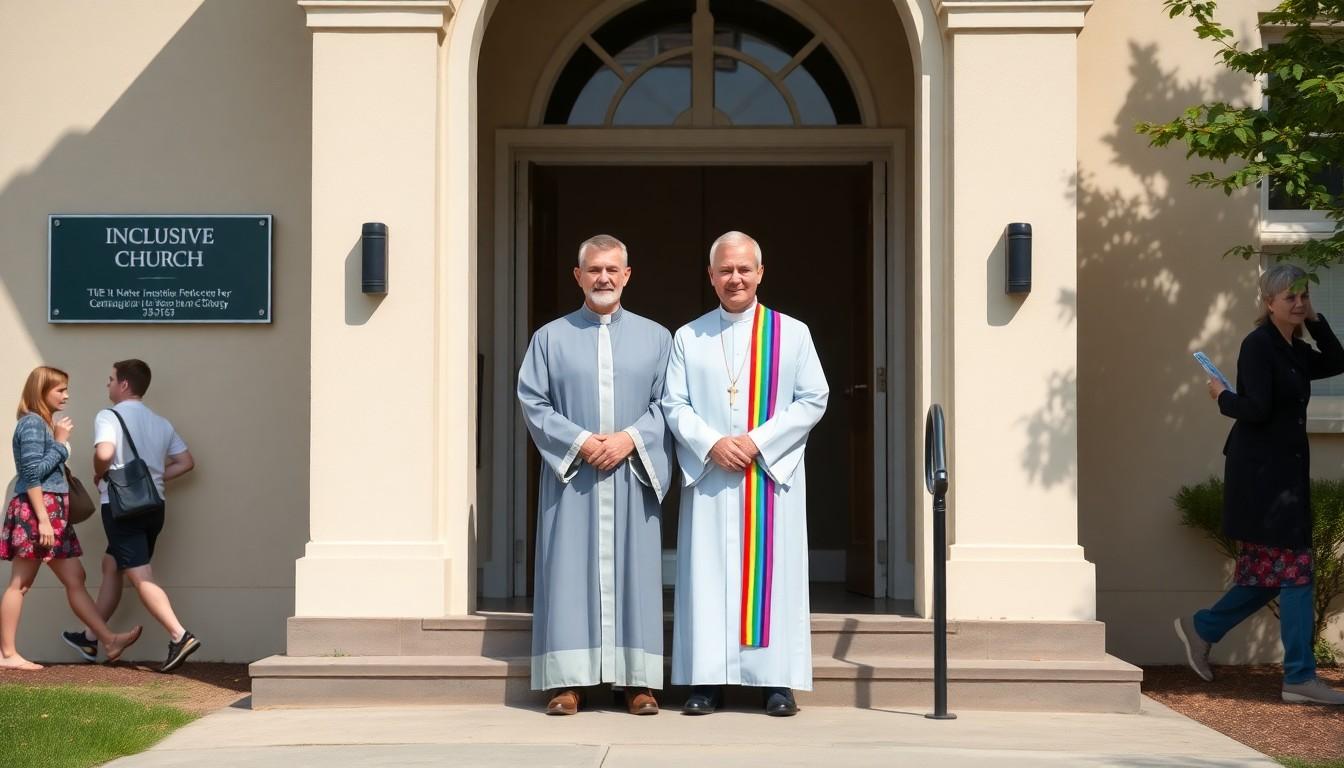
Couples are increasingly seeking wedding officiants who can honour faith, identity and family history in the same ceremony. For LGBTQIA+ couples, that can mean finding clergy who offer genuine welcome rather than vague promises, creating celebrations where religious tradition feels personal, visible and joyful.
Essential Takeaways
- Inclusive ceremonies are growing: Couples can find clergy who combine religious ritual with LGBTQIA+ affirmation.
- Representation matters: Seeing queer officiants and welcoming congregations can challenge the idea that faith and queer identity are incompatible.
- Look beyond the label: Ask potential celebrants how they support same-sex couples in practice, not just in principle.
- Personal details add meaning: Family objects, inherited rituals and carefully chosen readings can make a ceremony feel rooted and distinctive.
- A welcoming tone helps everyone: Inclusive wedding planning can give families space to learn, listen and celebrate together.
A wedding can quietly challenge an old assumption
The most revealing moment at an inclusive religious wedding may come after the vows. While guests are admiring the flowers or reaching for champagne, someone might admit they never realised queer love could be celebrated in a faith setting.
That reaction says a great deal about the cultural story many people have inherited. Religion is often presented as hostile to LGBTQIA+ people, even though affirming congregations, rabbis, ministers and other clergy have long been creating different experiences. Websites such as Reverend Dawn's and Rabbi Malka's show how couples can begin looking for faith leaders whose work is explicitly welcoming.
For couples, the ceremony isn't simply a formal exchange of promises. It's a public statement about whose traditions belong in the room, whose family stories deserve to be remembered and what kind of future the partnership hopes to build.
Faith and queer identity aren't opposites
The idea that religious devotion and queer identity cannot coexist has been strengthened by political campaigns and conservative interpretations of family life. That narrow picture can make LGBTQIA+ people wonder whether religious spaces have any place for them at all.
Yet affirming clergy offer another route. Their work shows that ritual can be adapted thoughtfully without becoming hollow, whether that means blending traditions, rethinking familiar language or making space for chosen family. A wedding officiant who understands both theology and lived experience can help couples avoid a ceremony that feels borrowed from someone else's life.
That matters emotionally as well as symbolically. When a couple sees their relationship treated with the same seriousness and tenderness as any other marriage, the ceremony becomes more than a beautiful occasion. It becomes evidence that belonging needn't be conditional.
The best ceremonies feel personal, not merely inclusive
A rainbow-friendly badge is a useful starting point, but it isn't the whole test. Couples should ask how an officiant approaches pronouns, family dynamics, readings, religious language and the possibility of blended traditions. The strongest celebrants will be curious about the couple rather than relying on a ready-made script.
Wedding directories and specialist services, including Allimr, Choose Love Weddings, Taylored 2U Weddings and WedCape, give couples different ways to explore officiants and ceremony support. Availability and regional coverage vary, so it's worth arranging an early conversation and asking for examples of ceremonies they've created.
Bring the meaningful details, too. A family tablecloth, a shared prayer, a cultural blessing or a story about someone who couldn't be there can give the service a soft, unmistakably personal centre. Those touches often do more than formal declarations to help guests understand what the marriage means.
How to choose a genuinely supportive officiant
Start with direct questions. Ask whether the officiant regularly works with same-sex couples, how they handle relatives who object and whether they can incorporate more than one faith tradition. If their answers sound rehearsed or evasive, keep looking.
It also helps to separate theological welcome from practical competence. A celebrant may be supportive but inexperienced with the rituals you want, while another may know the tradition beautifully but fail to understand the emotional realities of queer family life. The right fit combines both.
Pay attention to how you feel after the first call. You should feel heard, not managed; encouraged, not quietly edited. Wedding planning is already full of decisions, so an officiant who brings calm rather than extra uncertainty is worth their weight in confetti.
Visibility can make the door feel open
Supportive faith communities can offer more than a venue or a ceremonial service. For people who have experienced rejection, they can provide connection, continuity and a chance to approach spirituality without hiding important parts of themselves.
That doesn't mean every LGBTQIA+ person needs religion, or that an affirming ceremony resolves the wider harm caused by exclusion. It does mean that welcoming communities give people an option that prejudice has too often taken away. A queer wedding in a religious setting can therefore feel both intimate and quietly public, especially when guests are seeing a more generous version of faith for the first time.
The hope is that these celebrations eventually stop being treated as surprising. Until then, each thoughtful ceremony helps make the picture wider, warmer and harder to dismiss.
A meaningful wedding should make room for the whole couple, not just the most familiar version of love.
Source Reference Map
Story idea inspired by: [1]
Sources by paragraph: