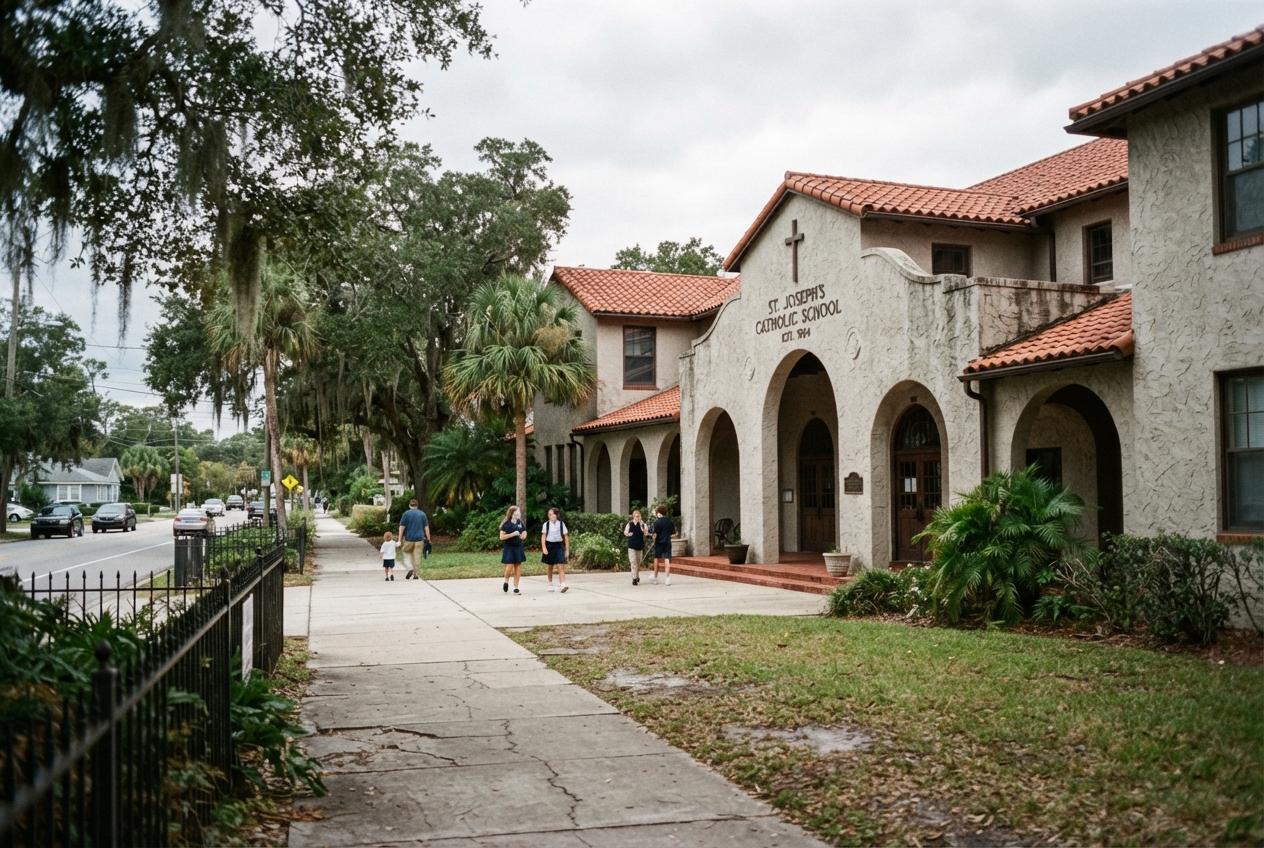
Florida’s dispute over vaccine rules in Catholic schools is becoming a wider argument about authority, religious independence and public health. As the state’s attorney general presses church-run schools over exemptions, bishops and school leaders are pushing back. The clash matters well beyond Florida, especially for families weighing school choice, faith-based education and who ultimately sets the rules.
Essential Takeaways
- The dispute is about control: Florida’s attorney general is challenging how Catholic schools handle vaccine requirements and exemptions.
- Church leaders are resisting: Bishops and Catholic education officials argue that state intervention risks undermining religious governance.
- Families face uncertainty: Parents may need to check each school’s current health policies rather than assume one rule applies everywhere.
- The argument fits a wider pattern: Battles over school authority increasingly overlap with politics, religion and culture-war messaging.
- Claims need checking: Viral statements about schools and children’s healthcare have repeatedly been found misleading or false.
Florida’s vaccine dispute is really about who runs schools
A disagreement over vaccine exemptions has turned into a test of institutional boundaries. Florida Attorney General James Uthmeier has warned Catholic schools about their policies, while church authorities have argued that the state shouldn’t dictate how religious schools operate.
According to CBS News Miami, the confrontation centres on whether Catholic schools can rely on religious exemptions and how far the state can go in enforcing public-health expectations. It’s a dry-sounding legal dispute, but for parents it lands in a very practical place: the admissions office, the medical form and the first day of term. Sources by paragraph: [2], [7]
The Catholic Church’s position is that its schools aren’t simply government contractors with a different logo. Florida officials, meanwhile, appear to view vaccination rules as a public responsibility that can’t be set aside whenever a school has a religious identity. That tension is unlikely to disappear quietly. Sources by paragraph: [5], [6]
Why the argument has become so politically charged
School policy fights now rarely stay confined to school policy. Vaccines, gender, curriculum, religious liberty and parental rights are often bundled into a single political conversation, making it harder for families to separate a genuine administrative question from a campaign slogan.
That matters because public figures have repeatedly used dramatic claims about schools to rally supporters. PolitiFact found Donald Trump’s claim that schools were carrying out gender-transition operations on pupils to be false, a reminder that education debates can be fuelled by statements that sound alarming but don’t withstand scrutiny. Sources by paragraph: [3]
The result is a noisy environment in which every new rule can be presented as either an attack on freedom or a necessary protection for children. In reality, parents usually want something less theatrical: clear requirements, honest explanations and enough notice to make sensible decisions. Sources by paragraph: [3], [5]
Catholic schools aren’t all governed in exactly the same way
A Catholic school may be part of a diocese, a religious order or an independent network, and its day-to-day policies can reflect that structure. That’s why families shouldn’t assume that a rule reported in one Florida school automatically applies across every Catholic campus.
Reports from Catholic World Report describe a growing confrontation between Florida’s attorney general and Catholic bishops over school vaccine mandates and exemptions. The coverage underlines the unusual nature of the dispute: the disagreement isn’t simply between a state agency and a private operator, but between public officials and church authorities with their own lines of accountability. Sources by paragraph: [5], [6]
For parents, the practical move is straightforward. Ask the school which vaccines are required, what exemptions are accepted, who makes the final decision and whether the policy could change during the academic year. It’s not thrilling paperwork, but it’s far better than discovering a problem after paying a deposit. Sources by paragraph: [2], [6]
The wider lesson for school choice
The row also exposes a trade-off that’s often glossed over in arguments about private education. Families may welcome smaller classes, a faith-based ethos or a different approach to discipline, but private and religious schools can still be affected by state rules, funding conditions and public-health requirements.
That becomes especially important as politicians promote school choice while simultaneously seeking greater influence over schools. The more public money, regulation or political attention enters the system, the less tidy the idea of complete institutional independence becomes. Florida’s conflict is a sharp example of that push and pull. Sources by paragraph: [5], [6]
The same need for careful scrutiny applies to education programmes more broadly. In a discussion of so-called science-based maths initiatives, Education Week urged readers to ask what evidence supports a programme, how strong that evidence is and whether it actually matches the claim being made. Those are useful questions here too: what is the rule, what authority supports it and what happens in practice? Sources by paragraph: [4]
What families should check before choosing a school
Parents comparing Catholic schools should look beyond the prospectus. Request the latest health and attendance policy, check whether exemptions are available, and ask how the school handles changes in state guidance. If the answers are vague, that’s useful information in itself.
It’s also worth separating medical advice from political commentary. A school’s policy should explain its requirements in plain language, while a doctor can offer individual guidance about vaccination and health risks. Online claims, however confidently delivered, shouldn’t be allowed to make either decision for you. Sources by paragraph: [2], [3]
The Florida dispute may eventually be settled through negotiation, litigation or a clearer state directive. Whatever happens, families will be watching for one thing: whether the final rules are predictable enough for them to plan around. Sources by paragraph: [5], [7]
Clear policies matter more than loud arguments, especially when children’s health and education are involved.
Source Reference Map
Story idea inspired by: [1]
Sources by paragraph: