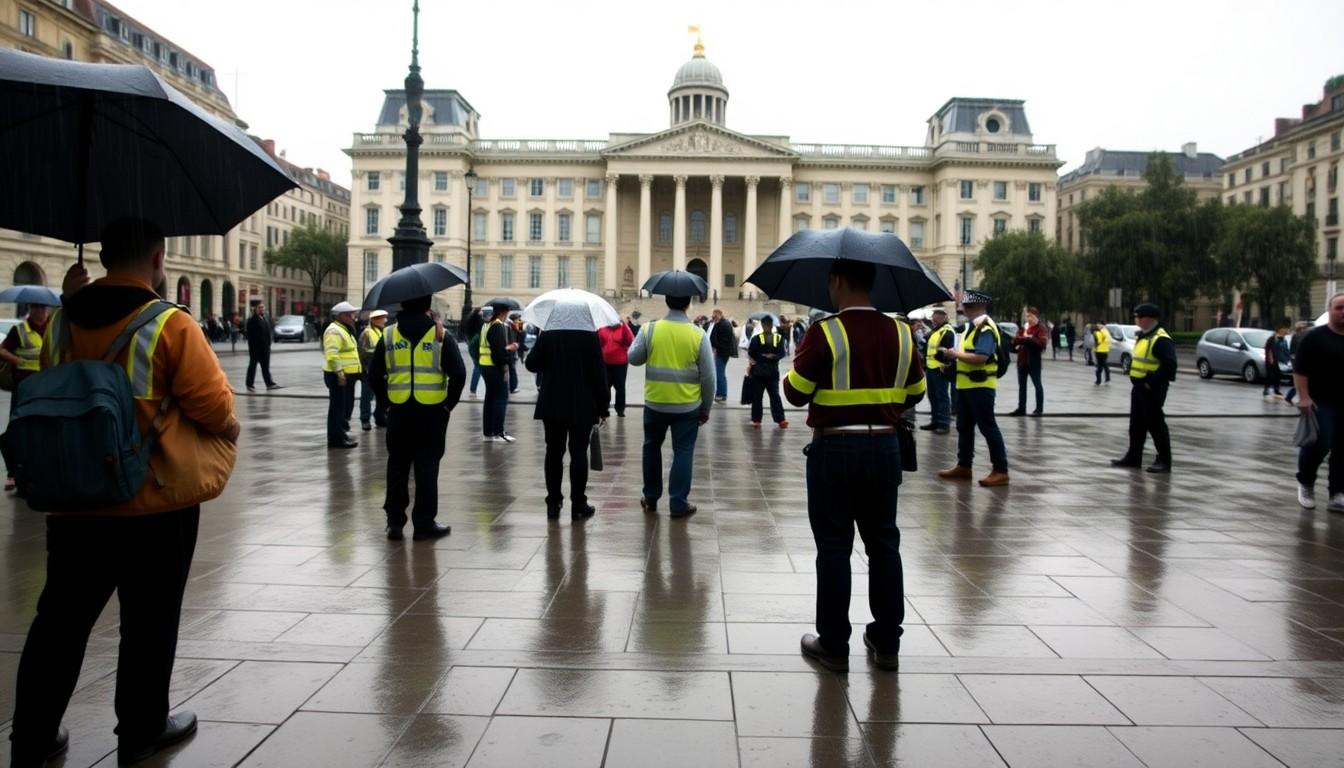
A rain-soaked London photo diary captures three very different scenes in one long day: Christ’s Hospital pupils processing through the City, activists challenging Uganda’s treatment of gay people, and supporters gathering for Parliament Square’s mass lone demonstrations. Together, the images offer a vivid snapshot of ceremony, protest and public space in 2006.
Essential Takeaways
- A historic school tradition: Christ’s Hospital pupils returned to the City for an annual St Matthew’s Day procession.
- Difficult shooting conditions: Heavy rain misted the photographer’s lens, producing blurred and atmospheric frames.
- A Ugandan rights protest: OutRage and supporters gathered outside Uganda House in Trafalgar Square.
- Mass lone demonstrations: Activists assembled near Parliament to support Brian Haw and challenge protest restrictions.
- A day of contrasts: Formal uniforms, campaign placards and eccentric street theatre shared the same central London backdrop.
One wet procession, and a camera fighting back
The day began with bright yellow coats, formal marching and relentless rain. Christ’s Hospital pupils processed from St Andrew’s Holborn towards Mansion House, continuing a tradition linked to the school’s long history in the City before its move to West Sussex.
The weather was so fierce that the camera became part of the story. Kept beneath a waterproof coat and repeatedly wiped clean, it eventually misted internally and stopped focusing. The resulting images may not be technically tidy, but they carry the sodden, slightly chaotic feeling of the occasion. Even a polished civic tradition can look wonderfully human when everyone is battling the elements.
Christ’s Hospital is known for its distinctive Tudor-inspired uniform and historic links with London, according to background information from Wikipedia and the school’s profile on Schrole. That visual identity makes the procession especially striking, even when the skies are uncooperative.
A school tradition rooted in London’s past
The annual return to the City connects present-day pupils with the school’s earlier home near Newgate. Christ’s Hospital relocated out of London in the early twentieth century, but ceremonial visits keep that relationship alive.
There’s a pleasing tension in the scene. The pupils move through modern streets filled with offices, traffic and financial institutions, yet their clothing and procession belong to an older civic London. It’s the sort of contrast street photography handles beautifully, especially when rain softens the edges of the architecture.
Historical accounts of Christ’s Hospital emphasise the institution’s unusual identity, charitable origins and enduring ceremonial customs. The school’s long-running presence gives the parade more weight than a simple day out; it’s a public reminder that London’s history is still performed in the street.
From disappointing galleries to a sharper public argument
After lunch, the photographer’s gallery visits began badly, with two venues closed despite advertising themselves as open. The National Portrait Gallery was available, but the exhibition proved underwhelming. The day’s strongest images were found elsewhere, outside and among people.
In Trafalgar Square, OutRage and other campaigners demonstrated outside Uganda House over the persecution of gay people in Uganda. Around 50 people eventually gathered, including supporters who had travelled considerable distances. Their protest turned a formal diplomatic building into the backdrop for an urgent human rights statement.
The demonstration reflected concerns that had already drawn international attention. Contemporary reports from Mambaonline and The Guardian described Uganda’s hostile political climate and the growing pressure on LGBT people. OutRage’s own archive also places the protest within its wider record of campaigning for LGBT rights.
Why the Uganda House protest still resonates
The photographs appear to capture more than a crowd holding placards. People inside Uganda House watched from windows, while one person reportedly approached the glass doors before retreating. That visual exchange, between demonstrators outside and observers within, gives the scene a quiet tension.
Protests around diplomatic buildings can feel deliberately theatrical, but that doesn’t make them superficial. The location matters because it directs attention towards the country and institutions being challenged. For photographers, it also creates layers: campaigners in the foreground, watchers behind glass and the familiar traffic of central London moving around them.
The wider reporting from 2006 shows why the activists considered the issue so serious. Uganda’s LGBT community faced harassment, legal threats and public vilification, making international solidarity an important part of the campaign.
Parliament Square turns protest into street theatre
The evening ended with mass lone demonstrations in Parliament Square, organised in the spirit of Mark Thomas’s idea and held in support of Brian Haw. Rather than one large collective banner, the square filled with individuals representing different causes.
That format produced an entertainingly unpredictable mix. Some placards addressed grave political issues, while others were eccentric, comic or painstakingly hand-painted. One tiny demonstration involved a painted bendy bus that arrived late, apparently delayed by London traffic, and was almost over before it had begun.
The protest sat within a broader argument about restrictions on demonstrations around Parliament. Earlier reporting from Indymedia documents the atmosphere surrounding Brian Haw’s campaign and the policing of protest in Westminster. The result, in these photographs, is less a tidy political rally than a lively cross-section of public dissent.
What this day says about photographing London
The most memorable thread is not a single campaign or landmark but the collision of different kinds of public life. School ceremony, LGBT rights activism and anti-war protest all occupy the same streets within hours. London makes room for solemnity, frustration, humour and historical ritual, often within a few hundred metres.
It’s also a reminder that imperfect photographs can be the most evocative. A misted lens, wet coats and awkward timing record the conditions honestly. The day didn’t produce a neat sequence of polished images, but it did produce something better: a textured portrait of a city where tradition and dissent are constantly sharing the pavement.
For anyone photographing public events, the practical lesson is simple. Protect the camera, carry a cloth, expect plans to change and keep watching after the official moment has passed. The strongest frame may come from a window, a late arrival or a protester holding a beautifully painted sign.
A long day in London can still feel fresh when the streets refuse to behave.
Source Reference Map
Story idea inspired by: [1]
Sources by paragraph: