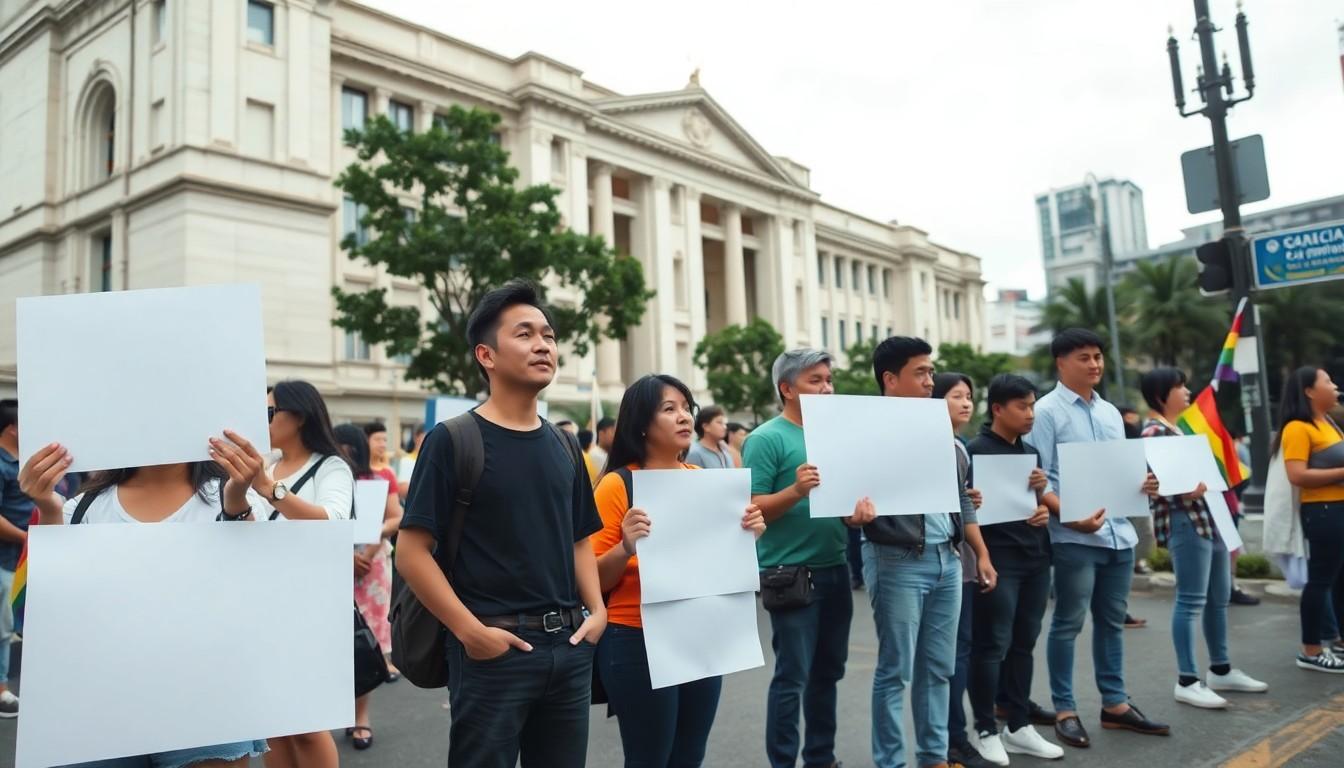
Protesters gathered in Manila for the 54th Martial Law commemoration, where LGBTQIA+ organisation Bahaghari called for accountability from powerful political figures. The group linked corruption to flooded communities, weak disaster protection and strained public services, arguing that public anger remains unresolved while alleged abuses of power go unpunished.
Essential Takeaways
- Bahaghari’s message: The LGBTQIA+ group demanded investigations and accountability from officials it says have placed personal interests ahead of the public.
- A wider protest: Demonstrators gathered at Liwasang Bonifacio in Manila during the 54th Martial Law commemoration.
- Corruption’s human cost: Bahaghari connected alleged misuse of public funds with flood-control failures, disaster risks and pressure on social services.
- Security presence: Philippine authorities prepared large deployments and traffic restrictions around the anniversary events.
- The campaign continues: The organisation said public calls for justice would continue while impunity remains a concern.
Bahaghari puts accountability at the centre of the protest
The strongest message from the Manila gathering was simple: political power shouldn't place anyone beyond scrutiny. Bahaghari joined demonstrators at Liwasang Bonifacio and directed its criticism at President Ferdinand Marcos Jr and Vice-President Sara Duterte, calling for greater accountability from those in positions of authority. The Philippine Star reported that protests marked the anniversary with a visible show of public dissent. [3]
For Bahaghari, the issue isn't confined to political drama in the capital. Its national spokesperson, Yell Teresa, argued that alleged corruption has a direct effect on ordinary families, particularly those facing flooding, illness and the loss of homes. The statement gave the gathering a distinctly practical edge, bringing national politics back to muddy streets and struggling neighbourhoods. [7]
Why flood control became part of the argument
Bahaghari's criticism focused heavily on where public money should go. Teresa said every peso allegedly taken through corruption is money that could otherwise support flood-control infrastructure, disaster preparedness and social programmes. It's a familiar frustration across vulnerable communities: the promised protection can feel distant, while the consequences arrive quickly and violently. [4]
That connection also reflects the wider stakes of public spending. When heavy rain overwhelms drainage systems or residents are left exposed to disease after floods, questions about planning and government responsibility become impossible to ignore. Bahaghari's intervention therefore framed corruption not as an abstract scandal, but as something people can feel in damaged homes, disrupted work and unsafe streets. [5]
A historic anniversary with a modern political edge
Martial Law commemorations carry a heavy historical weight in the Philippines, but the Manila protests showed how that history continues to shape present-day activism. Rappler has documented how activists have used anniversary marches to challenge authoritarian legacies and demand stronger democratic safeguards. [6]
This year's gathering also brought together a familiar mix of remembrance and resistance. The event was not only about looking backwards, but about asking whether public institutions are learning from the past. Associated Press reporting on Philippine political protests has likewise highlighted how civil society groups continue to use public demonstrations to press for transparency and democratic accountability. [7]
Police preparations added another layer
The demonstrations unfolded alongside a substantial security operation. DZRH reported that the National Capital Region Police Office deployed more than 15,000 personnel for the commemoration, underlining the scale of the official preparations. [5]
Traffic management was part of that planning too, with Manila police announcing road closures around the anniversary activities. For residents and commuters, that means a political event becomes a practical part of the day's landscape, bringing diversions, delays and a reminder that public protest can reshape a city block by block. [4]
The Philippine National Police also said no group had applied for a permit for one planned protest, according to The Philippine Star. That detail adds a procedural dimension to an already tense public conversation about assembly, policing and the right to be heard. [2]
What happens after the banners come down?
Bahaghari said the LGBTQIA+ community and the wider Filipino public would continue calling for a thorough investigation until officials are held responsible. The organisation also urged LGBT communities to unite against corruption and impunity, presenting solidarity as a necessary part of the campaign rather than a symbolic gesture. [3]
That outlook matters because protests rarely deliver instant answers. Their influence is often measured in the questions they keep alive, the records they demand and the pressure they place on institutions long after the crowd has gone home. As one protest ends, the harder work of proving accountability begins. [6]
The message from Bahaghari was especially direct: no political camp should be treated as untouchable. For people watching public money disappear while floodwater rises, that's not just a slogan. It's a demand for government that feels present when it matters most. [5]
It's a small sentence with a substantial challenge: power must answer to the people it serves.
Source Reference Map
Story idea inspired by: [1]
Sources by paragraph: