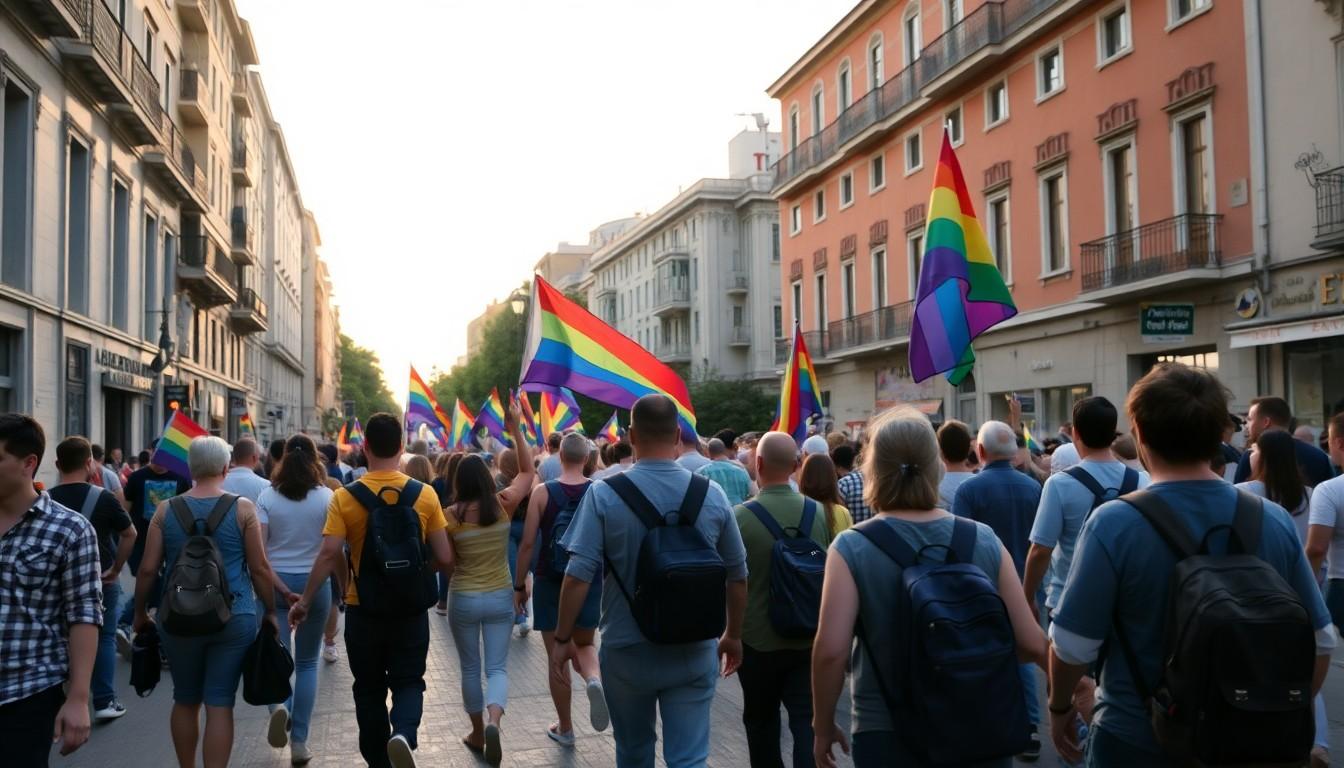
Campaigners and supporters are returning to Gladstonos Street in Athens for a memorial march marking eight years since the death of LGBTQ+ activist Zak Kostopoulos. The gathering matters because it keeps questions about violence, discrimination and justice in public view, while remembering a figure whose life and activism resonated far beyond Greece.
Essential Takeaways
- Memorial march: Supporters are gathering at Gladstonos Street, where Kostopoulos died, before marching in his memory.
- A wider message: Organisers connect his death with violence faced by marginalised people and LGBTQ+ communities.
- International attention: The case drew coverage from Greek and international media, including The Guardian and PinkNews.
- A public act of remembrance: Friends and supporters have used marches, performance and celebration to keep his legacy visible.
- Justice remains central: Reporting has focused on the circumstances of his death and continuing demands for accountability.
Athens returns to Gladstonos Street
The most striking detail about the memorial march is its location. Supporters are meeting on Gladstonos Street, the central Athens spot where Kostopoulos died, turning an ordinary city thoroughfare into a place of collective memory.
According to efsyn.gr, the march was scheduled for 6.30pm and organised around the eighth anniversary of his death. That choice of setting gives the event a quiet physical force: remembrance isn't abstract when it begins at the exact place where a life ended.
Kostopoulos was widely known as an LGBTQ+ activist, performer and public voice. Greek newspaper Kathimerini reported on the shock surrounding his death in Athens, while later international coverage followed the case and the demands for justice.
Who was Zak Kostopoulos?
Kostopoulos, also known as Zackie Oh, was an activist whose work challenged homophobia, stigma and social exclusion. His public identity blended campaigning with performance, creating a presence that was both politically outspoken and unmistakably personal.
Wikipedia records his involvement in LGBTQ+ activism in Greece, while PinkNews reported on the way friends and supporters remembered him through glitter, drag and celebration. That response was significant: it resisted reducing him to the circumstances of his death and insisted on remembering the full, vivid person.
There was warmth and colour in that remembrance, but also anger. For many supporters, celebrating Kostopoulos wasn't a distraction from the demand for accountability. It was part of it.
Why the case became a wider symbol
The groups calling for the march frame Kostopoulos's death as part of a broader pattern of violence against people pushed to society's edges. Their message links his case to the treatment of LGBTQ+ people, migrants, the poor and others who are often treated as disposable.
The Guardian reported on the continuing controversy surrounding the case and the calls for justice. PinkNews likewise described his death as a brutal attack that prompted outrage well beyond Greece, helping turn a local tragedy into an international human rights story.
That wider framing is why the annual march still matters. It asks people not only to remember one man, but to consider what happens when prejudice, fear and public violence are allowed to reinforce one another.
Remembrance can be joyful and furious
Memorials don't always look solemn. In Kostopoulos's case, supporters have brought drag, glitter and performance into public remembrance, according to PinkNews. The effect is both celebratory and confrontational, reflecting the personality of someone remembered for living openly and loudly.
That approach also challenges the tendency to flatten activists into symbols. Kostopoulos was a person with humour, style, friendships and a creative life, not simply a name attached to a legal case. Keeping those details visible makes the remembrance feel more human.
It also explains why the memorial has endured. People aren't just revisiting a painful event; they're defending a memory against silence.
The march keeps the questions alive
Eight years on, the march offers supporters a way to connect memory with accountability. Efsyn.gr reported that organisers described the violence inflicted on Kostopoulos as connected to the everyday violence experienced by excluded people in an oppressive society.
The language is political, but the underlying point is simple. A memorial gathering can honour the dead while asking what must change for others to remain safer, freer and more fully seen.
For people joining the march, the evening is likely to carry grief, anger and solidarity in equal measure. Its message is hard to miss: remembering Zak Kostopoulos means refusing to let his story disappear.
Remembering him keeps both his life and the demand for justice in view.
Source Reference Map
Story idea inspired by: [1]
Sources by paragraph:
- Paragraph 1: [2], [4]
- Paragraph 2: [3], [5]
- Paragraph 3: [6], [7]
- Paragraph 4: [5], [7]
- Paragraph 5: [2], [6]
- Paragraph 6: [3], [4]
- Paragraph 7: [5], [7]
- Paragraph 8: [6], [2]
- Paragraph 9: [3], [5]
- Paragraph 10: [2], [7]
- Paragraph 11: [5], [6]
- Paragraph 12: [2], [3]
- Paragraph 13: [5], [7]
- Paragraph 14: [2], [4]