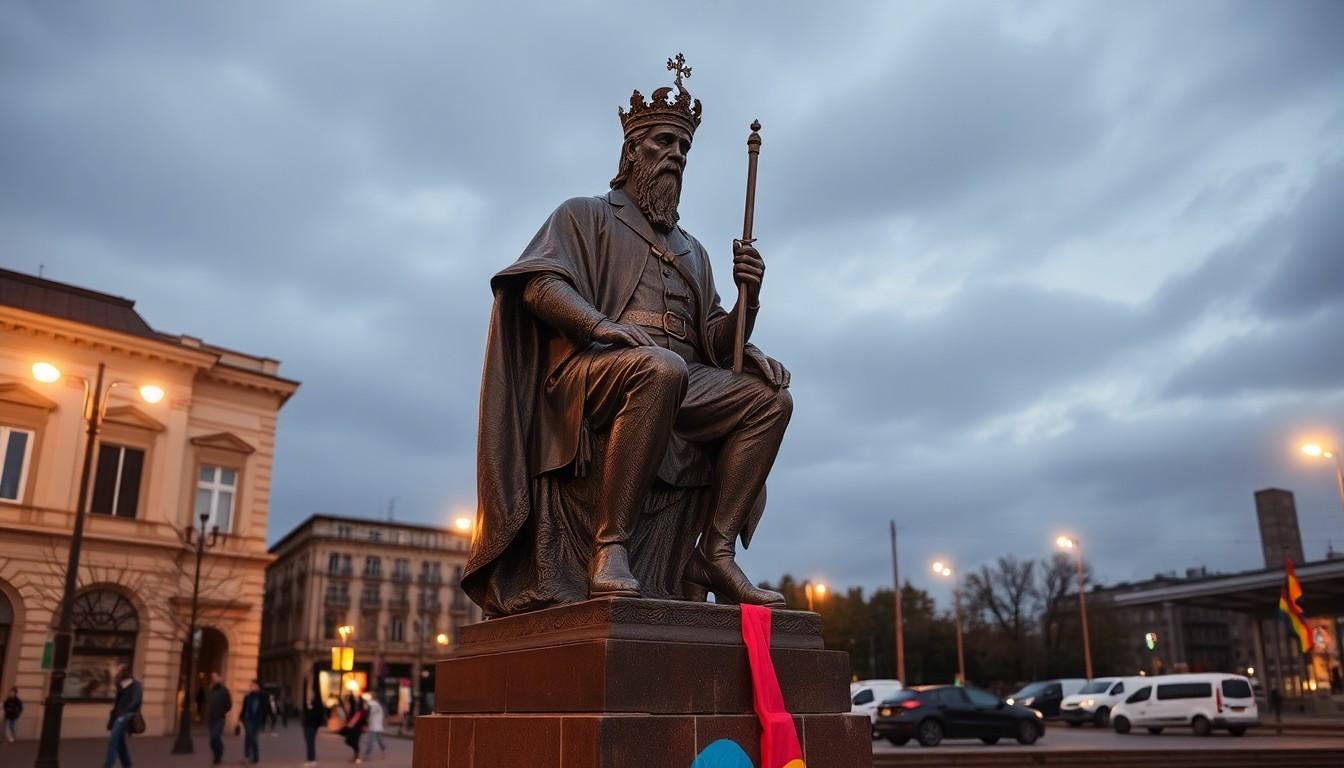
Visitors arriving at Ploiesti’s South Station have found a familiar literary figure in an unexpectedly vivid new look. The rainbow-painted Domnul Goe statue, part of the Artown NOW 2026 urban art festival, has prompted arguments over artistic freedom, local identity and the meaning people attach to colour in public spaces.
Essential Takeaways
- A new look: The Domnul Goe statue at Ploiesti South Station was painted in several bright colours as part of Artown NOW 2026.
- A divided response: The artist described the work as an expression of art, diversity and inclusion, while critics connected it to LGBT symbolism.
- Political backlash: PSD Ploiesti called for the paint to be removed and the statue returned to its former appearance.
- Wider fallout: The dispute has raised questions about permissions, public monuments and how urban art should be agreed with local communities.
- No simple ending: The statue's final fate remains tied to decisions by local authorities and project partners.
A familiar character suddenly becomes a city talking point
The brightly coloured figure outside Ploiesti South Station has turned an everyday arrival point into an unlikely cultural flashpoint. Instead of quietly recalling Ion Luca Caragiale's mischievous railway passenger, the statue now draws the eye with a bold, multi-coloured finish.
The change was made during the fifth edition of Artown NOW, a festival that brings artists into streets, buildings and other parts of the urban landscape. According to Conteaza.ro, the project included a range of interventions intended to give ordinary city spaces a more imaginative edge.
That ambition is easy to understand. Public art works best when it interrupts routine, even if the interruption leaves people muttering at the bus stop. Here, though, the visual shock quickly became a political argument, with the colours taking on meanings beyond the artist's stated intention.
Why the rainbow finish caused such a strong reaction
The controversy centres on interpretation. Corina Monea, known artistically as OCU, said the work wasn't created to copy an LGBT flag. She described her aim as making art and presented diversity and inclusion as positive values, according to reporting cited by G4Media-style local coverage and other Romanian outlets.
Opponents saw something different. PSD Ploiesti argued that the paint covered recognisable details associated with Domnul Goe, including his sailor-style clothing and cap, and demanded that the statue be cleaned. Informat.ro reported that the party framed the intervention as an inappropriate alteration of a cultural symbol.
That gap between intention and reception is the heart of the row. One viewer sees colour, energy and openness; another sees an imported political message imposed on a character tied to Romanian literature. Neither reaction can be separated from the atmosphere surrounding public debates about identity and representation.
Local politicians call for the statue to be restored
The response wasn't limited to social media criticism. PSD Ploiesti publicly requested the removal of the new paint, while PNL Prahova leader Mircea Rosca also said he disagreed with the intervention, despite acknowledging the importance of artistic expression and diversity.
According to Gandul, Rosca argued that the statue was a visible symbol of the city and questioned whether the work had received appropriate approval. His reaction brought a second concern into focus: public art isn't only about what is painted, but also about who authorised it and who is responsible for the result.
The debate then widened further. Telegrama reported that the local public services company, SGU Ploiesti, withdrew from its partnership with Artown NOW 2026. That move suggests the disagreement may have consequences for the festival itself, not just for one statue.
The Domnul Goe statue carries plenty of baggage already
Domnul Goe isn't a blank canvas. In Caragiale's well-known sketch, the spoilt boy travels by train towards Bucharest with three female relatives, creating a comic portrait of indulgence, bad manners and misplaced confidence. The railway setting at Ploiesti gives the statue an especially direct link to that story.
That literary connection helps explain why some residents reacted so strongly to the makeover. For them, the figure represents a piece of shared childhood and national culture, rather than simply an available surface for a contemporary art project.
But cultural symbols evolve, too. A monument can honour its original reference while still becoming part of a new conversation. The difficulty is deciding whether that conversation should be invited by the artist, negotiated with the community or avoided altogether when the object has strong public and historical associations.
What this means for future urban art projects
The Ploiesti row offers a practical lesson for festivals using public landmarks: explain the concept before the paint goes on. Clear information about the artist's intention, the approval process and the expected duration of an intervention can prevent a visual surprise from becoming a full-blown political quarrel.
It also highlights the importance of checking the surface and status of any object before work begins. A temporary installation on a blank wall is likely to attract a different response from a painted intervention on a statue linked to a major literary figure.
Local reporting, including Observatorul Prahovean's coverage, indicates that the mayor's office was drawn into the dispute as questions over authorisation and responsibility gathered pace. For organisers, that is a reminder that public art needs more than creative confidence. It needs careful civic groundwork.
For now, Domnul Goe remains a vivid example of how quickly a colourful public artwork can become a test of local identity. The final decision may be practical, but the argument has already exposed a much bigger question: who gets to decide what a city should look like?
A small statue has sparked a very large conversation about art, ownership and belonging.
Source Reference Map
Story idea inspired by: [1]
Sources by paragraph:
- Paragraph 1: [2], [4]
- Paragraph 2: [3], [4]
- Paragraph 3: [5], [7]
- Paragraph 4: [2], [7]
- Paragraph 5: [3], [6]
- Paragraph 6: [4], [5]
- Paragraph 7: [2], [7]
- Paragraph 8: [3], [6]
- Paragraph 9: [4], [5]
- Paragraph 10: [6], [7]
- Paragraph 11: [2], [3]
- Paragraph 12: [4], [5]
- Paragraph 13: [6], [7]
- Paragraph 14: [2], [3]