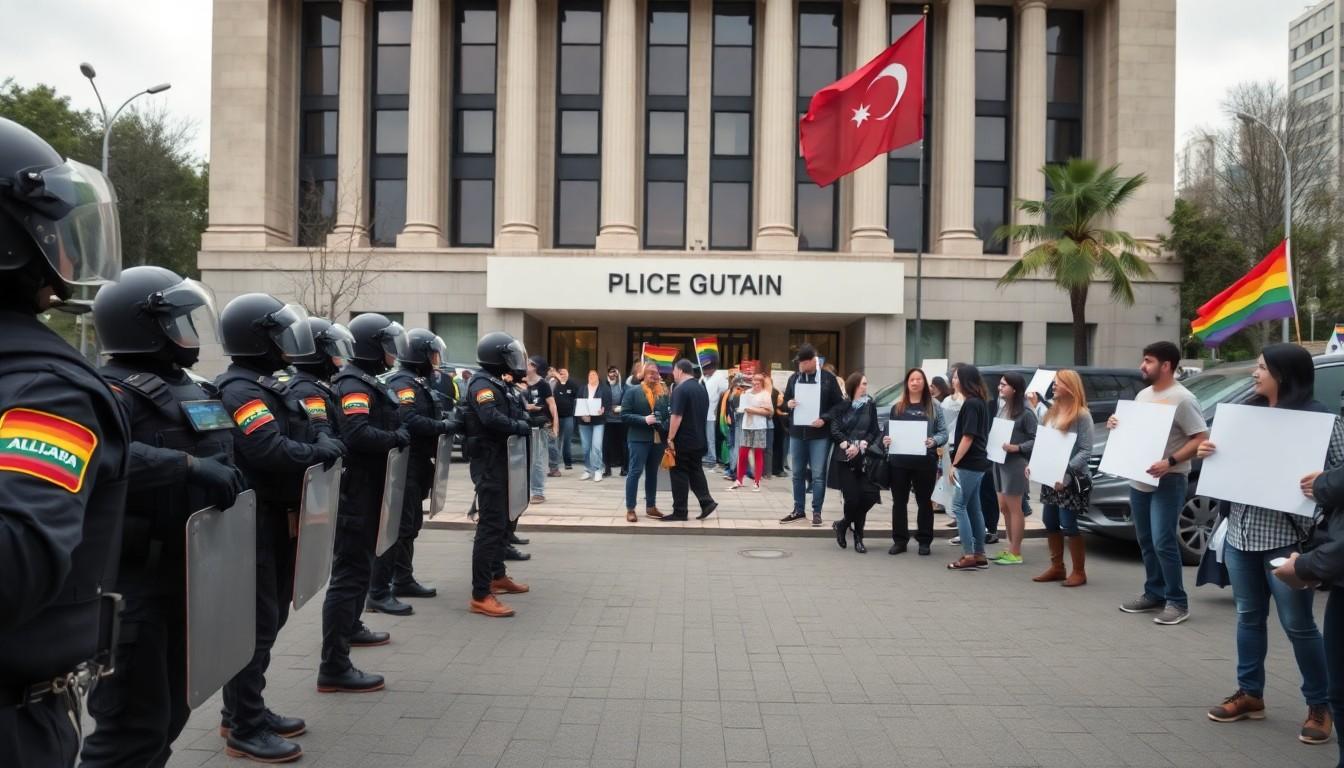
Authorities in Turkey have revived a sweeping crackdown on LGBT people, protesters and rights organisations, with dozens detained in Ankara and online platforms facing pressure. The campaign matters beyond the immediate arrests: activists warn it could deepen censorship, weaken civil society and redirect public anger away from Turkey's painful cost-of-living crisis.
Essential Takeaways
- At least 200 detained: Around half were reportedly released, while others remained under investigation.
- Protesters targeted too: Riot police moved against demonstrators before a planned Ankara gathering could begin.
- Media pressure is growing: Websites and social accounts documenting the arrests have faced blocking or fresh investigations.
- The official justification: The operation is framed around protecting children, families and social order.
- Rights groups see a wider threat: Funding networks and pro-democracy organisations could also come under scrutiny.
The crackdown is spreading beyond LGBT groups
The most striking feature of the latest operation isn't simply the number of arrests. It's the breadth of the pressure campaign, which has reached activists, demonstrators, journalists and civil society organisations.
According to Turkey Recap, the arrests began early on Sunday under a nationwide operation called "My Family is Safe". Homosexuality isn't illegal in Turkey, but authorities have reportedly used allegations including prostitution, drug offences and distributing obscene material to detain LGBT rights campaigners. Reports by Kaos GL have documented a broader pattern of discriminatory and hateful attacks against LGBT people in the country.
In Ankara, protesters attempting to gather were met by a heavy police presence. The scene, described as a sudden swoop by riot police, underlined how quickly a rights issue can become a public-order operation. For people watching from the pavement, it was a chilly reminder that even peaceful solidarity can now carry real risk.
A family-values message with political force
Justice Minister Akın Gürlek has presented the campaign as a defence of children, family life and social order. That language has become increasingly prominent in government-aligned media, where reports have focused on alleged foreign funding and supposed psychological dangers linked to LGBT visibility.
The Jerusalem Post has reported on the broader political environment surrounding Turkey's LGBT crackdown, including official rhetoric that casts LGBT rights as an imported threat. Israel Hayom has also described arrests and raids as part of a widening campaign against LGBT communities and their supporters.
Critics argue that this framing does more than set a social agenda. Labour Party MP Sevda Karaca told Turkey Recap that it encourages people to blame a supposed cultural enemy while avoiding harder questions about high rents, insecure work, low wages and the cost of raising children. It's an old political trick, but it remains effective: make the culture war louder and the household budget can disappear from the conversation.
Why the timing matters for Turkey's opposition
The operation arrives as Turkey's opposition remains under intense strain. Pressure on Istanbul Mayor Ekrem Imamoglu, including a political ban reported in the wider coverage, has sharpened concerns about whether elected opposition figures can compete on equal terms.
Associated Press reporting has tracked the continuing legal and political pressure surrounding Turkey's opposition, while the Jerusalem Post has covered the broader contest between President Recep Tayyip Erdogan's government and its challengers. Against that backdrop, the LGBT crackdown looks less like an isolated policy dispute and more like one strand of a wider governing strategy.
That doesn't mean every detention is centrally choreographed for the same purpose. But it does mean the consequences are likely to travel. When activists are silenced, journalists are blocked and opposition voices are forced to spend their energy responding to arrests, public debate becomes narrower and more defensive.
Civil society could be the next target
One of the most worrying details is the focus on organisations that fund or support LGBT rights work. Pro-government media have reportedly highlighted international donors, raising fears that scrutiny could spread to independent newsrooms, charities and other organisations whose finances overlap with the same networks.
Kaos GL's reporting on discriminatory attacks helps place that concern in context. The risk isn't only that a particular group loses access to a website or faces an investigation. It's that smaller organisations begin censoring themselves before authorities even need to intervene. That quieter effect can be more powerful than a dramatic raid.
Rights officials have challenged the government's legal reasoning. Michael O'Flaherty, the Council of Europe's commissioner for human rights, said that references to family values or child protection alone cannot justify restrictions on fundamental rights, according to Turkey Recap. The point is straightforward, even if the political debate isn't: protecting children can't become a blank cheque for suppressing adults.
What happens next?
The immediate outlook is likely to depend on whether the arrests remain a short operation or become a recurring enforcement model. Previous reporting by the Jerusalem Post and Israel Hayom suggests that raids, detentions and hostile public messaging have already become familiar tools in Turkey's treatment of LGBT communities.
For activists, the practical advice is grim but clear: document arrests carefully, seek legal support quickly and avoid assuming that online visibility offers safety. Organisations will also need to review digital security, funding arrangements and emergency communication plans. None of that should be necessary in a rights-respecting democracy, but preparation matters when the rules feel deliberately elastic.
The deeper test will be whether other groups stand alongside LGBT people or retreat into silence. As Karaca warned in comments to Turkey Recap, repression succeeds not only when people are arrested, but when neighbours stop defending one another. That may be the campaign's most consequential aim, whether or not officials say so publicly.
The crackdown is therefore about more than one community or one week of arrests. It's a test of how much public space remains for dissent in Turkey.
Source Reference Map
Story idea inspired by: [1]
Sources by paragraph:
- Paragraph 1: [5], [6]
- Paragraph 2: [2], [3]
- Paragraph 3: [4], [6]
- Paragraph 4: [5], [7]
- Paragraph 5: [2], [4]
- Paragraph 6: [3], [5]
- Paragraph 7: [4], [6]
- Paragraph 8: [5], [7]
- Paragraph 9: [2], [3]
- Paragraph 10: [4], [6]
- Paragraph 11: [5], [7]
- Paragraph 12: [2], [4]
- Paragraph 13: [3], [5]
- Paragraph 14: [6], [7]