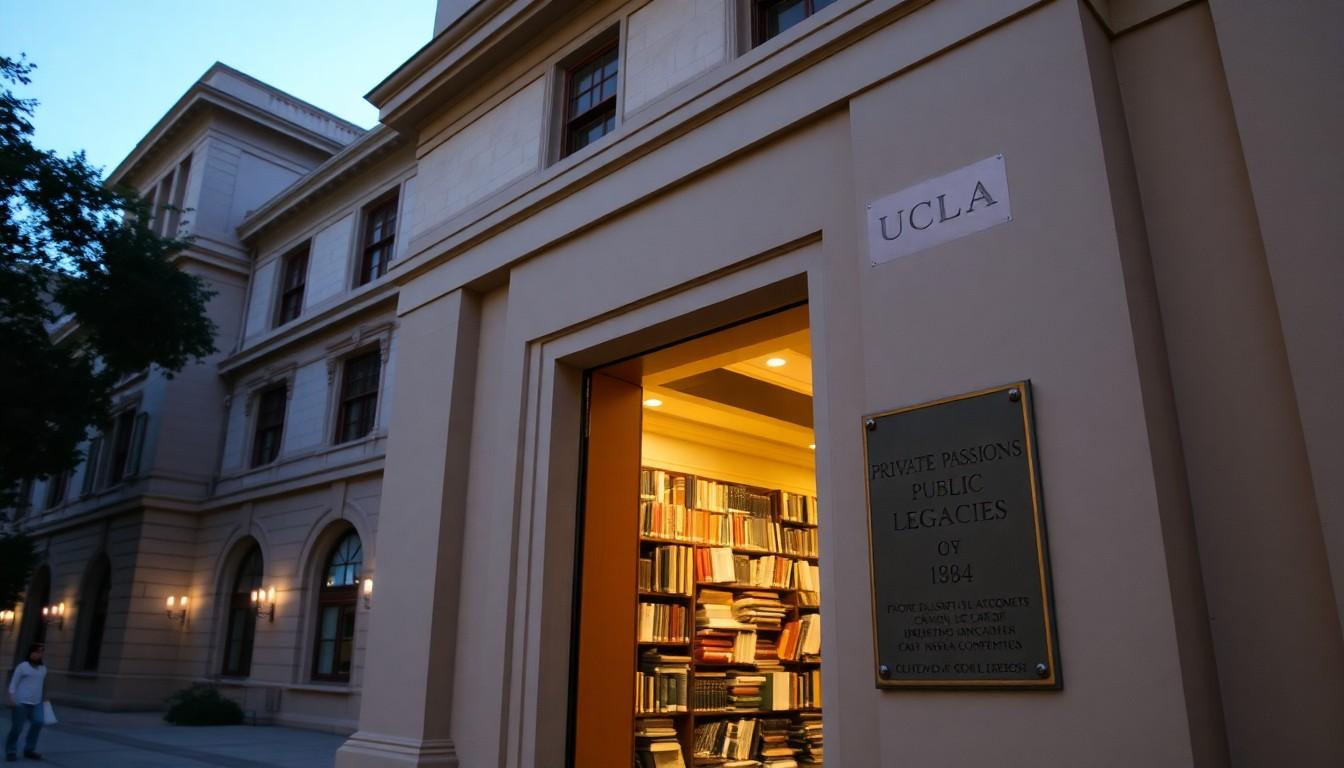
Visitors exploring Dublin’s literary landmarks might not expect Montana to enter the story. Yet William Andrews Clark Jr., a wealthy Butte-born philanthropist, assembled an extraordinary Oscar Wilde collection, funded the Los Angeles Philharmonic and left UCLA a landmark library. His life also reveals how easily queer history can be softened, sidelined or overlooked.
Essential Takeaways
- A surprising collector: William Andrews Clark Jr. built one of the most important Oscar Wilde collections in the United States.
- A major cultural legacy: His philanthropy helped establish the Los Angeles Philharmonic and support the Hollywood Bowl.
- A remarkable library: The William Andrews Clark Memorial Library at UCLA holds rare books, manuscripts and other literary treasures.
- A hidden personal story: Clark’s long relationship with Harrison Post offers a glimpse into queer life in early 20th-century America.
- History needs context: The library’s collections show why preserving difficult, intimate and marginalised stories matters.
The Oscar Wilde connection begins in Montana
Oscar Wilde’s name tends to summon images of Victorian London, sharp wit and elegant scandal. But one of the finest collections of his work was assembled by a man born in Deer Lodge, Montana, a state more readily associated with copper, cattle and wide-open landscapes than decadent literature.
William Andrews Clark Jr. became a lawyer, businessman, philanthropist and book collector. UCLA’s William Andrews Clark Memorial Library describes a collection built around rare books, manuscripts and cultural history, with Wilde among its most compelling strengths. The result is a pleasingly unlikely link between a Montana fortune and one of Ireland’s most famous writers. According to the Clark Library, its Oscar Wilde holdings include important editions, correspondence and other material connected with the author’s life and work. (UCLA’s William Andrews Clark Memorial Library, sources [2], [5])
That contrast is part of the appeal. Clark’s story feels like the sort of historical detail that should be better known: a wealthy western American quietly creating a literary archive with international importance. It’s proof that cultural influence doesn’t always arrive wearing the expected costume.
A fortune turned into a public cultural legacy
Clark inherited substantial wealth from his father, the mining magnate and former US senator William Andrews Clark. Rather than keeping his interests confined to private estates and family affairs, he poured money into music, architecture, books and the arts.
His support for the Los Angeles Philharmonic helped the orchestra survive and grow during its early years. He also contributed to the development of the Hollywood Bowl, while his library and surrounding property eventually became part of UCLA. The institution now bears his full name, preserving both his collection and the scale of his ambition. (William Andrews Clark Jr.’s biography, source [7]; UCLA, source [5])
There’s something especially striking about the combination. Clark wasn’t simply accumulating beautiful objects for display. He was helping shape Los Angeles as a cultural city, while building a research collection intended to outlast him. That kind of philanthropy can feel grand, even extravagant, but its best results are practical: students, scholars and curious visitors still have somewhere to begin.
Why his relationship with Harrison Post matters
Clark’s private life adds another layer to the story. He was closely connected with Harrison Post, who worked as his secretary and became his companion, confidant and intellectual partner. In an era when same-sex relationships were heavily stigmatised and male homosexuality could be treated as a criminal offence, public presentation required caution.
The pair maintained separate homes across the street from one another in Los Angeles, a practical arrangement that offered privacy and a degree of social cover. UCLA’s work on queer histories places Clark and Post within a wider effort to recover relationships that official records often avoided naming directly. (UCLA’s queer history project, source [3])
The library itself contains an evocative clue. Its vestibule ceiling features fourteen naked male figures bearing Post’s face, an intimate artistic statement that is difficult to read as accidental. Details like this don’t provide a complete biography, but they complicate the old habit of treating wealthy historical figures as if their personal lives were irrelevant or entirely conventional.
The archive can reveal what silence hides
Clark’s story also demonstrates why researchers must look beyond tidy family narratives. Personal letters were destroyed after his death, including correspondence involving his father and Post. That loss created gaps in the record, but an absence of documents doesn’t necessarily mean an absence of feeling, conflict or relationship.
Modern archival work is increasingly alert to those gaps. UCLA’s Clark Library explains that its collections are valuable not only for famous names, but also for the social networks, private interests and cultural worlds they reveal. Its collecting policies make space for material that helps researchers understand how people lived, read, loved and expressed themselves. (UCLA’s collection policy, source [6])
This is where queer history becomes part of mainstream history, rather than a separate footnote. Clark’s sexuality, his relationship with Post and the way their lives were represented all help explain the period. The human detail makes the archive richer, not narrower.
A library that keeps the Wilde story alive
The Oscar Wilde collection remains one of the clearest ways to understand Clark’s literary taste. UCLA notes that the holdings support research into Wilde’s writing, reception and continuing cultural influence, bringing together books and related material that would be difficult to study in one place elsewhere. (UCLA’s Oscar Wilde collection, source [2])
A companion account from UCLA also highlights how the collection connects Wilde with the history of the Clark Library itself. That connection feels fitting: Wilde’s work is full of questions about reputation, secrecy and the stories societies tell about their most complicated members. Clark’s own history raises similar questions, only this time the archive is the one being examined. (UCLA Magazine, source [4])
The wider lesson is simple but easily forgotten. Libraries don’t merely preserve famous texts; they preserve evidence of taste, friendship, identity and power. Sometimes a rare book opens the door. Sometimes it’s a painted ceiling, a missing letter or the name someone chose to place on a public institution.
Why remembering the whole story matters
Clark’s legacy is not only about wealth or collecting. It’s about the cultural institutions that benefited from his money, the literary world he helped preserve and the queer history that survives in fragments. Leaving out any one of those elements produces a flatter, less truthful account.
There’s a temptation to tidy the past, particularly when a person’s identity or relationships challenge modern expectations. But history works better when it contains contradictions: a powerful heir could also be a devoted collector; a public benefactor could live privately; a Montana businessman could become one of Wilde’s most important American champions.
That fuller version is more interesting, too. It reminds us that the past was populated by real people, not cardboard labels. And if a library can keep those complicated lives visible, it’s doing more than storing books.
The best history doesn’t erase the awkward parts. It lets them speak.
Source Reference Map
Story idea inspired by: [1]
Sources by paragraph: