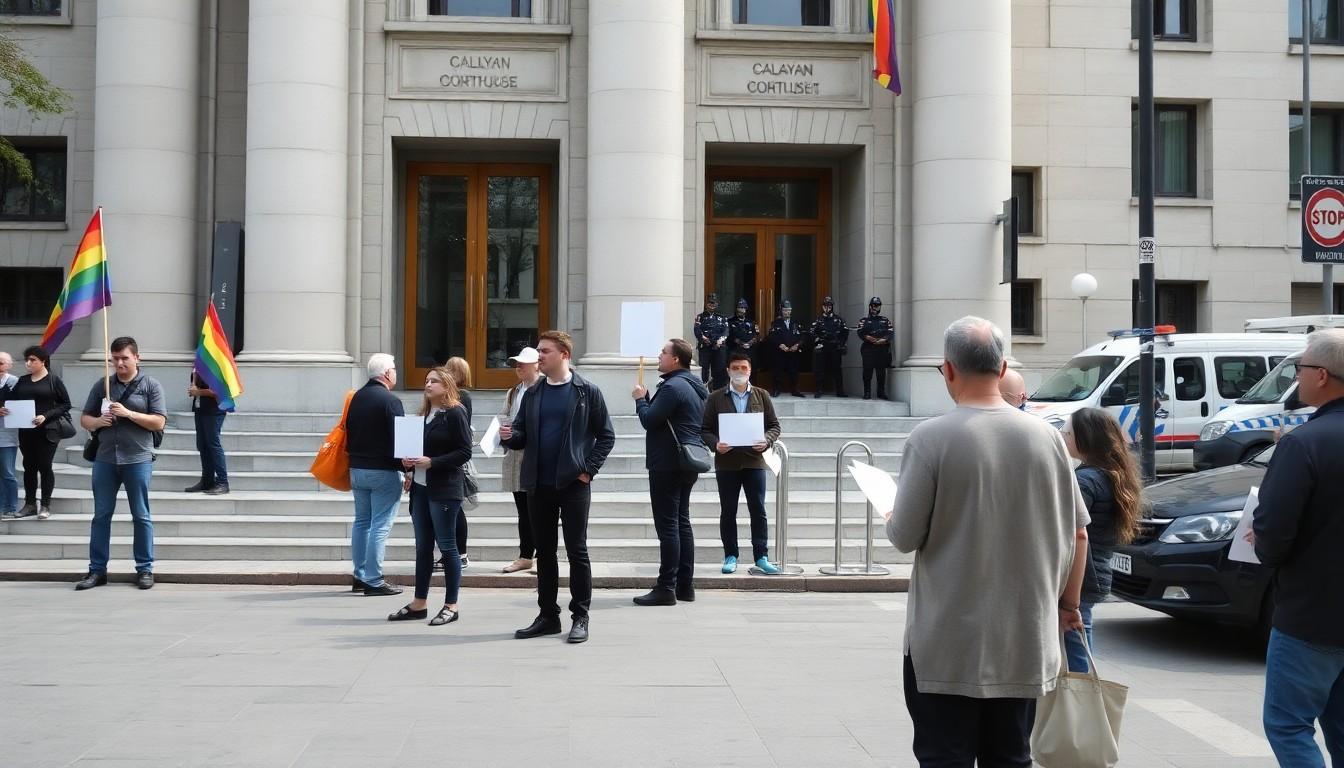
At least 150 people were reportedly detained in Istanbul after police broke up a planned LGBTQ+ rights demonstration outside a courthouse. The arrests follow raids, website restrictions and detentions across Turkey, prompting concern from human rights organisations and European officials over a widening campaign framed by authorities as protecting children and family values.
Essential Takeaways
- At least 150 detained: Police intervened at a gathering outside Istanbul’s Çağlayan courthouse, according to witness accounts.
- A wider operation is under way: Investigators are examining 162 suspects, nine associations and 13 businesses across 15 provinces.
- Organisations have been raided: LGBTQ+ groups and HIV support services have reportedly faced searches and disruption.
- Online access has been restricted: Websites and social media accounts linked to activists, groups and independent media have been blocked.
- European concern is growing: The Council of Europe’s human rights commissioner called for detainees held over civil society work to be released.
Police move against Istanbul protest
The latest confrontation unfolded outside Istanbul’s Çağlayan courthouse, where demonstrators had planned to speak to the press about recent arrests targeting LGBTQ+ people and organisations. Instead, police prevented the statement from taking place and moved in as the crowd chanted for life and against hatred.
At least 150 people were detained, according to witness accounts reported by Reuters and carried by Naftemporiki. The scene captures the tension surrounding public protest in Turkey, where even a short gathering outside a court can quickly become a major confrontation.
The arrests came after a weekend operation in which authorities detained at least 26 people in Istanbul and 21 in Ankara. International reporting from Al Jazeera and UPI described the actions as part of a broader anti-LGBTQ+ campaign.
Raids spread across Turkey
The investigation isn't limited to one city. Turkey’s justice minister said prosecutors in Istanbul, Ankara, Izmir, Aydin and Mersin were coordinating inquiries involving 162 suspects, nine associations and 13 businesses in 15 provinces.
A court in Izmir also ordered 16 people to be held in pre-trial detention, according to the local prosecutor’s office. Reports from Reuters, published by Internazionale, and the Los Angeles Times indicate that offices connected to LGBTQ+ and HIV support groups have been among the locations targeted.
The government has called the operation “My Family Is Safe”, presenting it as an effort to protect children and preserve family values. That language may sound reassuring on paper, but rights advocates argue that broad moral claims shouldn't be used to justify mass arrests or the silencing of civil society.
Internet restrictions add another layer
The pressure has reportedly moved online, too. Authorities have restricted access to websites and social media accounts belonging to LGBTQ+ organisations, individuals and independent media outlets.
The blocked accounts reportedly include the Turkish branch of Amnesty International on X, formerly known as Twitter. The Washington Post and RTS have highlighted the digital restrictions alongside the raids, underlining how quickly a street-level crackdown can extend into the information people rely on to organise, report and seek help.
For activists, that creates a particularly difficult environment. A closed office is visible; a blocked account can disappear quietly, leaving supporters unsure where to find updates or assistance.
European officials challenge the justification
Michael O’Flaherty, the Council of Europe’s commissioner for human rights, said he was concerned about the arrests, raids and online restrictions affecting LGBTQ+ civil society and human rights defenders.
He argued that references to family values or child protection cannot, by themselves, justify restrictions on fundamental rights. His comments, reported by Reuters and echoed in coverage by Al Jazeera and the Washington Post, included a call for the release of people detained because of their human rights or civil society activities.
The dispute now reaches beyond Turkey’s domestic politics. It also raises a familiar question across Europe: where does legitimate child protection end, and where does discrimination begin? For LGBTQ+ groups, the answer matters not only in courtrooms but in clinics, community centres and ordinary online spaces.
What happens next?
The scale of the investigation suggests the story may continue well beyond the Istanbul protest. With prosecutors examining people, organisations and businesses across multiple provinces, further arrests or legal proceedings could follow.
The international reaction is likely to intensify if websites remain blocked or detained activists aren't released. Meanwhile, the people caught up in the crackdown face the most immediate uncertainty, with families and supporters waiting for clarity about charges, access to lawyers and the next steps in court.
For now, the courthouse protest has become a stark symbol of a wider struggle over visibility, civil rights and who gets to speak in public. It’s a small gathering with much larger consequences.
Explore reliable updates carefully, especially when online access is being restricted.
Source Reference Map
Story idea inspired by: [1]
Sources by paragraph:
- Paragraph 1: [2], [3]
- Paragraph 2: [4], [5]
- Paragraph 3: [2], [6]
- Paragraph 4: [4], [5]
- Paragraph 5: [6], [7]
- Paragraph 6: [2], [4]
- Paragraph 7: [5], [6]
- Paragraph 8: [2], [6]
- Paragraph 9: [4], [7]
- Paragraph 10: [2], [5]
- Paragraph 11: [3], [6]
- Paragraph 12: [4], [5]
- Paragraph 13: [2], [7]
- Paragraph 14: [3], [6]
- Paragraph 15: [2], [4]
- Paragraph 16: [5], [7]