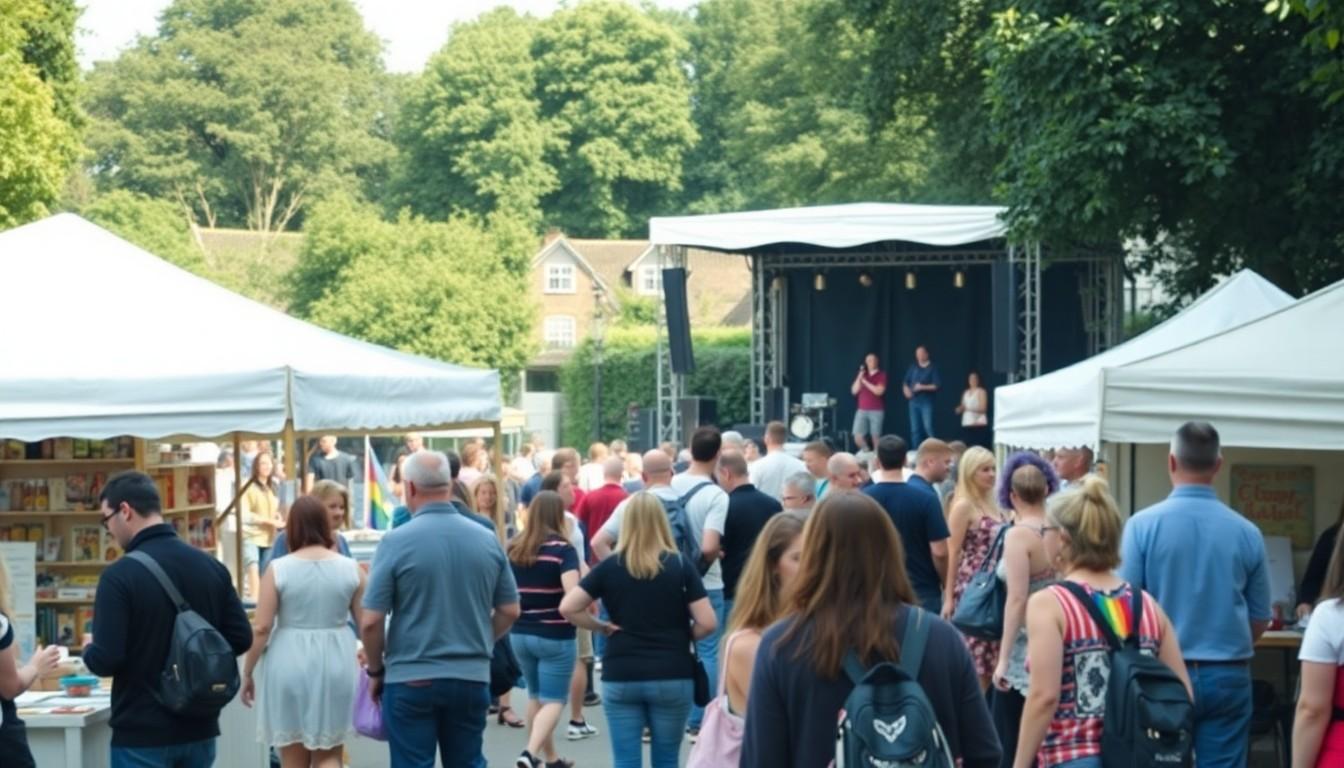
Brighton’s first Dyke Pride brought around 3,000 people to St Ann’s Well Gardens on 5 September, turning a free local gathering into a striking display of queer community, creativity and collective joy. With music, makers, food and drag, the event offered a more grassroots alternative to mainstream Pride.
Essential Takeaways
- Big debut: Around 3,000 people attended Brighton’s first Dyke Pride.
- Free and community-led: The event featured stalls, crafts, games, food and live entertainment.
- A different Pride model: Organisers focused on a welcoming, community-first space rather than a corporate-style celebration.
- Strong historical links: Speakers highlighted the activism of previous generations of dykes and queer communities.
- Support still matters: Donations remain important as the event develops beyond its first year.
Brighton’s first Dyke Pride made a serious entrance
A crowd of roughly 3,000 people filled St Ann’s Well Gardens for Brighton’s first Dyke Pride, creating the sort of warm, noisy, colourful afternoon that makes a park feel like a small city of its own. The free celebration combined music, food, crafts and community stalls, giving visitors plenty to explore between performances.
According to event listings from Outsavvy, the gathering was designed as an inclusive celebration for dykes, queer women and gender-diverse people. That broad welcome helped distinguish it from a traditional festival format, with the emphasis placed firmly on participation rather than simply watching from the sidelines.
The launch had been promoted as a new Brighton queer event before the day itself, with Scene Magazine and Sussex News both highlighting its community focus. A first edition can often feel tentative, but this one arrived with considerable energy and a sizeable audience.
Music, makers and drag gave the day its rhythm
The programme mixed a makers market from Dyke Mart Brighton with arts and crafts, games and food stalls. It was a deliberately hands-on line-up, so the day wasn't only about the stage. Visitors could browse, chat, eat and make things, which is often what turns an event from a spectacle into a genuine social space.
Live entertainment included Wildblood and Queenie, Louise Fidelia, and a drag cabaret hosted by Prince of Persia and Simply the Jest. The combination of DJs, singers and drag performers gave the celebration a lively, slightly anarchic pulse, while the gardens provided a relaxed setting for people to come and go.
G10 Group's coverage also presented Brighton Dyke Pride as a significant new addition to the city's queer cultural calendar. That matters because local events tend to build loyalty in a way that large, one-size-fits-all festivals can't always manage.
Why a community-first Pride feels important
Organisers described the event as an alternative vision of Pride, one rooted in community rather than sponsorship and commercial visibility. That distinction may sound subtle, but it changes the atmosphere: people aren't just consumers in the crowd, they're part of the reason the event exists.
Event details shared by Brighton Dyke Pride and earlier promotional coverage stressed its free, accessible character. Removing a ticket price can make a meaningful difference, particularly for younger attendees, people on tight budgets and anyone who wants to attend without committing to a major festival spend.
The event also carried a strong sense of continuity. Speakers pointed to earlier generations of queer activists, including trans women of colour and those who organised during the HIV and AIDS crisis or challenged Section 28. In other words, the celebration wasn't presented as appearing from nowhere. It was framed as part of a longer, often hard-won story.
A clear message when disruption arrived
A small number of trans-exclusionary protesters attempted to disrupt the event, but reports said they left after the crowd responded with the chant, "LGB WITH THE T!" The moment underlined the organisers' inclusive position and showed how quickly a large gathering can find its collective voice.
That response also reflected the event's wider mood. Brighton Dyke Pride wasn't simply celebrating identity in the abstract; it was making a practical statement about who gets to belong in queer spaces. The contrast between a hostile interruption and a crowd answering together was uncomfortable, but undeniably powerful.
For many attendees, that sense of solidarity may become one of the day's lasting memories. The music and food might draw people in, but belonging is what encourages them to return.
What comes next for Brighton Dyke Pride?
The event's first year has created a strong foundation, but future editions will need continued volunteer effort, fundraising and local support. Crowdfunding information published for Brighton Dyke Pride suggests that donations are part of the project's longer-term sustainability, particularly if organisers want to keep the event free and community-led.
The challenge will be preserving the intimacy and independence that made the launch distinctive as interest grows. More people may mean greater visibility, but it can also bring higher costs, more logistics and pressure to become something slicker and more commercial.
For now, Brighton has shown there is a real appetite for a dedicated dyke celebration that feels welcoming, political and joyful all at once. As one organiser put it in remarks reported by DIVA, joy can feel radical in difficult times. In this setting, it also looked wonderfully practical: people gathered, shared space and refused to be pushed into the background.
It's a memorable first step for a Pride built around community, visibility and joy.
Source Reference Map
Story idea inspired by: [1]
Sources by paragraph:
- Paragraph 1: [2], [3]
- Paragraph 2: [7], [4]
- Paragraph 3: [2], [3]
- Paragraph 4: [7], [5]
- Paragraph 5: [4], [7]
- Paragraph 6: [2], [3]
- Paragraph 7: [6], [7]
- Paragraph 8: [4], [5]
- Paragraph 9: [2], [3]
- Paragraph 10: [7], [6]
- Paragraph 11: [4], [5]
- Paragraph 12: [6], [7]
- Paragraph 13: [6], [3]
- Paragraph 14: [2], [4]
- Paragraph 15: [5], [6]