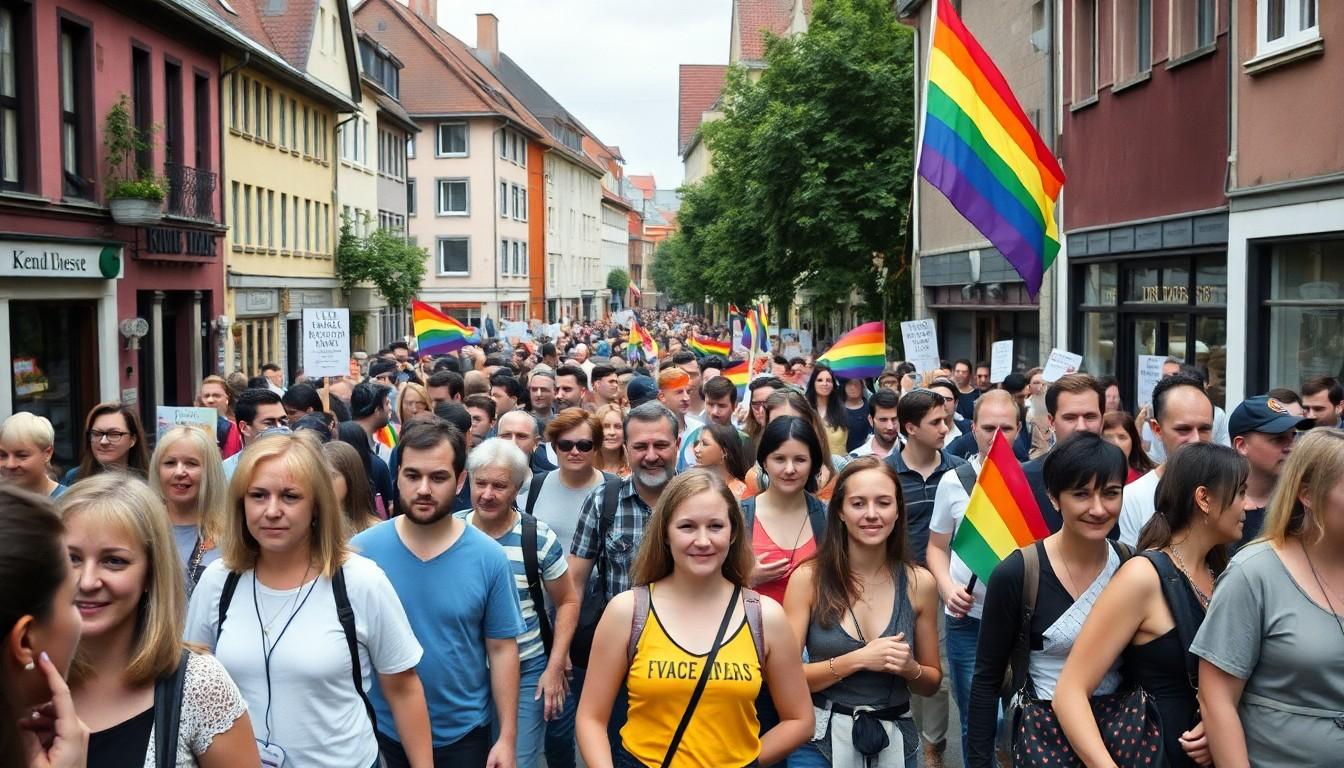
Watching a town bloom in colour: Brühl’s third Christopher Street Day drew about 700 people to the Rathausplatz and the high street, with live music, glittered outfits and a protest march that mattered, because visibility in small towns still changes lives.
Essential Takeaways
- Strong turnout: Around 700 people joined Brühl’s third CSD for a peaceful, celebratory protest and programme.
- Local support: Private citizens, clubs and institutions lined the route and staffed information stalls at the Rathausplatz, friendly, informative and bright.
- Political purpose: Organisers stressed that CSD is a political demonstration for rights and visibility, not just a party.
- Diverse messages: Banners ranged from “Love knows no hate” in Arabic to calls to protect trans youth, giving the event emotional weight.
- Family feel: The atmosphere was described as “picture-perfect” by police, with a mix of theatrical outfits and sober solidarity.
A small town, a big splash of colour
Brühl’s high street was a visual feast: glittered faces, rainbow flags fluttering on the town hall and balloons bobbing above the crowd. The scene looked joyful and theatrical, but organisers were clear this wasn’t just a carnival. According to local reporting, Pride Brühl organised its third Christopher Street Day to combine celebration with a protest-minded march, reminding everyone that visibility still carries political force. If you were there, you’d notice the warmth first, then the messages.
Why community participation mattered
The event felt like a town rallying around its neighbours. Local clubs, arts groups and civic organisations manned stalls to share information about queer services in Brühl and the wider Rhein-Erft-Kreis. That kind of grassroots presence signals more than friendliness: it helps normalise queer life in places outside big cities and gives people practical routes to support and resources. For anyone organising or attending, bringing an information table is one of the most useful ways to turn goodwill into longer-term help.
A protest dressed in sequins
Organisers kept returning to a practical point: CSDs are political demonstrations. Pride Brühl’s leadership and speakers reminded attendees that rights can’t be taken for granted, and that protest remains necessary even when the mood is celebratory. This mirrors wider discussion in Germany and beyond, where large city CSDs often combine parties and policy demands. For visitors, that dual identity is important, enjoy the fun, but also read the banners and listen to the speeches.
Messages that reached beyond the parade
Some banners made local statements, others addressed global concerns: two sisters carried slogans in Arabic reading “Love knows no hate,” while another group placed a stark demand centre stage, protect trans children so they can survive. Those moments turned moments of lighthearted costume into serious civic conversation. If you plan to attend a future CSD, pack both your party shoes and your curiosity, you’ll want to read what people carry and ask why it matters.
What Brühl’s CSD says about the wider movement
Small-town Pride is increasingly visible across Germany, and events like Brühl’s follow the pattern of larger parades in Cologne and Berlin that mix celebration with political armour. According to national coverage, queer visibility has broad reach and can influence local politics and services. For organisers, that means keeping events inclusive, informative and safe. For townsfolk, showing up is a simple, meaningful act of solidarity.
It's a small change that can make every march feel like progress.
Source Reference Map
Story idea inspired by: [1]
Sources by paragraph: