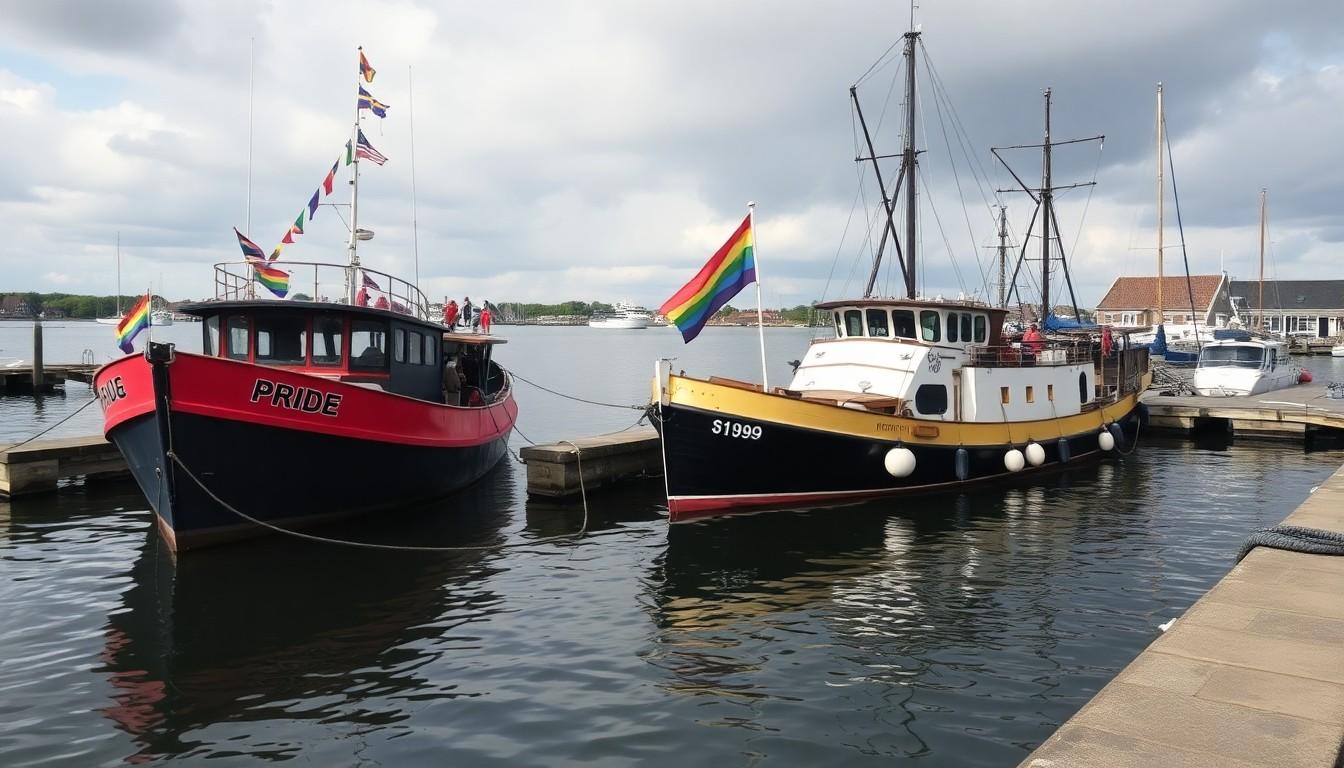
Watchful locals and colourful activists met on a Zierikzee quay this weekend as a pride boat sailed in and out before the traditional Havendagen, showing why visibility and tradition can collide , and why both matter to the town’s sense of identity.
Essential Takeaways
- What happened: A pride boat briefly joined Zierikzee’s Havendagen festivities, then left before the official fishermen’s celebrations began; tensions rose online and locally.
- Two worlds: Fisherfolk saw the Havendagen as a long-standing trade celebration, locals and queer residents saw the appearance as a needed visibility moment.
- Public reaction: Strong feelings on social media ranged from “keep it for the mosselfeest” to calls for recognition and safety for LGBT+ people.
- Emotional tone: The weekend felt odd and unresolved , polite reserves and silence from the fishing community contrasted with determined visibility from the Pride participants.
- Practical note: Small gestures of coexistence , timing, signage, and joint events , could reduce friction and build shared spaces.
A bright boat, a quiet quay: the image that stuck
The clearest image from Zierikzee is almost cinematic , a colourful pride boat slipping out of the harbour before the fishermen’s official program began, bright flags against a grey sky and a town that suddenly felt split. Reporters noted the visual contrast: the town’s hard-working maritime culture and the flamboyant, public-facing pride display. For visitors it was striking; for residents it underlined how different ideas of “public celebration” can meet in the most literal sense.
This episode didn’t erupt into violence, but it did spotlight nerves. Organisers of the Havendagen chose caution, and many fishermen declined to comment, preferring to protect a decades-old tradition rather than debate it on the quay. That silence spoke as loudly as any interview.
Why fishermen felt the Havendagen was “theirs”
The Havendagen have been the fishing community’s party for generations, a chance to show craft, grit, and local produce like fresh mussels to visitors. From that perspective, the sudden arrival of a pride flotilla felt like an unexpected takeover. Industry figures and locals told journalists they feared polarisation and media sensationalism, so the event was managed tightly.
It’s useful to see this as cultural stewardship rather than plain hostility: many in the fleet viewed the day as their moment to celebrate labour and heritage. If you’re choosing how to introduce new elements to a long-running festival, start with dialogue and shared aims rather than an unannounced splash of colour.
Why visibility matters to queer residents
For queer people in smaller towns, visibility isn’t decadence , it’s safety and affirmation. Participants on the pride boat explained that hand-in-hand gestures and bold colours are not meant to antagonise, but to claim a place in public life where invisibility has been the norm. In places where a kiss or a same-sex couple still attracts attention, a public gesture can be a form of protection.
Advocates argued that acceptance doesn’t always arrive quietly; sometimes it needs noise and numbers. That’s a tricky sell in tight-knit communities, but one that helps explain why the pride participants felt compelled to be seen at the Havendagen.
Social media amplified difference , and hardened positions
As soon as footage and commentary circulated online, comment threads swelled. Some readers insisted the Havendagen should remain a “mosselfeest” and criticised the pride presence as “over the top.” Others pointed out that asking for normal treatment while insisting on invisibility is a contradiction. The push-and-pull is familiar from other Dutch and international towns where LGBTQ+ visibility meets local custom.
If organisers want less online flare-ups next time, practical steps can help: clear scheduling, joint messaging from community leaders, and shared events that tie queer visibility into heritage themes rather than presenting them as competing displays.
How to move from parallel ceremonies to shared space
The weekend ended without a neat resolution: both sides made their point, and both retreated into their routines. But readers and some participants offered a constructive note , that giving space to one group needn’t take it from another. Practical ideas include small, respectful collaborations: a staged talk on local LGBT+ history during the Havendagen, a community stall about safety and respect, or timed appearances that let both traditions breathe.
It’s promising to imagine a future Havendagen where a pride boat and a trawler can tie up together, not as a showdown but as an uneasy , then growing , conversation. Real change will take patience, and a few brave conversations over fresh mussels.
It's a small change that can make every quay feel like it has room for everyone.
Source Reference Map
Story idea inspired by: [1]
Sources by paragraph: