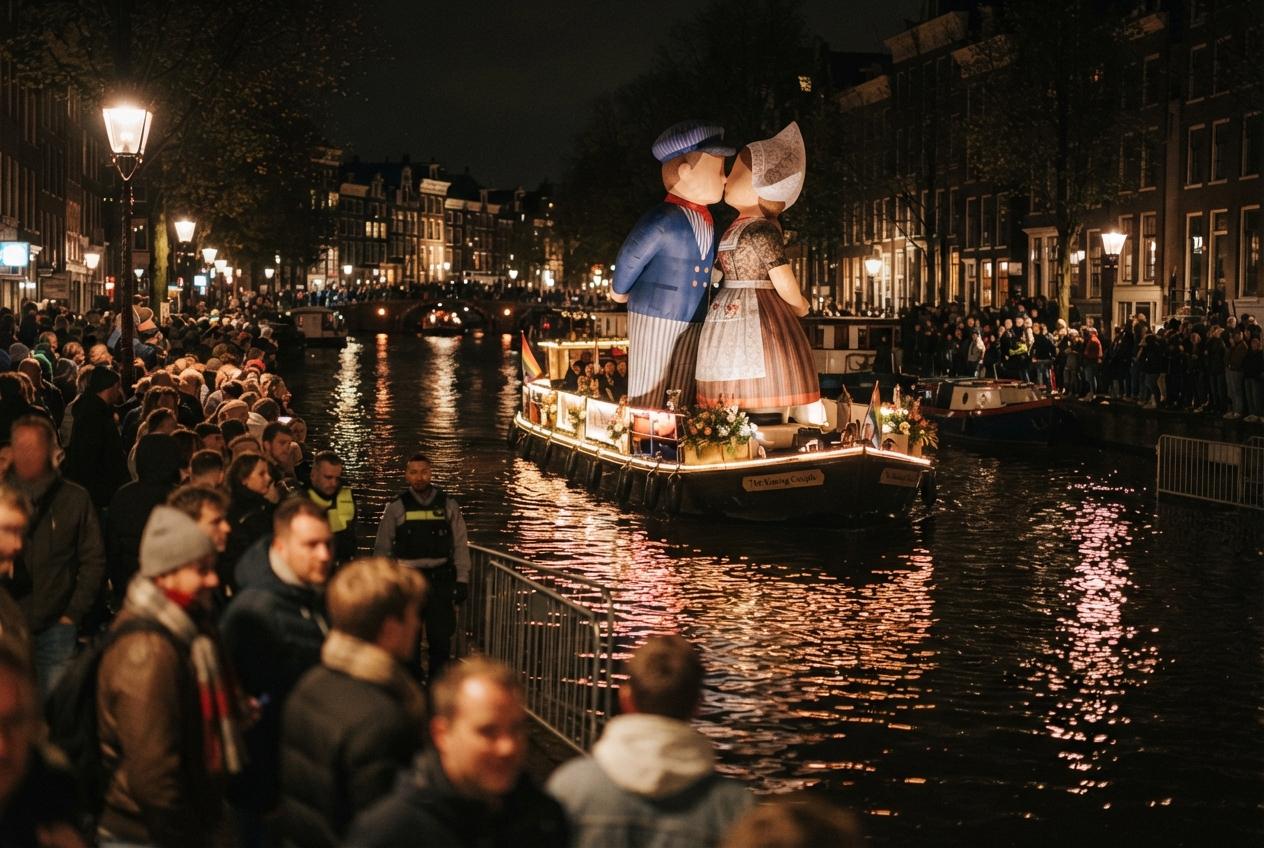
Shoppers and parade-goers couldn't miss a giant, Delft-blue kiss as Amsterdam’s WorldPride Canal Parade turned political and playful, drawing crowds and headlines; organisers say the oversized Trump–Putin float was meant to humanise power while Pride events across Europe tightened security after a recent deadly attack.
Essential Takeaways
- Eye-catching spectacle: A huge inflatable pair styled like Delft porcelain drew loud reactions as they leaned in for a staged kiss on the canals.
- Symbolic styling: The figures held tulips and wore blue-and-white motifs referencing Dutch ceramics, adding a cheeky local nod to the protest.
- Safety on edge: The parade took place amid heightened security after a deadly attack at a Pride event in Berlin days earlier.
- Political context: The installation highlighted tensions around leaders linked to anti-LGBTQ+ policies, prompting debate about protest and provocation.
- Civic participation: Dutch Prime Minister Rob Jetten, an openly gay leader, joined the Canal Parade, underscoring the event’s political resonance.
A float that stopped conversations , and the boats
The Canal Parade is a feast for the senses, but this year one installation made people stop and stare: an enormous kissing couple modelled to resemble Donald Trump and Vladimir Putin, their faces framed by Delft-blue patterns and tulips. Spectators described it as playful and startling at once, the sort of visual that lingers in photos and feeds social chatter.
Organisers say they wanted to “pause power for a moment” rather than simply provoke, and that framing matters. According to Pride Amsterdam’s programme, art and symbolism have long been part of the parade’s language, and this was a theatrical, localised riff that mixed souvenir culture with political theatre.
Why the imagery landed so hard
The choice of Trump and Putin was hardly random. One figure is a recent former US president who courts controversy with grand gestures; the other is a Russian leader whose administration has enacted laws curbing LGBTQ+ rights. Placing them in an affectionate pose forces an uneasy juxtaposition: absurd intimacy against a backdrop of real-world repression.
That tension is why the float became one of the most-talked-about moments from a parade where about 80 decorated boats processed through Amsterdam’s canals. People reacted with laughter, selfies and heated debate, exactly the mix protest art often aims to ignite.
Security tightened after Berlin tragedy
This year’s spectacle came against a sobering backdrop. European Pride events had already been put on alert after a deadly attack targeting a Pride gathering in Berlin left one person dead and dozens injured. News wires reported increased police patrols and visible security at Amsterdam’s canals as the parade went ahead.
Organisers and officials stressed the need to balance celebration with vigilance. That approach was visible on the water: more officers on duty, coordinated monitoring, and a quieter undercurrent of caution even as music and colour dominated the route.
Political participation with a personal touch
Dutch Prime Minister Rob Jetten, who is openly gay, took part in the Canal Parade , a symbolic show of support that drew comment across media. His presence underlined the event’s civic importance: Pride here is not only festivity but a public statement about rights, representation and safety.
Local leaders framed the parade as especially meaningful this year. When politicians join the boats, it changes the tone: it’s celebration with a clear public-policy subtext, a reminder that visibility can be both joyous and political.
How to read protest art at Pride , and what to take away
Public art at Pride often sits on the knife-edge of satire and solidarity. If you’re at an event and spot a provocative float, consider the message, the method, and the audience. Is it sparking conversation, critiquing policy, or simply courting attention? All of the above happened in Amsterdam, and that mix kept the parade lively and talked-about.
For visitors, practical tips matter: expect heavy crowds, look out for increased security, and bring a compact plan for meeting friends if you get separated. And if a float makes you laugh or wince, that reaction is part of the point.
It's a small change in costume or a giant puppet that can make the politics of Pride visible and unforgettable.
Source Reference Map
Story idea inspired by: [1]
Sources by paragraph: