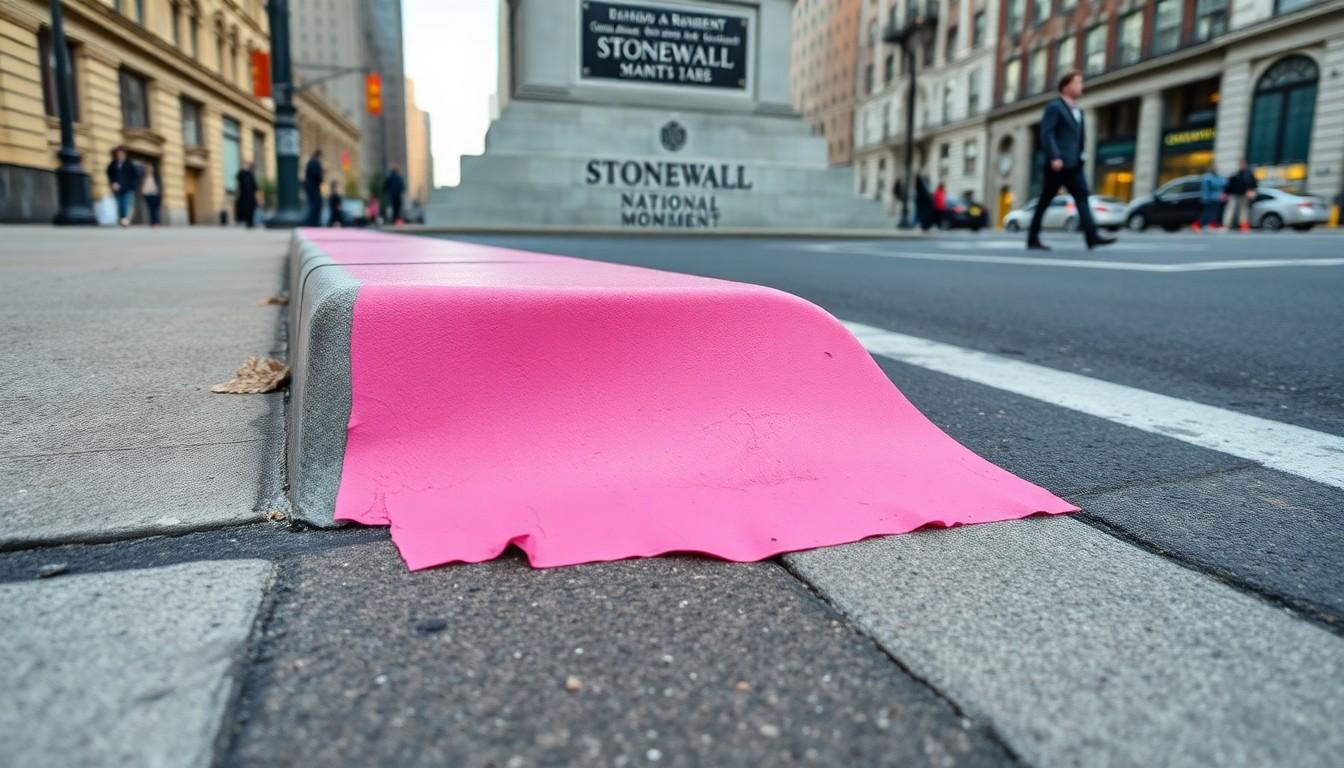
Shoppers and tourists already notice the rainbow flag at Christopher Park, but activists are pushing further , proposing a bright pink curb to form a triangle honouring Marsha P. Johnson, a small public-art move meant to reclaim space, spark conversation, and mark trans history where it happened.
Essential Takeaways
- Bold proposal: A pink curb at Christopher Park would create a visible Marsha P. Johnson Pink Triangle Curb beside the Stonewall National Monument.
- Local control likely: The curb probably falls under New York City agencies, not the National Park Service, so city approval would be required.
- Symbolic resonance: The pink triangle evokes LGBTQ+ history and specifically honours trans activist Marsha P. Johnson.
- Timing challenge: Activists eyed Aug. 24 (Marsha’s birthday) as a target date, but getting community and municipal sign-off in time is unlikely.
- Practical touchpoints: If approved, organisers expect a grassroots rollout , volunteers, paint, and a media push to make it feel celebratory, not guerrilla.
A small pink idea with a loud purpose
Putting a swathe of bright pink along the curb at Christopher Park sounds almost cheeky, but the image lands hard: a triangle pointing towards the Stonewall fence, a visual greeting for anyone arriving at this queer shrine. The proposer wants the end result named the Marsha P. Johnson Pink Triangle Curb , or simply Marsha’s Curb , and argues it would claim more of the park for LGBTQ history and visibility. It’s the kind of tactile, low-tech public art that feels immediate: you see it, you smile, you think.
Who actually owns the curb, and why that matters
The legal detail is the practical sticking point. The Stonewall National Monument itself is federal only within the fenced park, so the surrounding curb is most likely municipal, falling to the New York City Department of Parks & Recreation or the Department of Transportation. That matters because it’s city agencies and local community boards, not the National Park Service, who would sign off , and bureaucratic sign-off takes time. So while the spirit of the idea is simple, the route to making it permanent runs through city procedures.
Why Marsha P. Johnson and the pink triangle?
Marsha P. Johnson is a name that keeps coming up in any conversation about trans and queer resistance in New York. Honouring her on her birthday would add a specifically trans-focused marker at one of the movement’s most photographed sites. The pink triangle is a loaded symbol , reclaimed from darker history to become an emblem of pride and remembrance , and combined with Marsha’s name it would foreground trans experience in a space often read simply as gay and lesbian history. That shift in attention would feel meaningful to many visitors and residents alike.
Timing, tactics and a dash of theatre
The proposer hoped to get the curb painted by Aug. 24, Marsha’s birthday. Realistically, lining up local community boards, the Greenwich Village neighbourhood, city agencies and press takes longer than a few weeks. So the practical play would be to use the date as a launch moment for advocacy: a press conference at the monument, petitions, and a coordinated outreach to the parks or DOT. If approvals come through quickly, volunteers would be ready with brushes and knee pads; if not, the idea still works as a campaign to build momentum for a permanent installation.
How this fits wider moves to honour trans activists
New York has been expanding public recognition for transgender activists in recent years, from smaller plaques to larger monuments that name Marsha P. Johnson and Sylvia Rivera side by side. This curb project fits that trend: low-cost, high-visibility, and ideologically simple. According to local reporting, there’s appetite for more physical markers that celebrate trans leadership, and a painted curb could be an easy-to-understand addition alongside existing memorials and statues.
Practical tips if you want to help or replicate the idea
If you’re an organiser: start with the local community board and photos showing precedent projects. If you’re a neighbour: ask about materials and maintenance so the paint stays bright without damaging infrastructure. And if you’re a visitor: treat any grassroots paint projects with care , they’ll mean more if they’re community-led and sustained rather than a fleeting stunt.
It’s a small, colourful gesture that could nudge a famous corner of the city toward clearer recognition of the people who made the moment possible.
Source Reference Map
Story idea inspired by: [1]
Sources by paragraph: