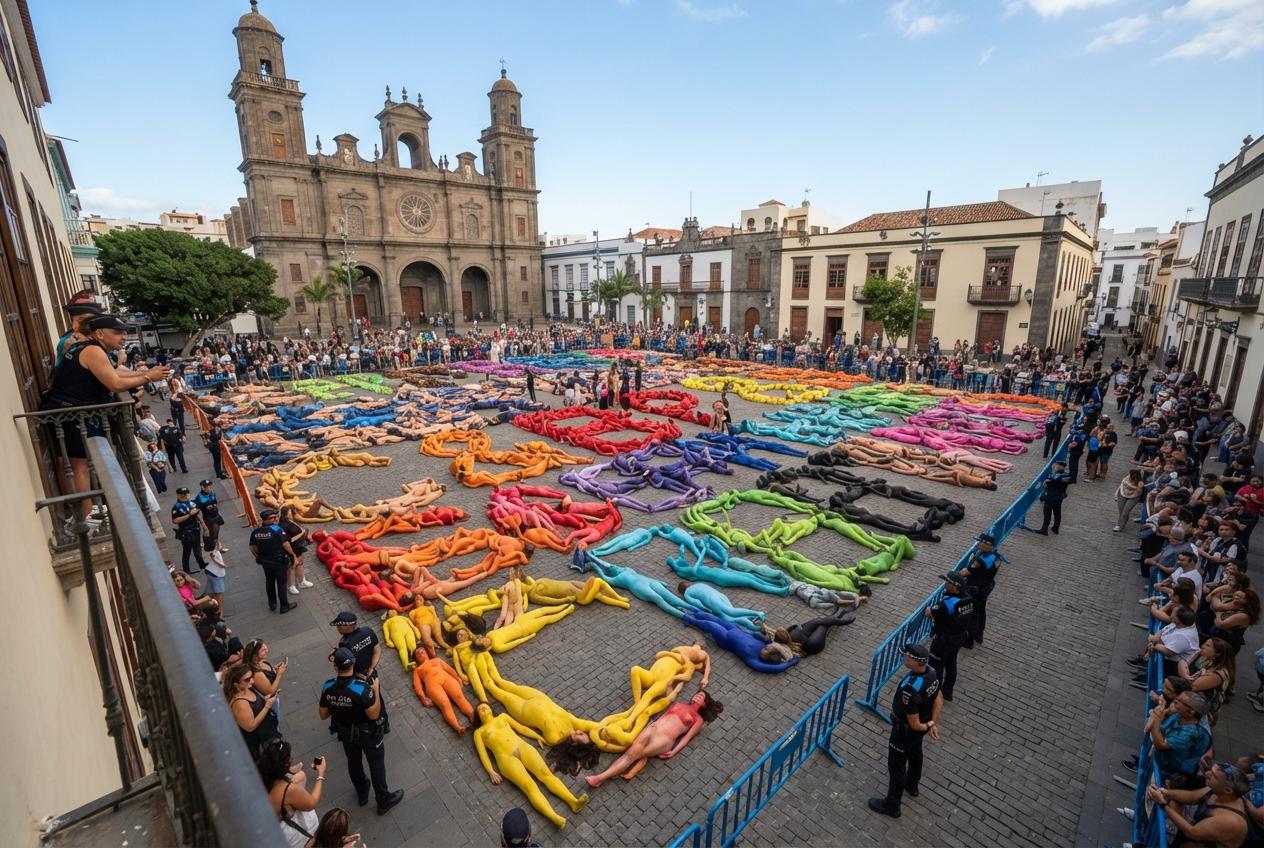
Shoppers and visitors noticed a colourful, human tide in Vegueta as around 500 volunteers stripped down and were painted for Gran Spectrum, Spencer Tunick’s latest installation in Las Palmas de Gran Canaria , a striking, visible defence of LGTBIQ+ diversity staged during Culture & Business Pride 2026.
Essential Takeaways
- Large-scale participation: About 400–500 volunteers from some 23 countries joined the shoot, creating broad visual impact.
- Vivid palette: Bodies were painted in eleven colours inspired by the Progress Pride flag, giving a layered, inclusive look.
- Historic setting: The main images were taken in Plaza de Santa Ana and around Vegueta, framed against the cathedral and Casa de Colón.
- Careful logistics: The production ran overnight into the morning, with roughly 40 crew handling security, paint, and coordination.
- Message-forward art: Tunick framed the work as both celebration and political statement in defence of LGTBIQ+ rights.
A dawn spectacle that felt alive and defiant
Tunick’s team began before sunrise, and the scene had that quiet, anticipatory hum that makes public art feel cinematic. Participants were organised by colour, painted, and moved into formations while the artist directed from a municipal terrace. According to RTVE and EFE, the main session lasted more than two hours and then spilled into adjacent historic streets for more compositions. The result reads both as a joyful celebration and a deliberate act of visibility.
Why the Progress Pride palette matters here
The eleven-colour scheme used for Gran Spectrum riffs on the Progress Pride flag to represent a wider set of identities and histories. That expanded rainbow made the piece feel deliberately inclusive, not just decorative. News outlets such as La Vanguardia and Cadena 3 noted how the chromatic bands became visual metaphors for solidarity , a practical reminder that choices in colour can carry political and cultural weight.
Setting a human composition against religious architecture
Staging naked, painted bodies in front of Las Palmas’ cathedral and around Casa de Colón added a striking contrast between flesh and stone. Organisers coordinated entry to the cathedral so religious services could proceed, and police managed cordons without incidents, EFE reported. That courteous coexistence turned the city’s most recognisable square into a temporary forum for debate about public space, representation and respect.
How Tunick’s long career informs this gesture
Spencer Tunick has been making mass nude photographs since the 1990s, scaling up from small gatherings to events like Mexico City’s 2007 Zócalo shoot with thousands of participants. Coverage from El Espectador and RTVE places Gran Spectrum in that lineage: part performance, part sculpture, and part civic provocation. For locals and visitors who’ve seen his work before, this felt familiar , but the political climate around LGTBIQ+ rights gives the piece sharper urgency now.
Practical takeaways for would-be participants or viewers
If you’re considering joining a Tunick shoot, expect early starts, organised paint stations and clear choreography , production teams of around 40 handled logistics here. Dress for the waiting, bring water, and be ready for the emotional lift of participating in something that’s equal parts art and community statement. For onlookers, arrive with time to explore Vegueta’s architecture; the interplay between bodies and buildings is the point.
It's a small change in a city’s morning routine that can make public support for diversity visible and hard to ignore.
Source Reference Map
Story idea inspired by: [1]
Sources by paragraph: