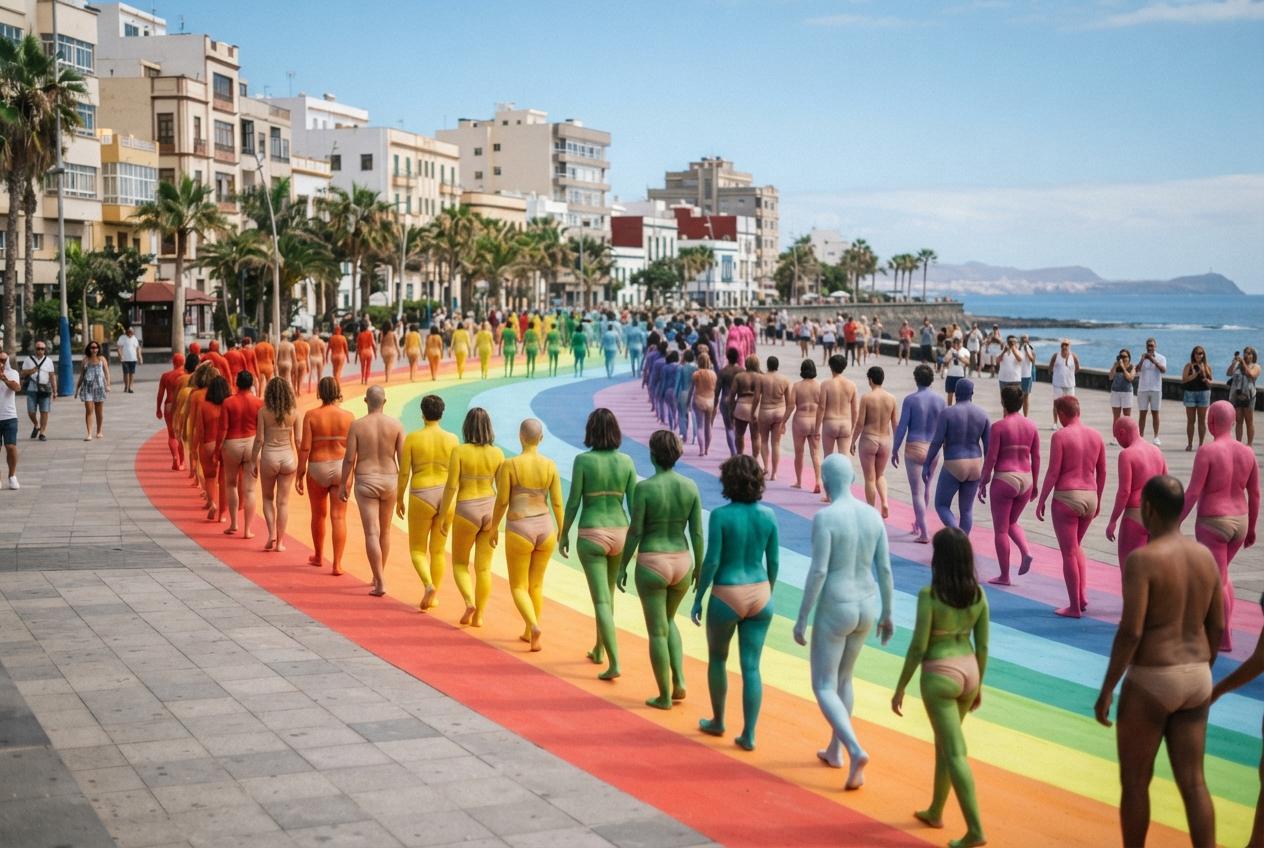
Shoppers and onlookers paused as hundreds of people, painted in vivid hues, gathered in Las Palmas to create Spencer Tunick’s Gran Spectrum, an enormous, living rainbow that turned bare skin into a public statement of LGBTQ+ visibility and communal pride. The colourful installation mattered because it made belonging visible, right in the city’s heart.
Essential Takeaways
- Mass participation: Hundreds registered online to join the Gran Spectrum installation in Las Palmas, open to all genders, races and backgrounds.
- Eleven colours: Tunick used eleven different bodypaint shades to build a large-scale rainbow composition, producing a vivid, tactile spectacle.
- Message of visibility: The piece highlights LGBTQ+ rights and community presence amid ongoing political debates about identity.
- Practical staging: Participants were organised on Gran Canaria’s main square, standing or lying to form the pattern; the work mixes performance, public art and photography.
- Artist context: Spencer Tunick has a decade-long history with bodypainting and large nude collectives; this project pushes that approach further with a marked emphasis on spectrum and inclusion.
A vivid city-centre tableau you couldn’t ignore
Tunick’s newest project looked like paint spilled across a plaza, only this paint breathed. According to reports, hundreds answered an open call and, after being coated in colour, stood or lay down on Gran Canaria’s main square to build the rainbow. The visual was bold and immediate; from a few metres away you could make out the palette and, from above, the composition snapped into place. It’s the sort of artwork that stops people walking by and forces a double-take.
The artist told Metal Magazine that while he’s worked with bodypaint for years, this was the first time he’d used such a wide range of hues. And that matters: the extra colours give the piece a textured, almost painterly feel, rather than a flat stripe. For viewers, the effect is both beautiful and slightly vulnerable, which is the point , visibility as a physical experience.
Why the rainbow still matters now
Tunick framed Gran Spectrum as more than a celebratory image; it’s a statement about belonging at a time when LGBTQ+ rights remain contested around the world. Project pages describe the work as transforming participation into a “powerful act of visibility,” and news outlets note the timing alongside Culture and Business Pride 2026. Public art like this converts private identity into a shared civic moment, and that often shifts conversations in small but important ways.
Artists and activists alike have used collective nudity to call out exclusion before, but packing it into a rainbow composition brings explicit symbolic weight. It’s also inclusive by design: anyone could register and be part of the image, which flips the idea of a spectator into that of a participant.
The logistics behind a colourful crowd
Pulling off a mass nude shoot is surprisingly logistical. Organisers took online registrations and coordinated paint stations so people could be coloured in eleven distinct shades. Participants were arranged precisely across the square to build the image, with some standing and others reclining to modulate texture and shadow. It’s a choreography as much as a photoshoot.
If you’re curious about how to take part in similar events, look out for clear registration rules, arrival windows, and what to bring , a towel, water and consent forms are common. Tunick’s team also tends to make safety and dignity a priority, so marshals and assistants are usually on hand to guide people.
How this fits into Tunick’s career and public art trends
Spencer Tunick has long been associated with large-scale nude gatherings that turn human bodies into topographical statements. This iteration leans into bodypainting and spectrum language, reflecting a contemporary push in public art toward inclusivity and activist messaging. Media coverage in Spain and international outlets placed Gran Spectrum as both a cultural event and a protest of sorts , gentle, visual, but unmistakably political.
Looking ahead, projects like this point to a trend: public art that invites rather than instructs, and that foregrounds participation as the medium. It’s art you enter, not just view, and that can be quietly powerful.
What viewers and participants took away
People who watched said the scene felt joyful and oddly tender, while participants described an emotion that mixed pride and exposure. For onlookers it was a colourful interruption to everyday life; for those painted in layers of colour it was a shared statement of presence. The work doesn’t solve political fights, but it makes a claim that identity exists in public space, visibly and collectively.
If you missed this one, watch for future Tunick calls or local Pride events where similar collective pieces are staged , they tend to get announced through cultural programmes and the artist’s channels.
It's a small change in routine that makes being seen feel like celebration.
Source Reference Map
Story idea inspired by: [1]
Sources by paragraph: