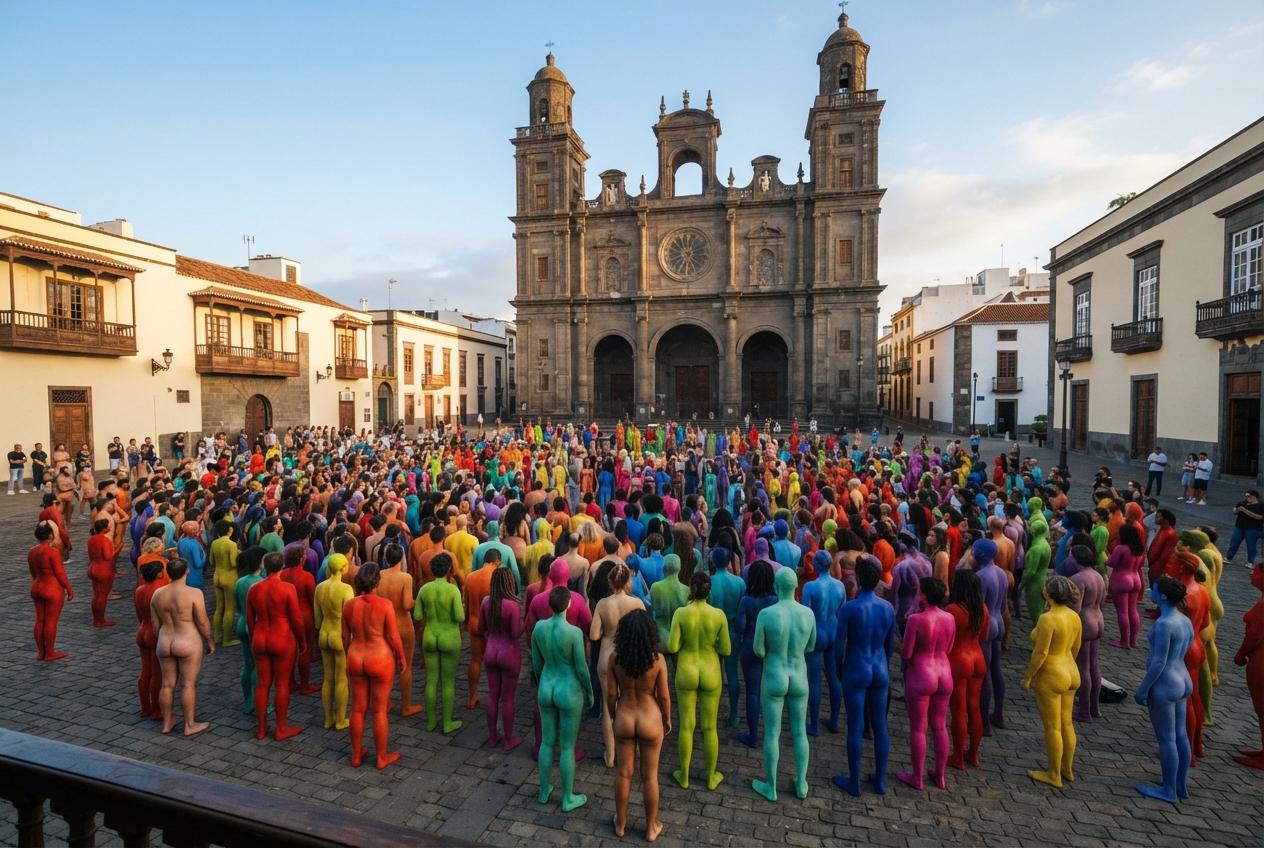
Shoppers are turning heads: photographer Spencer Tunick staged Gran Spectrum in Las Palmas, using painted nude volunteers to mark Pride and spark conversation about inclusion, identity and public space in Gran Canaria. The early-morning action drew hundreds, looked vivid against the cathedral, and travelled the long tradition of Tunick’s mass nudity into a rainbow-rich moment.
Essential Takeaways
- What happened: A one-day collective art action called Gran Spectrum saw roughly 400–500 volunteers pose nude in Las Palmas, their bodies painted in 11 colours drawn from Pride symbolism.
- Where and when: The performance took place at dawn in Vegueta, in front of the Catedral de Santa Ana, creating a striking contrast of historic stone and painted skin.
- Visual detail: Participants were not simply in traditional rainbow order; the palette included white, pink, black and brown alongside the classic rainbow hues for broader representation.
- Atmosphere: The event was closed to spectators, with only Tunick and his production team on site, producing quiet, staged images rather than a public spectacle.
- Local response: Religious and civic reactions were muted; the local bishop reportedly expressed no objection, framing nudity as an ordinary sight at the beach.
Tunick’s newest large-scale nude is vivid, deliberate, and public‑minded
Tunick has long made a career out of transforming urban and natural landmarks with naked bodies; this time he painted them, turning flesh into a living Pride flag. The morning light on the cathedral’s square gave the painted figures a soft, almost ritual feel, a contrast that’s both visual and emotional. According to local reporting, the choice to include pink, black and brown alongside the rainbow was a conscious nod to wider inclusion in the LGBT+ community.
The project sits within a lineage of Tunick’s gatherings, from New York to Mexico City, where he once photographed 18,000 people in the Zócalo. But Gran Spectrum narrows the focus: fewer participants, a more explicit political and symbolic palette, and a clear link to Pride programming in the islands. If you’ve seen Tunick’s earlier monochrome groups, this feels like an evolution , bolder in colour, and more pointed in message.
Why paint the bodies? It’s about identity, representation, and visibility
Painting rather than leaving bodies bare shifts the conversation from nudity alone to what the bodies represent. News coverage emphasised that the colours weren’t decorative only; they were deliberate choices to represent diverse identities within the queer community. That makes the photographs function as both spectacle and statement.
For viewers and participants alike, painted skin carries a tactile immediacy , you imagine the brushwork, the coolness of paint at dawn. Practically, organisers chose a limited palette and a controlled location to keep the action safe, respectful and easy to document. If you’re thinking about staging or joining an action like this, consider clothing options for arrival and departure and confirm whether paint used is skin-safe and easily removable.
Local setting adds texture: historic cathedral meets modern protest
Placing the action in Vegueta, directly in front of the 16th‑century Santa Ana Cathedral, gave the images extra tension. On paper it’s a provocative pairing: centuries-old religious architecture and freshly painted, unclothed bodies. In practice, organisers kept the scene intimate , no public audience, only Tunick’s team , which shifted the tone from confrontation to creative expression.
Local voices matter in moments like this. Reports note that Bishop José Mazuelos said he wasn’t offended, pointing out that people see naked bodies at the beach. That kind of pragmatic reaction is telling: it suggests the action landed as an artistic contribution to a Pride programme rather than a culture-war provocation, at least in this community.
How this fits Tunick’s career , and what’s different now
Tunick has choreographed more than 100 mass nude photo shoots globally, and the scale of his projects varies dramatically. Gran Spectrum is modest next to his biggest works, but its message is compact and clear. Media outlets framed it as an international symbol of freedom and LGBTIQA+ rights, and the project forms part of Culture & Business Pride 2026 programming on the islands.
Where earlier Tunick works sometimes foregrounded pattern and human form in anonymous monochrome waves, Gran Spectrum foregrounds politics and identity through colour. Expect these images to circulate in press and social channels as a contemporary take on a long-standing practice.
Practical takeaways for readers who want to engage or attend similar events
If you’d like to participate in or photograph community art actions, plan for early starts and practicalities: wear cover-up clothes to the site, check paint safety and removal instructions, and confirm whether the event is closed to the public. For photographers, respect the artist’s direction and participant consent; Tunick’s shoots are choreographed and controlled, not free-for-alls.
For locals and visitors, the action demonstrates how public space can host quiet, meaningful expression. It’s a reminder that art can be both beautiful and civic , and that sometimes a simple colour choice changes the conversation.
It's a small change that makes every colour , and every body , part of the story.
Source Reference Map
Story idea inspired by: [1]
Sources by paragraph: