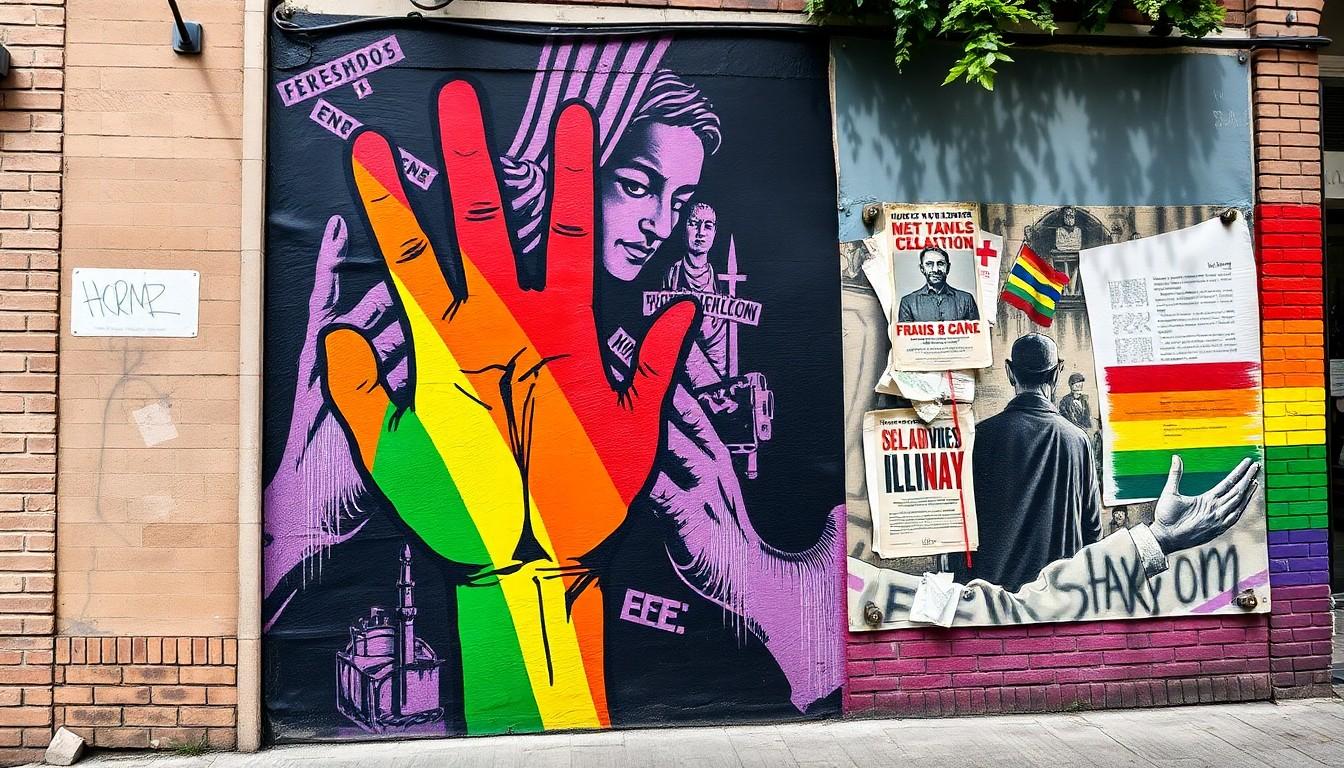
Shoppers and night-strollers are encountering new, conversation-starting street art in Milan’s Gay Street, where a striking mural by aleXsandro Palombo confronts the fallout of the Berlin Pride attack and asks whether democracies can defend hard-won freedoms in the face of rising extremism. It’s timely, vivid and designed to provoke.
Essential Takeaways
- Bold mural by aleXsandro Palombo appeared on via Lecco, Milan’s historic Gay Street, after the Berlin Pride attack.
- Visual impact: a hand grips a Pride flag as rainbow colours fade into an Islamist extremist emblem, creating a stark, unsettling image.
- Paired artwork: nearby piece, originally vandalised at Rome Pride, depicts Audrey Hepburn on a Vespa beside an armed militant, amplifying the message.
- Core question: the works urge debate about solidarity with Palestine versus the risk of normalising or excusing extremist violence.
- Practical note: public art like this sparks dialogue but can also attract vandalism or heated public responses.
A mural that hits you in the chest
The new work by Palombo doesn’t whisper; it grabs you. The rainbow, usually a soft, hopeful spectrum, visually erodes into a black emblem that signals religious-fundamentalist violence, and the effect is chilling. According to local accounts, it was installed in via Lecco, the artery of Milan’s Gay Street, a place where LGBTQ+ life has long been visible and vibrant. The piece reads like an urgent postcard from a community on edge, and people walking by have reacted with surprise and, in some cases, anger.
Palombo’s team says the work was created in the wake of the attack at Berlin Pride and is meant to force reflection. This isn’t just art for galleries; it’s designed as a civic alarm bell, reminding passers-by that rights can feel fragile. If you visit, expect a loud visual and an emotional tug, this isn’t intended to be decorative.
Two murals, one stark conversation
Placed beside Palombo’s latest is another controversial image that had already sparked debate after being vandalised at Rome Pride. That painting shows Audrey Hepburn on a Vespa next to a militant, a juxtaposition that many found jarring. Side by side in Milan, the two pieces create a dialogue about image, memory and political ambiguity, how pop culture, innocence and violence can be braided together in public discourse.
This pairing sharpens the original message: democratic freedoms and LGBTQ+ rights are contested terrain. Street artists have long used such contrasts to wake people up, and here the tactic is unmistakable. If you’re comparing murals across the city, these two are among the most provocative right now.
Why the timing matters: solidarity, nuance and the risk of erasure
Palombo’s note accompanying the mural highlights a thorny debate that’s been simmering in Europe: after the 7 October events, expressions of solidarity with Palestinians sometimes blurred into an indistinct response that didn’t always condemn radical groups. The mural asks whether solidarity can slip into silence about violence, and whether that silence undermines democratic values and minority protections.
This is a sensitive knot. Public reaction has split between those who praise the artist for defending hard-won rights and those who see the works as politically loaded or inflammatory. For anyone trying to make sense of modern civic debate, the mural is a visual shorthand for how complex and emotionally charged these conversations have become.
What this means for communities and public space
Art in the street is loud on purpose; it stirs debate, provokes, comforts and sometimes offends. For Milan’s LGBTQ+ quarter, the mural functions as both a memorial of vulnerability and a rallying cry. Community leaders and passers-by have described feelings ranging from validation to alarm, and that mixed response is part of the point, art that asks questions rarely hands out answers.
If you’re a resident or visitor, be prepared for strong reactions and, potentially, heavy policing or counter-demonstrations when topics like this are on display. Practical tip: photograph responsibly, be mindful of crowds, and remember that murals like this are meant to be engaged with, not just consumed as background.
Looking ahead: public art as civic thermometer
Street art has become a quick-reading thermometer of public sentiment. According to coverage of similar works and controversies, artists often push boundaries to force societies to talk about uncomfortable truths. Palombo’s intervention follows that tradition, and whether you agree with its framing or not, it’s likely to keep the debate alive.
Art won’t solve geopolitical conflicts, but it can sharpen local conversations about identity, safety and the lines between solidarity and complicity. Expect more pieces like this in urban centres where politics and public life collide.
It's a small change to the cityscape that insists we keep talking about what we've won, and what we might lose.
Source Reference Map
Story idea inspired by: [1]
Sources by paragraph: