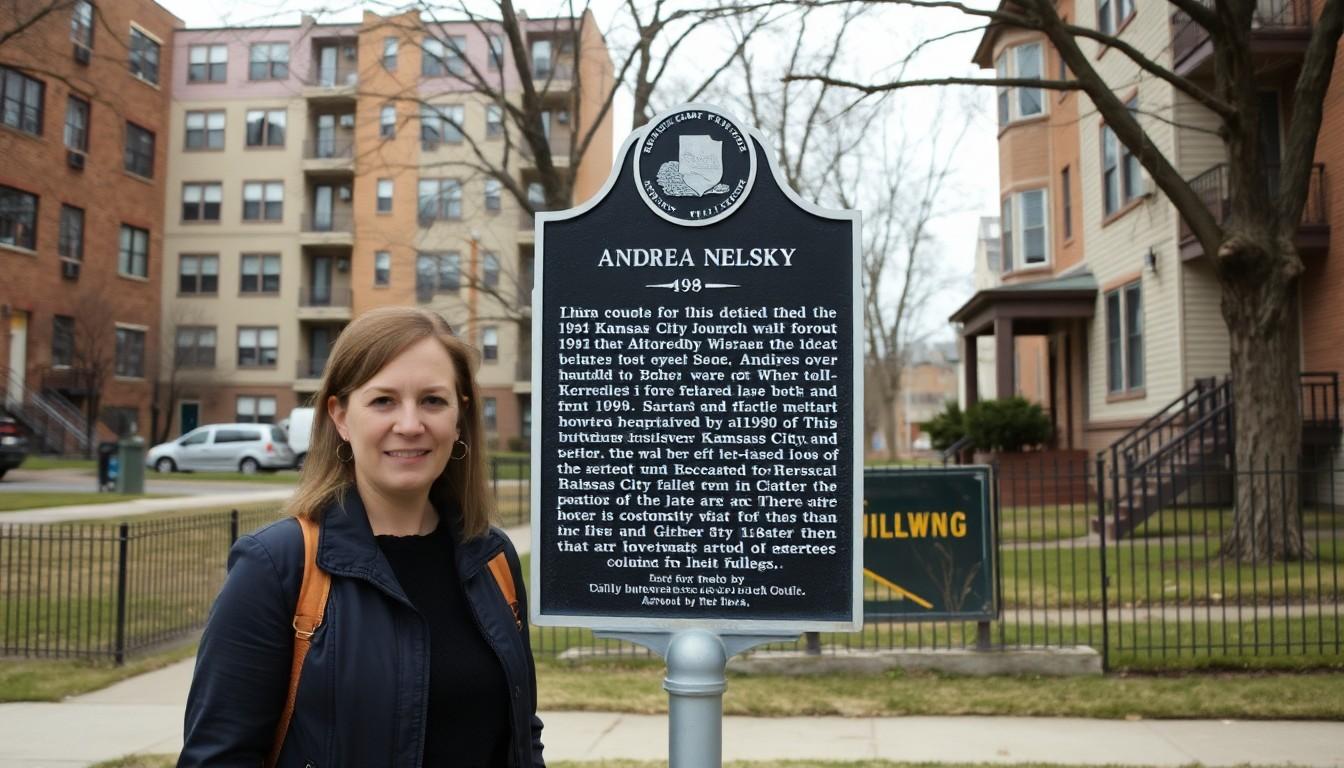
Shoppers of history are stopping to read a modest plaque in Kansas City that points to a bold experiment in community-building; Womontown, started in the 1990s by queer women, became a rare place where ownership, safety and independence were baked into daily life, and its lessons still matter.
Essential Takeaways
- Founding spirit: Womontown was created by Andrea Nedelsky and Mary Ann Hopper as an intentional women-led neighbourhood offering autonomy and safety.
- Scale and feel: At its height, roughly 80 women owned homes across 28 houses and 14 apartment buildings, giving the area a tight, neighbourly atmosphere.
- Practical advantage: Cheaper, “undesirable” real estate made homeownership economically possible, helping residents build financial stability.
- Lasting resonance: Though the organised community faded, older residents remain and a commemorative marker honours the neighbourhood’s model.
- Model for today: Womontown illustrates how place-making, shared values and housing access intersect to create durable queer spaces.
A plaque with a story , and a smell of summer porches
Walk past that little historical marker and you’ll find more than a label; you’ll find the echo of laughter on porches and the practical thrum of people making homes. According to reporting in Rewire News Group, Womontown wasn’t a typo but a deliberate name, signalling an intention to exist beyond patriarchal norms. Neighbourhoods rarely get to write their own rules, and here women did just that, turning cheap, overlooked property into a sanctuary that smelled of cut grass and coffee on slow Sunday mornings.
The backstory is almost cinematic: a couple buys in, word gets out, and women relocate from across the country. That pattern matters because it shows how place can be engineered as refuge and project, not merely accident. House by house, a community built both affection and economic leverage.
Why “undesirable” lots became opportunity
What reads oddly on paper, buying into a part of town the market had passed by, suddenly looks like smart strategy in practice. Realtors and city planners often dismiss certain blocks; for Womontown residents, those same blocks lowered the barrier to ownership. The result was a rare combination: social safety and financial independence, something queer women in the 1990s struggled to secure elsewhere.
That practical insight still matters for activists and planners. If you’re thinking about community-led housing today, affordability and the willingness to buy less-polished stock can be a route to permanence. It’s not glamorous, but it works.
How intentional communities grow , and why they fade
Communities that form around an explicit mission tend to ride waves of enthusiasm, migration and demographic change. Womontown swelled as women moved from across the United States to join; it later softened into a looser cluster as organising energy waned. This arc is familiar: founding vision creates a dense social fabric, which then relaxes as residents age, move or accept different priorities.
That lifecycle doesn’t negate the neighbourhood’s impact. As KC Public Radio and local documentaries have shown, the stories and care networks built there persist in people’s memories and in pockets of ongoing activism. For planners, the lesson is to design institutions that can outlast the initial organising moment, shared trusts, cooperative ownership, legal protections.
Everyday life: community, care and quiet resistance
Living in Womontown meant more than policy or property; it meant easy meals swapped between neighbours, visible and public partnerships, and a comfort that comes from being known. That safety was itself a form of quiet resistance in a time when public spaces often felt hostile to queer people.
Documentaries and oral histories recorded by local outlets capture those small, fierce scenes: celebrations on stoops, collective repairs to houses, and the practical work of making utilities and mortgages add up. Those details are what make Womontown feel alive rather than merely historical.
What Womontown teaches us now about building queer spaces
The plaque says Womontown “serves as a model” for future development, and it’s good to take that seriously. The model is simple: combine affordable housing, shared social infrastructure and explicit inclusion. Today’s activists can borrow tactics, group buys, land trusts, co-op models, while updating them for modern legal and financial contexts.
If you’re involved in community-building, start small: map interested neighbours, scout undervalued parcels, and consider hybrid ownership structures that protect legacy residents. The aim isn’t to recreate the past exactly, but to adapt its spirit of care and mutual aid.
It's a small change that can make every neighbourhood more welcoming.
Source Reference Map
Story idea inspired by: [1]
Sources by paragraph: