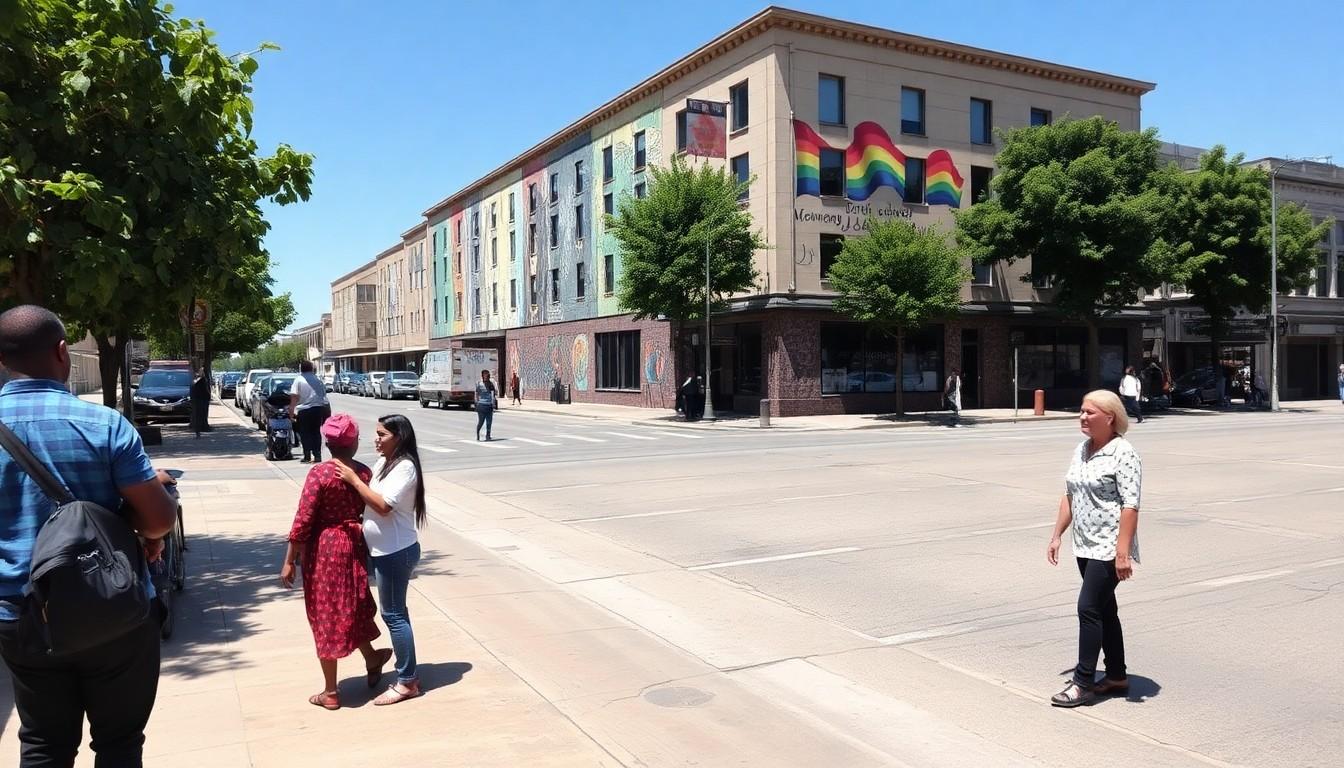
Shoppers and commuters are pausing to admire a bold new mural on Nelson Mandela Avenue in Windhoek, where artists and activists teamed up to declare that liberty belongs to everyone , a colourful, public reminder that visibility matters in a place where queer symbols remain rare.
Essential Takeaways
- Bold location: The mural sits on one of Windhoek’s busiest roads, making it highly visible to drivers and pedestrians.
- Inclusive message: It features the phrase “hold high the banners of liberty” with rainbow flags, inviting viewers to recognise LGBTQI+ Namibians.
- Community-made: Produced by Sister Namibia, ENK Public Art and local artists, the piece reflects broad collaboration and public participation.
- Interactive element: Blank banners on the mural were filled in by guests at the unveiling, giving people a chance to leave messages.
- Symbolic impact: In a region where public LGBTQI+ symbols are uncommon, the mural acts as both art and civic statement.
A mural that stops you in your tracks
The first thing you notice is the colour , bright flags and a crowd of figures against Windhoek’s everyday grey, a visual jolt that feels deliberately warm and inclusive. According to reporting from local outlets, Sister Namibia and ENK Public Art presented the piece on Nelson Mandela Avenue just as Pride Month wrapped up, transforming a routine commute into a moment of recognition and reflection. For passers-by, it’s the kind of public art that makes you slow down and look; for the queer community, it’s a rare public nod of belonging.
Why the message matters now
The mural borrows a line from the national anthem , “hold high the banners of liberty” , and repurposes it as an invitation rather than a declaration for a few. Project coordinator Ndapwa Alweendo told guests at the unveiling that public spaces tell stories about who belongs and who’s seen, a point that hits home in Namibia where visible queer symbols are still sparse. This artwork is designed to counter a lifetime of being told to be smaller, quieter and less visible.
Collaboration turned public pledge
This wasn’t the work of one hand or one group. Veteran artist Nicky Marais, muralist Taanyanda Matheus and assistants from Ombi Art joined ENK Public Art, Equal Namibia and Namibia Pride Week among others to make it happen. The result reads as a community statement: organisers invited attendees to write on blank banners within the mural, literally giving the public authorship. It’s a useful model for anyone looking to back similar public projects , pool artistic talent, local organisations and civic funding to amplify reach.
How this fits regional trends
Activists at the event framed the mural as both local celebration and regional counterpoint. Speakers referenced tense developments elsewhere in Africa and argued Namibia can be a beacon by protecting assembly and expression. The mural follows other grassroots visual efforts in the country , from rainbow sidewalks to flag-raising initiatives , that quietly reshape the public landscape and signal safety to queer people and allies. If you’re watching the wider picture, these symbolic acts often precede policy debates and civic shifts.
Practical points for supporters and artists
If you want to replicate or support similar projects, start small and think about location: high-footfall routes mean the artwork reaches more people. Partner with civil society groups for legitimacy and broader engagement, and include interactive elements so the community can claim the work. Donations and in-kind support are often the lifeblood of these efforts, so local patrons and foundations make a real difference. Finally, expect both praise and pushback , public art that changes narratives is rarely neutral.
It’s a small change to the city’s skyline, but a loud one for the people it names and welcomes.
Source Reference Map
Story idea inspired by: [1]
Sources by paragraph: