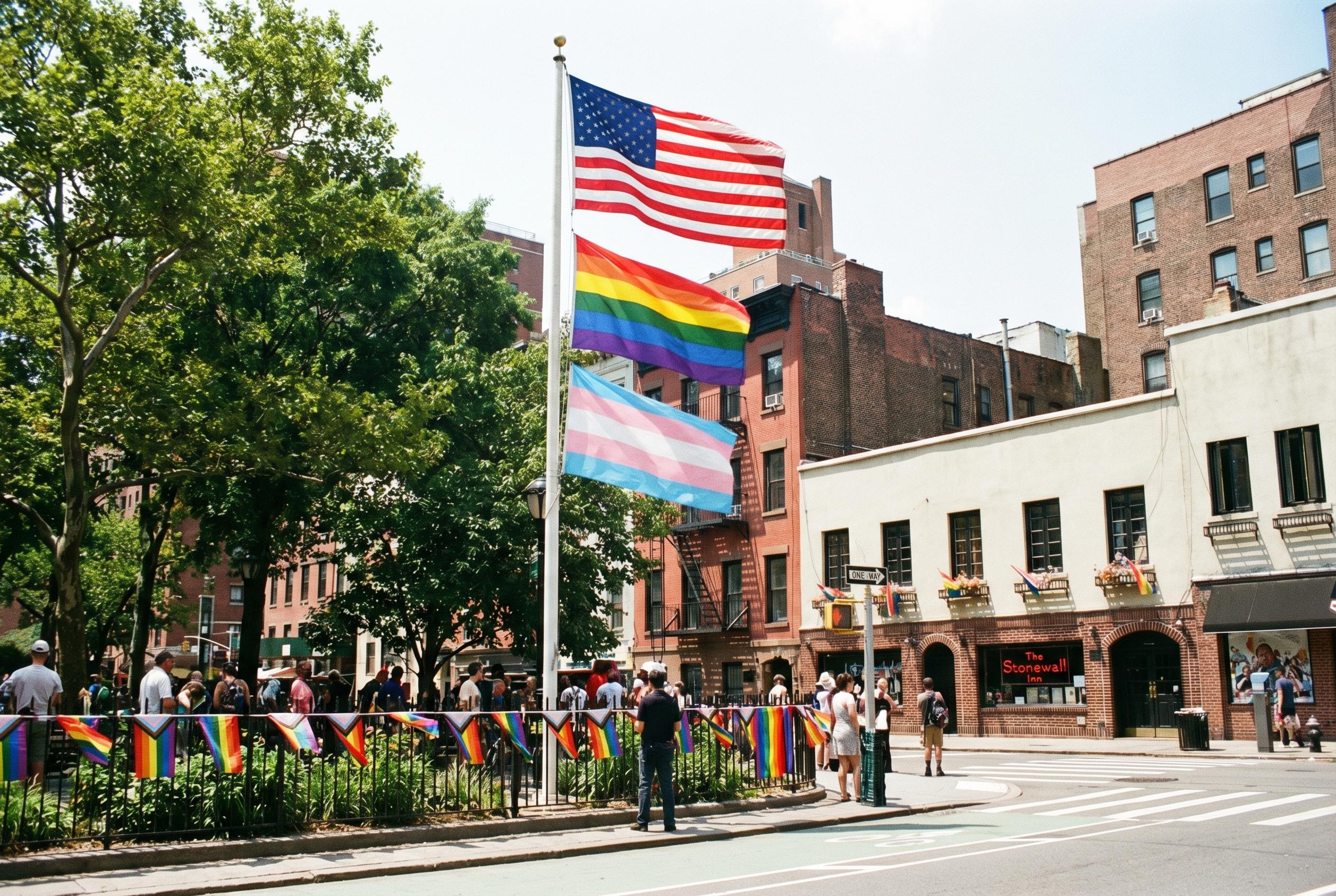
Celebrate: activists won a court settlement that forces the Trump administration to reinstall the Pride flag at Stonewall National Monument in Greenwich Village, a symbolic reversal that matters to residents, visitors, and anyone who cares about memorialising LGBTQ+ history.
Essential Takeaways
- Court settlement confirmed: The federal government agreed to reinstall three flags on Stonewall’s flagpole within a week.
- Legal basis: Plaintiffs argued the Pride flag qualifies as “historical context” under National Park Service rules.
- Community action mattered: New Yorkers re-raised the flag publicly after its February removal, keeping the symbol visible.
- Wider pattern: Removal followed broader federal moves last year to strip LGBTQ+ language and revised flag rules.
- Practical note: The flag’s return is permanent for now, but advocates are pursuing congressional fixes to protect future displays.
A clear win: the Pride flag is back after a legal challenge
The starkest fact is simple and visual: the Pride flag will again fly at Stonewall’s flagpole after a federal settlement, restoring a bright, familiar banner to Christopher Park. According to the Associated Press, the government agreed to reinstall three flags within a week, ending weeks of uncertainty and an unofficial re-raising by city officials and activists. For many locals the sight of the colours is both comforting and energising , a tiny, fluttering reminder that public memory can be defended. Legal pressure, community protest and municipal muscle combined to make it happen.
How the lawsuit framed the flag as history, not politics
Plaintiffs argued the flag’s removal violated an NPS policy that allows non-agency flags when they provide historical context, and they convinced a court to settle rather than prolong a fight. The suit was led by nonprofits including a foundation honouring Gilbert Baker, the flag’s creator, which framed the banner as an artefact of civil-rights history, not partisan signalling. The case shows how legal strategy can reframe cultural symbols as protected heritage , a useful playbook for other groups trying to shield contested monuments or displays.
The community reaction: rallies, re-raisings and elected officials
New Yorkers didn’t wait passively. City leaders and hundreds of residents re-raised the Pride flag days after it was taken down, and local officials celebrated the settlement as proof of civic resolve. Manhattan Borough President Brad Hoylman-Sigal and Mayor Zohran Mamdani publicly hailed the outcome, arguing that grassroots action and public pressure mattered as much as the legal filing. It’s a reminder that when a symbol is removed, communities often respond with ceremonies and collective memory work that make the issue louder and harder to ignore.
Context: part of a broader rollback of LGBTQ+ references
The flag episode sits inside a bigger federal pattern: last year the National Park Service removed transgender and other LGBTQ+ references from Stonewall’s webpage, and the administration narrowed which flags could fly on federal land. Those actions fed the lawsuit’s urgency and coloured public perception, turning what might have been a technical policy spat into a broader debate about erasure and history. Observers say this case could set precedent for how cultural symbols on public land are treated going forward.
What this means practically , for visitors, advocates and lawmakers
For visitors, the return of the flag restores a key piece of place-making at a site central to modern LGBTQ+ rights; it helps visitors read the park as a living memorial. For advocates, the victory shows the value of combining litigation with public mobilisation, while for lawmakers the episode has prompted proposals to designate the Pride flag by statute so future removals are harder. If you care about protections, supporting local preservation groups or backing legislative fixes are pragmatic next steps.
It's a small change that makes every visit to Stonewall feel truer to the history it commemorates.
Source Reference Map
Story idea inspired by: [1]
Sources by paragraph: