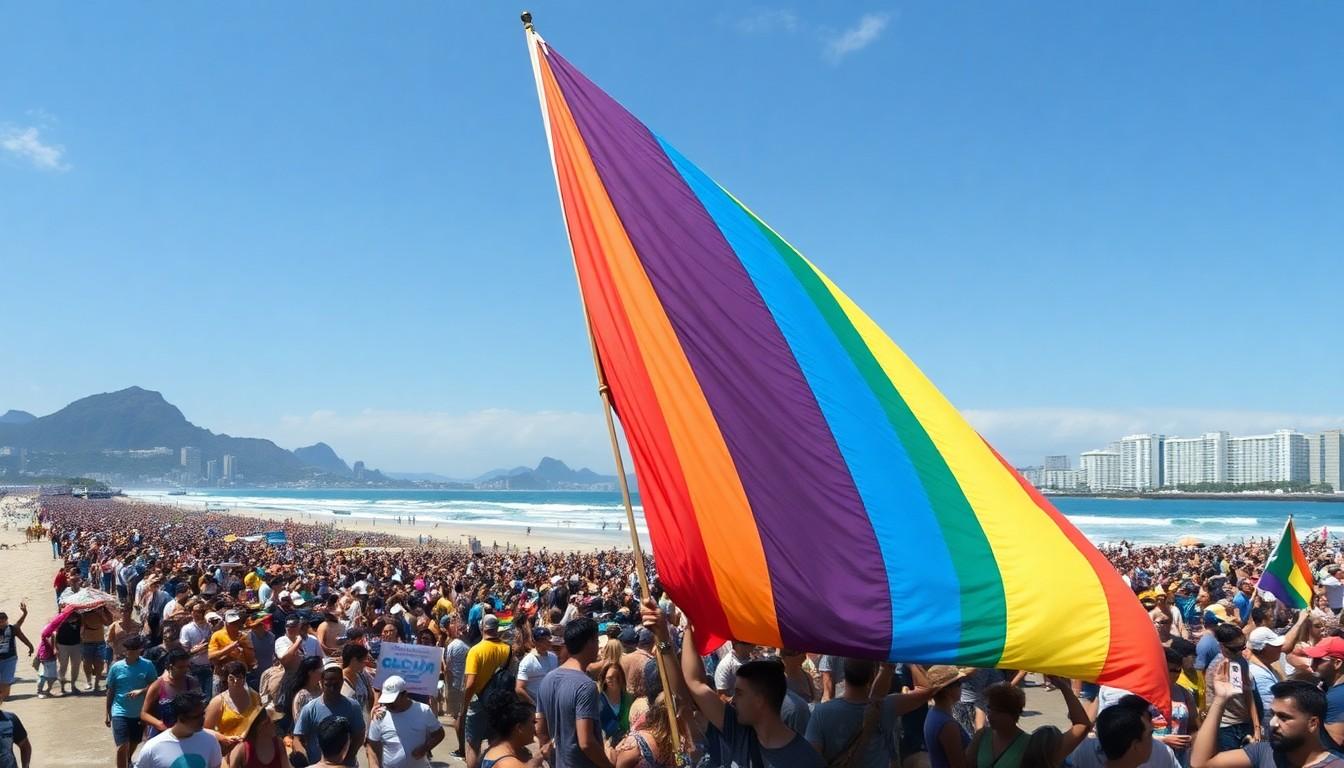
A giant rainbow flag brought colour to Rio de Janeiro’s Copacabana waterfront as thousands gathered for the city’s 31st LGBTI+ Pride Parade. The celebration marked 15 years since Brazil’s Supreme Federal Court recognised same-sex stable unions as family entities, while organisers used the occasion to press for stronger legal protections and action on ongoing violence.
Essential Takeaways
- A landmark anniversary: The parade marked 15 years since Brazil’s Supreme Federal Court recognised same-sex stable unions as family entities.
- A vivid celebration: A 141-metre rainbow flag and more than 200 artists featured in the Copacabana event.
- Rights remain central: Organisers called on Congress to put rights established through court decisions into law.
- Violence is still a concern: Official figures recorded rising reports of violence against gay and bisexual people, and against trans people and travestis, in 2024.
Copacabana turned into a sea of colour
A 141-metre rainbow flag stretched along Avenida Atlântica as music, floats and flamboyant costumes filled the Copacabana seafront. Thousands attended Rio de Janeiro’s 31st LGBTI+ Pride Parade, a celebration with a serious message beneath the bright colours and sound trucks.
Correio da Manhã reported that the event included more than 200 artists and ten sound trucks, with singer Ludmilla making a surprise appearance. The parade was organised by Grupo Arco-Íris and centred on a message affirming the legitimacy of every form of love and existence.
Fifteen years since a landmark court ruling
The parade’s anniversary gave the gathering a particular significance. On 5 May 2011, Brazil’s Supreme Federal Court unanimously recognised same-sex stable unions as family entities, granting them the same rights and duties as heterosexual stable unions, according to the court.
That ruling helped widen legal recognition for same-sex families and paved the way for equal civil marriage. The Supreme Federal Court notes that, in 2013, Brazil’s National Council of Justice required civil registries to perform same-sex marriages or convert stable unions into marriages.
The celebration also carried a political message
For Grupo Arco-Íris, Pride is not only a public celebration. Its campaign calls for Congress to put rights won through court decisions into legislation, helping make those protections more secure.
Agência Brasil reported that the organisers see this as a central demand: rights that depend on court rulings, they argue, need legislative guarantees. The group’s campaign also points to protections for transgender and travesti people, including the ability to change civil registration details without surgery or medical reports.
Rising reports of violence underscore the stakes
Against the festive backdrop, concern about safety remained sharply in view. Brazil’s 2026 Atlas da Violência recorded 10,250 reports of violence against gay and bisexual people in 2024, up 5.5 per cent from 2023, according to the Brazilian government.
The same report counted 5,575 notifications involving transsexual people and travestis, a rise of 2.5 per cent. These are recorded reports, not a complete count of every incident; the government also warns that inconsistent recording of motives can make violence against LGBTQIAPN+ people harder to track and address.
Why the street-level show still matters
The parade brought remembrance, celebration and a call for change into the same public space. Its organisers are asking for stronger laws and more effective public policies, while the figures on violence show why legal progress alone doesn’t settle questions of safety.
There’s a powerful contrast in that combination: a giant flag announcing visibility, and a demand that equal rights be protected beyond the parade route.
A celebration can honour progress and still insist that the work isn’t finished.
Source Reference Map
Story idea inspired by: [1]
Sources by paragraph: