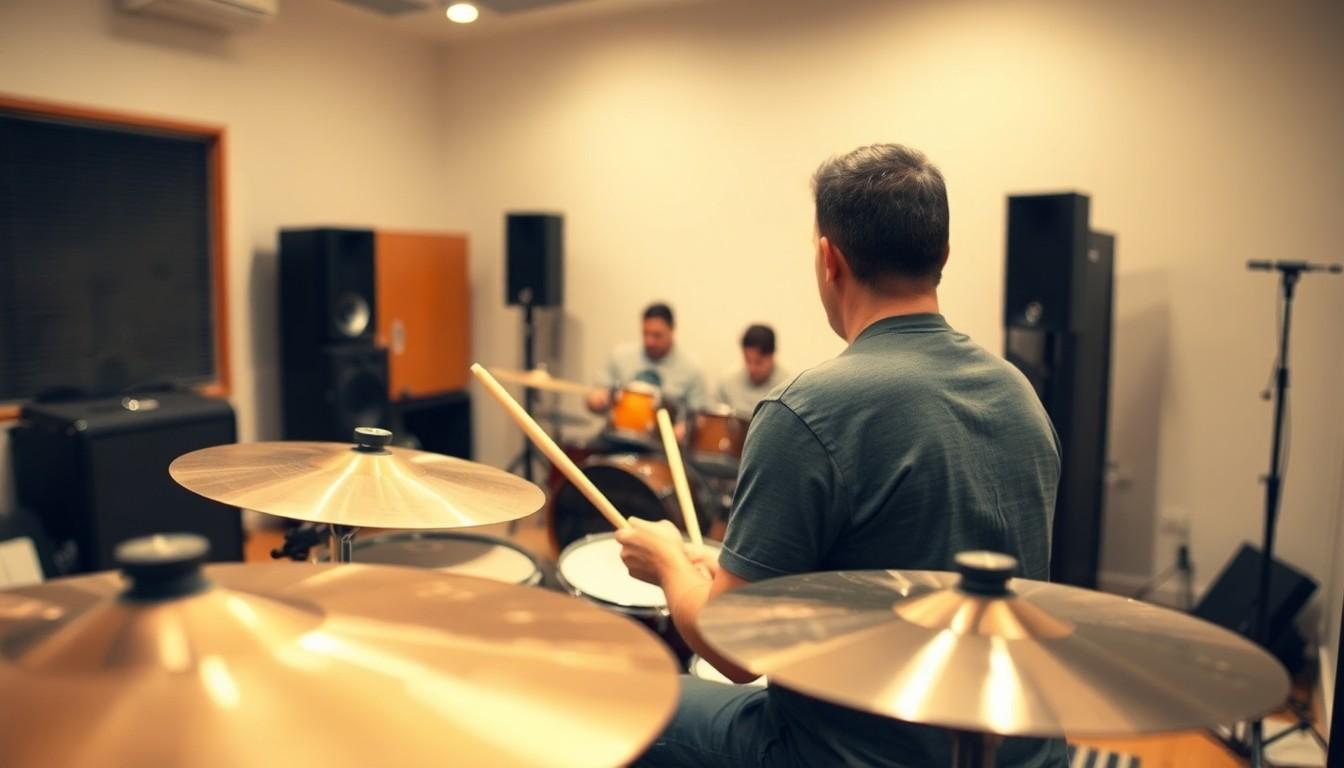
Queer drummers have helped shape rock’s sound and its public story, from The B-52s and Hole to The Go-Go’s and G Flip. Their experiences are different, but together they show how visibility in music can unfold over decades, through interviews, documentaries and personal announcements. Here’s the context behind several names in the conversation.
The beat has a history of its own
A drummer’s place in a band can change, but their influence doesn’t disappear. Keith Strickland began as The B-52s’ drummer before moving to guitar after fellow band member Ricky Wilson died in 1985, according to Rough Draft Atlanta. Strickland publicly came out as gay in 1992, explaining that the social and political climate made openness with the media feel important. [2]
That history gives a little extra resonance to the idea of queer drummers: the instrument may sit at the back of the stage, but the person behind it can still make a visible mark. Strickland’s story also belongs to the longer arc of a band that grew from its beginnings in Athens, Georgia, to mainstream success. [2]
Patty Schemel spoke openly about being gay
Hole drummer Patty Schemel has described coming out publicly in Rolling Stone in 1995. In an interview with Spinning Platters, she reflected on being openly gay in the band and music scene, and on the shortage of lesbian role models she encountered. [3]
Her account is about more than a date in a timeline. It connects visibility with belonging, and shows why representation can matter even when a musician is already surrounded by a community. Schemel’s reflections also sit alongside her wider story in music, including her work with Hole and later band Upset. [3]
The Go-Go’s documentary brought a personal story forward
The 2020 documentary The Go-Go’s brought renewed attention to the band’s history, including a relationship between drummer Gina Schock and bandmate Jane Wiedlin. Rolling Stone Australia reports that the two briefly dated during the group’s early years, while Windy City Times also recounts the relationship as discussed in the film. [5] [7]
It’s a reminder that a music documentary can add intimate detail to a familiar band story, not just revisit the songs and performances. Here, the disclosure forms one part of a wider look at the members’ lives and the band’s past. [5] [7]
G Flip’s announcement was about gender identity
G Flip announced on Instagram in 2021 that they identify as non-binary and use they/them pronouns, according to triple j. The report describes the announcement as a personal explanation of how they understood their identity. [4]
That distinction matters: being non-binary isn’t the same as being gay. The interviews and reporting about G Flip offer a useful reminder that queer musicians’ identities aren’t interchangeable, and that the language used to describe someone should reflect what they’ve shared. Them also discusses G Flip’s music and public identity, rather than treating one announcement as the whole story. [4] [6]
Visibility can take many forms
These musicians’ stories arrived in different ways: through a media interview, a documentary, or a direct social-media announcement. There isn’t one template for being public, and the sources show how personal context can matter as much as the headline milestone. [2] [3] [4] [5] [6] [7]
For readers exploring queer drummers in rock, it’s worth keeping those differences in view. A coming-out story, a relationship disclosed in a film and a non-binary identity announcement each tell us something distinct about the person behind the kit. [2] [3] [4] [5] [6] [7]
The rhythm is shared; the stories are their own.
Source Reference Map
Story idea inspired by: [1]
Sources by paragraph: