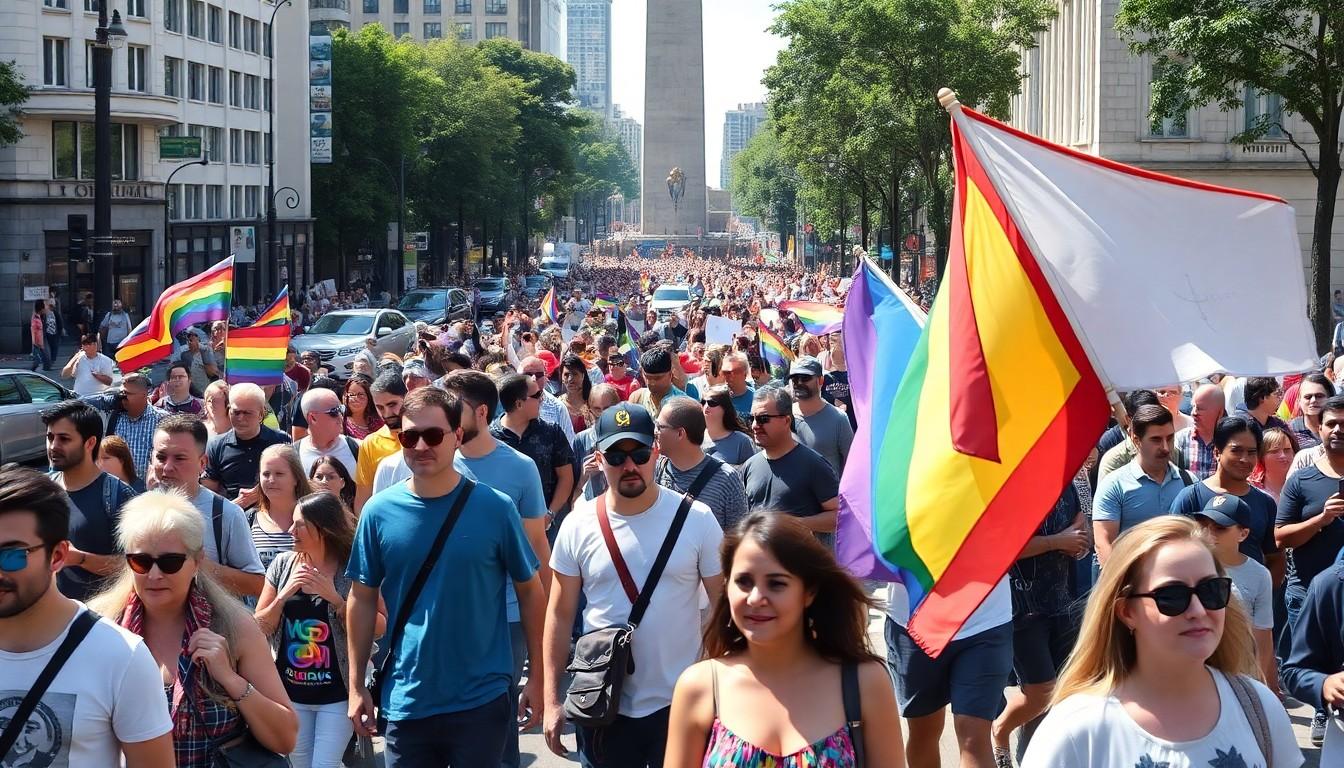
A crowded Saturday in central Buenos Aires brought the Pride March and Boca Juniors supporters into the same urban landscape. The football final and the march unfolded alongside one another, turning the city centre into a vivid mix of colour, noise and movement. That overlap offers a striking reminder of how public streets can hold very different communities at once.
Essential Takeaways
- Two events, one city centre: The 2023 Pride March coincided with Boca Juniors’ Copa Libertadores final on 4 November.
- The march’s route: Organisers planned a gathering near Plaza de Mayo before participants headed towards Congress.
- Football drew a crowd too: Boca supporters followed the final around the Obelisk, alongside Pride activity in central Buenos Aires.
- The outcome matters: Boca lost 2-1 to Fluminense after extra time, so the gathering wasn’t a celebration of a Boca title.
When the streets became a meeting place
On 4 November 2023, central Buenos Aires had more than one reason to draw a crowd. The Pride March and Boca Juniors’ Copa Libertadores final took place on the same day, bringing football colours and LGBTQ+ flags into the same city-centre setting, Infobae reported.
That convergence gives the columnist’s account its central charge: the street isn’t just a route from one place to another. It can become a place where different groups, moods and ways of seeing the city meet, sometimes in close quarters.
Pride was a march, a festival and a call for rights
The day’s Pride programme was more than a procession. Página/12 reported plans for a gathering at Plaza de Mayo, with stalls and live music, followed by a march towards the National Congress. The organisers’ message centred on rights and the role of a democratic state in guaranteeing them.
Argentina’s Ministry of Justice and Human Rights also described a lively public event, with music, floats and an information stand near Plaza de Mayo. Its account gives the celebration a practical civic dimension too: along with visibility and festivity, public institutions were there to share information about access to rights.
Boca fans brought another current of energy
Around the Obelisk, Boca supporters followed the final as their team played Fluminense in Rio de Janeiro. Infobae reported that fans watched on mobile phones, while La Nación also described football imagery mixing with Pride colours and glitter in the city centre.
But there’s an important correction to the idea of a Boca victory celebration: Boca lost the final 2-1 after extra time. The crowd and the shared setting are part of the day’s story; a winning outcome isn’t.
Why the overlap makes a compelling city story
The events had different purposes, but both made use of central public space. The Pride March carried an explicit message about rights, while the final drew supporters into a collective experience shaped by the match’s changing fortunes. Put together, they offer a vivid picture of how a city’s streets can host several public stories at once.
The columnist’s close-up observations of particular people and glances remain personal impressions, not details independently confirmed by the reporting. Still, the wider picture is corroborated: Pride participants and Boca fans were present in the same central area, and the city’s transport plans anticipated disruption from both events.
A little planning can help on busy event days
For visitors, checking the route and timing before heading into a major city-centre event is sensible. TN reported planned Pride gatherings near Plaza de Mayo and at Diagonal Norte and Florida, with the march expected to proceed towards Congress, while Boca supporters might gather around the Obelisk.
Those were forecasts, rather than proof that every closure or gathering happened exactly as planned. Even so, when a march and a major match coincide, checking transport updates can make the difference between a relaxed outing and an accidental tour of the traffic queues.
A city’s most memorable moments can begin when different crowds share the same streets.
Source Reference Map
Story idea inspired by: [1]
Sources by paragraph: