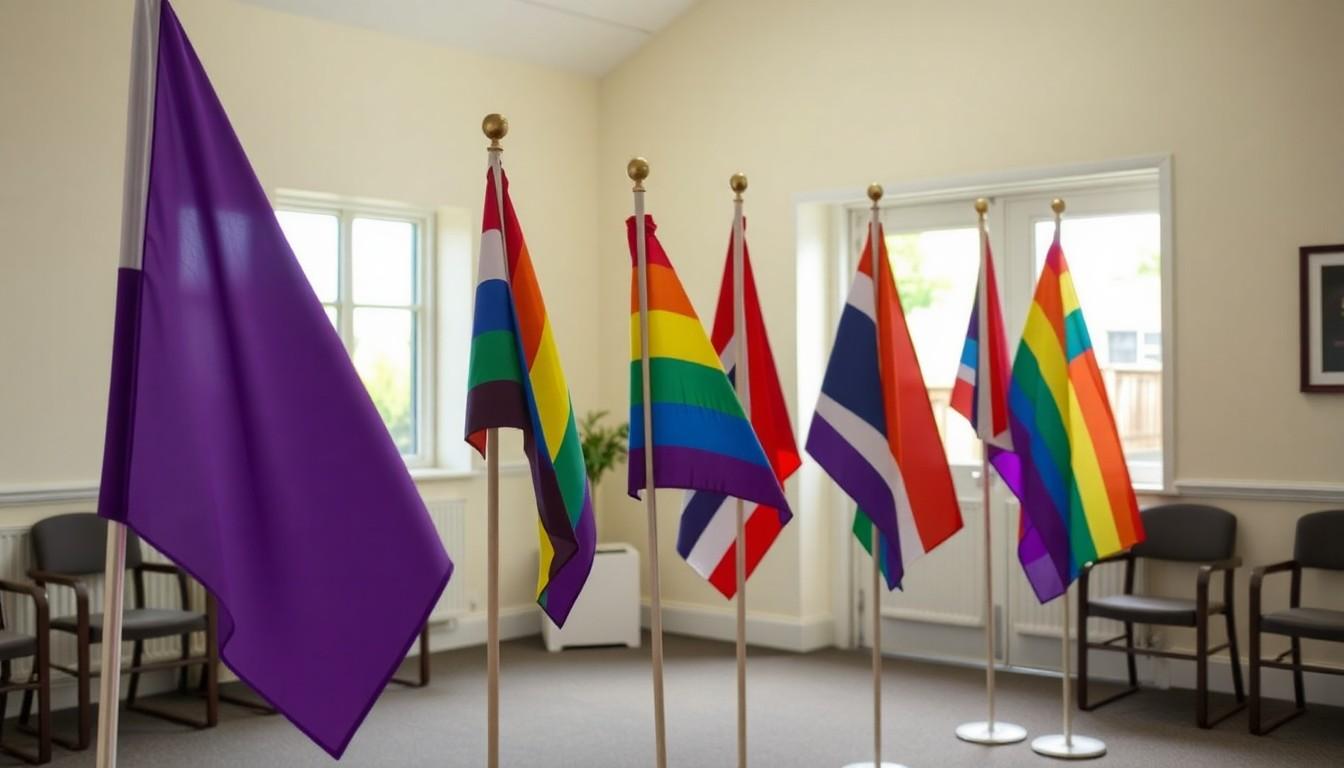
From Gilbert Baker’s original rainbow to today’s Progress Pride design, pride flags make identities and communities visible. But there’s no official count, and meanings can vary between guides. Here’s how some of the best-known flags came about, what their colours are commonly understood to represent, and why their history matters when you choose one to display or share.
Essential Takeaways
- There’s no official total: Pride flags cover many identities and communities, and new designs continue to emerge.
- The rainbow began with eight stripes: Gilbert Baker created the original flag in 1978; practical changes led to the familiar six-stripe version.
- Progress flags spotlight inclusion: Later designs added colours and symbols to bring particular communities into clearer view.
- Some origins are uncertain: Not every flag has a reliably documented designer, date or single agreed interpretation.
- Respect the community behind the symbol: A flag’s meaning is shaped by the people it represents, not just its colours.
The rainbow flag started with eight stripes
The familiar rainbow began as a larger, more colourful design. San Francisco artist and activist Gilbert Baker created the original eight-stripe flag in 1978, and it was first displayed at that year’s Gay Freedom Day Parade, according to the GLBT Historical Society.
Each stripe had a meaning: pink for sex, red for life, orange for healing, yellow for the sun, green for nature, turquoise for art and magic, blue for serenity, and purple for spirit. The Society says pink and turquoise were later removed for practical reasons, leaving the six-colour version that became widely recognised. [2]
That change is a useful reminder that a flag’s appearance isn’t always fixed from the start. Designs can shift as communities use them and practical realities shape what’s possible.
Progress Pride makes inclusion more visible
The Progress Pride flag keeps the rainbow but adds a forward-pointing chevron at the hoist. Designer Daniel Quasar introduced it in 2018, combining colours associated with the transgender flag and Philadelphia’s rainbow design to draw attention to transgender people and LGBTQ+ people of colour, the Victoria and Albert Museum says. [7]
The Human Rights Campaign also presents the Progress design as a way to bring those communities into focus within the wider LGBTQ+ symbol. The chevron changes the flag’s visual balance, making inclusion feel like part of its message rather than a footnote. [5]
In 2021, an intersex-inclusive version added the intersex flag’s purple circle on a yellow field to the chevron. Intersex flag designer Morgan Carpenter says that circle represents wholeness and completeness, while the design as a whole was created as a positive symbol grounded in intersex people’s experiences. [6]
Identity flags offer more specific ways to be seen
The rainbow is a broad community symbol, but many people also use flags that speak more directly to their identity. The University of California, Santa Barbara’s glossary covers designs for gender identities, sexual and romantic orientations, and communities including bears and polyamorous people. It describes itself as non-exhaustive, and its entries show that some histories are better documented than others. [4]
The transgender flag is one example with a well-recorded history. The Smithsonian identifies Monica Helms as its designer in 1999 and says she first presented it at a Pride parade in Phoenix in 2000. Its light blue and pink stripes reflect colours traditionally associated with boys and girls, while the central white stripe represents people who are intersex, transitioning or without a defined gender. [3]
Helms designed the stripes to mirror each other, so the flag remains correctly oriented whichever way it’s flown. It’s a small but thoughtful detail: the design makes room for people to find their own sense of what is right. [3]
Check the history, but don’t expect one master list
There’s no single authoritative count of pride flags. UCSB’s glossary is explicitly non-exhaustive, while the Human Rights Campaign presents a selection of recognised designs rather than a complete catalogue. Together, they show how varied the flags are, and why a definitive list is hard to pin down. [4][5]
Origins and meanings can also differ between community guides. UCSB notes dates for many designs but records uncertainty or differing accounts for some, while the Smithsonian and GLBT Historical Society document particular flags through institutional collections and histories. So if a detail matters, check who is describing it and whether they’re speaking as a designer, a community source or a museum. [2][3][4]
And remember that a flag can mean more than a set of colour definitions. The Human Rights Campaign describes pride flags as symbols of identity, visibility and shared experience, while Carpenter’s account grounds the intersex design in self-determination. That context is worth keeping in view when displaying or discussing one. [5][6]
A thoughtful way to choose and use a flag
Start with the community the flag represents, then look for a reliable guide to its design and history. UCSB’s glossary can help with a broad range of flags, while the Smithsonian, the GLBT Historical Society and designers’ own accounts offer useful context for particular designs. [2][3][4][6]
If you’re choosing a design for a display or sharing it with others, don’t assume every stripe has one universally agreed explanation. UCSB’s glossary shows that interpretations and records vary, and Carpenter’s account underlines why it matters to let communities speak for their own symbols. [4][6]
Pride flags are vivid by nature, but their most important work is often quieter: helping people feel recognised. Knowing a little of their history makes that gesture more meaningful.
Choose the flag that reflects the community you want to honour, and take a moment to learn its story.
Source Reference Map
Story idea inspired by: [1]
Sources by paragraph:
- Paragraph 1: [2]
- Paragraph 2: [2]
- Paragraph 3: Lead article only
- Paragraph 4: [7]
- Paragraph 5: [5]
- Paragraph 6: [6]
- Paragraph 7: [4]
- Paragraph 8: [3]
- Paragraph 9: [3]
- Paragraph 10: [4][5]
- Paragraph 11: [2][3][4]
- Paragraph 12: [5][6]
- Paragraph 13: [2][3][4][6]
- Paragraph 14: [4][6]
- Paragraph 15: Lead article only