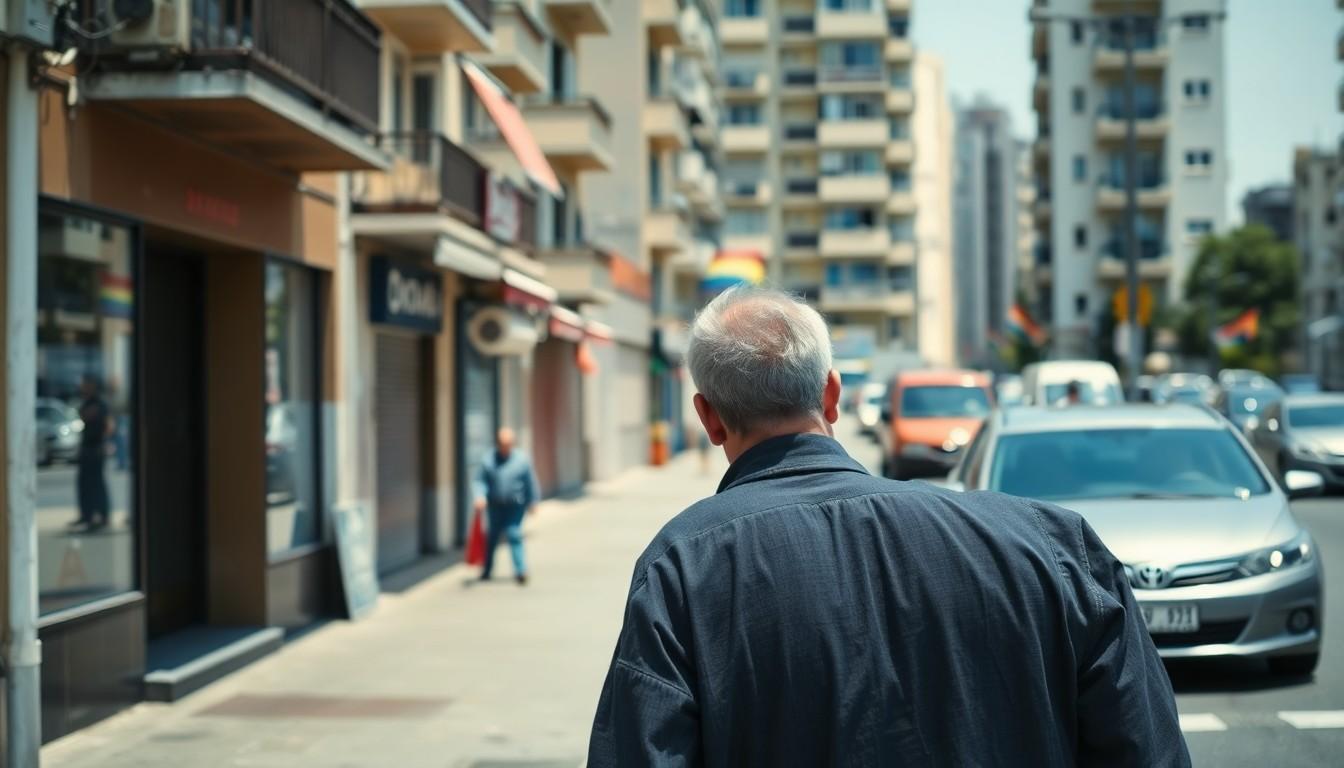
A Man Walks Down the Street follows Raanan, a middle-aged gay man returning to Tel Aviv after 30 years away, and asks what it takes to live more honestly later in life. Yuval Hadadi’s Hebrew-language drama brings a painful past into the present, while a new connection challenges Raanan’s guarded ideas about intimacy, identity and change.
Essential Takeaways
- A return with consequences: Raanan comes back to Tel Aviv to sell his late mother’s flat, but an encounter from his youth unsettles his carefully guarded present.
- Two generations meet: A brief relationship with the confident, younger Adir puts Raanan’s shame and emotional reserve into sharp focus.
- Coming out isn’t the whole story: The film explores how habits formed in a closeted youth can persist long after someone begins living openly.
- The city has changed: Tel Aviv’s shifting social landscape mirrors the contrast between earlier ways of meeting people and today’s dating apps.
- A story with a longer reach: The film has screened at festivals, including Austin Film Festival and OUTshine; OUTshine’s 2026 results list it as a jury Best Feature Film runner-up and an Audience Award honourable mention.
Returning home doesn’t mean the past stays put
Raanan’s trip back to Tel Aviv begins with a practical task: selling his late mother’s flat. But a chance encounter with someone from his youth brings buried pain into view, turning a straightforward visit into an emotional reckoning. The film’s central tension is quietly compelling: time and distance may change a person’s surroundings without automatically loosening the grip of old fears.
The OUTshine programme describes the 2025 Israeli drama as a 91-minute Hebrew-language film directed by Yuval Hadadi. Its synopsis likewise places Raanan between a suppressed past and a present that no longer feels settled. MidnightEast adds that the story moves between present-day events and flashbacks, making the choices of Raanan’s younger self part of the emotional landscape he must now face.
That structure suits a man whose past hasn’t stayed neatly behind him. Raanan’s return is less a homecoming than a collision between who he was, who he became and who he might still be.
Self-acceptance can take longer than coming out
Hadadi connects the film’s exploration of internalised homophobia to his own experience of growing up closeted. In the Las Vegas Pride interview, he describes recognising how self-hatred affected his younger adult life, and says the emotional habits formed early can remain difficult to shift. The film therefore looks beyond the moment of coming out to what self-acceptance may require afterwards.
Raanan has spent decades away from the environment that shaped him, yet his guarded manner and discomfort with intimacy still bear its imprint. OUTshine’s synopsis identifies internalised homophobia, unresolved grief and the consequences of a withdrawn life among the film’s central themes. These aren’t problems the story treats as easily fixed; they’re part of what makes Raanan’s search feel so personal.
Hadadi also pushes against the idea that coming out is a one-off milestone. As he tells Las Vegas Pride, it can happen again whenever someone is asked about their personal life. That observation gives the film a thoughtful point of entry: living openly can be a beginning, not an instant cure for fear.
Adir’s openness brings the contrast into focus
Adir, played by Yotam Rotshtain, is younger, sexually confident and more open about who he is. For Raanan, that ease is both attractive and unsettling. MidnightEast describes Adir’s confidence as a challenge to Raanan’s reserve, while OUTshine’s synopsis frames their brief affair as a source of desire, confusion and shame.
The film contrasts Raanan’s experience of secrecy with Adir’s greater openness, but it doesn’t present one generation as simply better than the other. Instead, their different expectations reveal how much the social world has shifted, and how little that shift can do by itself to heal someone’s old wounds. Raanan sees in Adir a freedom he lacks, yet wanting that freedom and knowing how to live with it are two different things.
That makes their connection more than a romance between men of different ages. It becomes a test of whether Raanan can move towards intimacy without letting fear dictate every step.
Tel Aviv reflects a changing way to connect
The city is part of the story’s emotional texture. In the Las Vegas Pride interview, Hadadi describes the contrast between earlier ways of meeting potential partners, including personal ads and cruising areas, and the more immediate world of dating apps. The film’s movement between past and present lets those changes sit alongside Raanan’s personal history.
For Raanan, the newer pace doesn’t necessarily feel like progress. He prefers meeting face to face and letting chemistry develop, while the world around him offers quicker ways to connect. That mismatch gives the film a useful question to sit with: new options can be liberating, but they don’t suit everyone in the same way.
If you’re drawn to films about identity across generations, this is a story that links private experience to a changing city without making either feel like a simple backdrop. Tel Aviv’s transformation matters because Raanan has to find his footing in it, not merely watch it pass by.
Festival audiences have met Raanan on their own terms
The film’s festival trail has included Austin Film Festival and OUTshine. Austin Film Festival’s 2025 programme book confirms the film’s place in its narrative-feature programme, while OUTshine’s listing records a Miami screening in April 2026. At OUTshine’s 2026 festival, the film was named a jury Best Feature Film runner-up and received an Audience Award Best Feature Film honourable mention.
Hadadi told Las Vegas Pride that older gay viewers often responded emotionally to Raanan’s history, while younger men were interested in seeing how different gay life could look only a few decades earlier. That split in response fits the film’s generational focus: one audience may recognise the weight of secrecy, while another encounters it as a history that still shapes the present.
The same publication describes Hadadi’s earlier feature, 15 Years, as another film concerned with complicated relationships and personal history. Taken together, his work shows a recurring interest in how the past can unsettle adult lives, rather than staying politely in the rear-view mirror.
Raanan can’t rewrite his history, but the film’s message is that it’s not too late to change what comes next.
Source Reference Map
Story idea inspired by: [1]
Sources by paragraph: