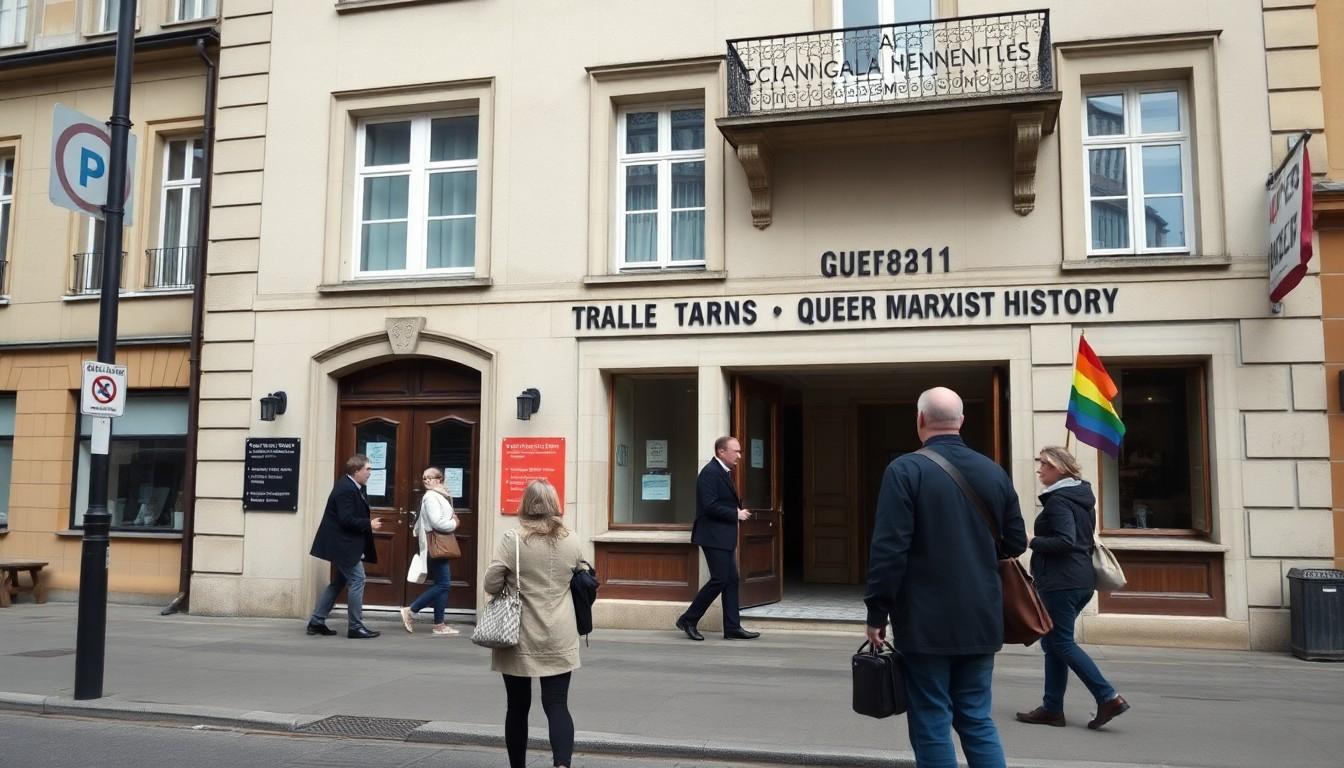
Queer Marxism has never been one settled political tradition. In a wide-ranging history, writer Peter Drucker traces its roots from early socialist campaigns for sexual freedom to today’s battles over the far right, nationalism and queer organising. The account is a reminder that progress can be reversed, and that movements often have to rethink their alliances as politics shifts.
Essential Takeaways
- A long, uneven history: Early socialist and communist movements sometimes supported sexual emancipation, but later Stalinist and Maoist periods largely broke with that legacy.
- Queer activism took shape in the 1990s: AIDS activism, groups such as Queer Nation and academic queer theory helped reshape political language and organising.
- Marxist ideas entered queer theory: Kevin Floyd connected sexuality to concepts including reification and totality, offering a framework for thinking about gender, class and capitalism together.
- Sexual politics now cross geopolitical lines: Drucker argues that both homonationalism and anti-LGBTQ reaction can serve wider political agendas.
- Mainstream organising may not be enough: His closing challenge is for queer activists on the left to build broader alliances rather than assume established organisations will lead the work.
Queer Marxism began before there was a queer movement
The history starts with a distinction: socialist and communist movements engaged with sexual emancipation well before a distinct queer movement existed. Peter Drucker’s account reaches back to the 1860s, describing early support for sexual reform alongside a much longer record of political silence and retreat.
One notable chapter came after the Russian Revolution, when Soviet Russia removed existing laws against homosexuality. The University of Chicago Press describes Dan Healey’s study of revolutionary Russia as a history of sexual dissent, legal change and the later turn towards repression. That broader picture matters: the period wasn’t a straight line from liberation to progress.
Drucker also recalls the contribution of socialist campaigners such as Magnus Hirschfeld and August Bebel, and the ambitions of early Bolshevik women’s politics around sexual freedom and shared domestic work. But the Stalinist and Maoist periods brought a long interruption, he argues, with little of that earlier sexual libertarianism surviving.
The 1990s changed queer activism and language
A different phase took shape in the early 1990s. Drucker links the emergence of queer activism to groups that grew out of ACT UP and the AIDS crisis, including Queer Nation, which helped turn “queer” into a deliberately political identity. The Online Archive of California describes Queer Nation as a protest-oriented organisation formed by former ACT UP members.
At the same time, queer theory was challenging fixed ideas about identity, sex and gender. Routledge’s overview of Judith Butler’s Gender Trouble describes its critique of essentialist categories and its account of gender as something produced through repeated social acts, rather than a simple expression of nature.
That shift gave activists new ways to question labels and gender roles. But Drucker notes a tension: queer theory and politics gathered force just as Marxism was losing influence after the collapse of the Soviet Union. Some people saw Marxism as too narrowly focused on economics, even as socialist feminists and Marxist feminists were already broadening its analysis.
Marxist theory met queer theory through capitalism
Kevin Floyd’s The Reification of Desire helped bring Marxist thought and queer theory into closer conversation. The University of Minnesota Press says Floyd uses Marxist concepts such as reification and totality to examine sexuality, gender and capitalism, rather than treating sexuality as an add-on to economic analysis.
In Drucker’s account, reification means treating social relationships as if they were things. Applied to sexuality, that idea helps explain how identities can come to feel fixed and self-contained. Totality, meanwhile, points to the connections among social relations, offering a way to consider gender, sexuality, class and race together.
But theory isn’t only an academic concern. It can help explain why identities and social expectations change with economic and political conditions. Drucker also links the later concepts of homonormativity and homonationalism to debates about capitalism, nationalism and imperial power. Historical Materialism describes his book Warped as an international study of the changing relationship between capitalism, sexuality and LGBT politics.
Homonationalism shows how queer rights enter geopolitics
Jasbir Puar’s concept of homonationalism became important to arguments about the war on terror and the way some states present themselves as defenders of LGBTQ people. Duke University Press describes Puar’s book as an analysis of how sexuality, race, nationalism and security intersect, including the use of LGBTQ inclusion to draw a line between supposedly liberal nations and racialised or Muslim outsiders.
Drucker argues that sexual politics can also shape how countries present themselves against one another. He points to contrasting approaches in China and Taiwan, and in Russia and Ukraine, while stressing that claims of tolerance can be limited and politically useful. These are his interpretations of complex national situations, not simple measures of how safe or equal life is for queer people.
That’s a useful caution for readers: a government’s language about LGBTQ rights doesn’t, by itself, tell the whole story. The legal position, daily experience and political purpose behind that language may not line up neatly.
The far right puts queer organising under pressure
Drucker sees a sharper political turn after the financial crisis of 2008, with stronger opposition to queer rights and growing transphobia. He describes France’s debate over same-sex marriage as a turning point in the political climate, and says the Dutch far right helped block a proposal to make legal gender change easier after the 2023 election.
His final concern is practical. In the Netherlands, he says, mainstream LGBTQ organisations have relied heavily on state funding and have not always mobilised on the streets, leaving radical activists to take on more of the work. He also argues that queer politics needs strong links with anti-racist activism and broader social movements.
And that may be the most human part of his argument: movements can’t assume that yesterday’s allies will do tomorrow’s organising. Drucker’s history is a call to keep building connections, especially when political conditions change.
Queer Marxism’s history is unfinished, and its next chapter will depend on who organises together.
Source Reference Map
Story idea inspired by: [1]
Sources by paragraph:
- Paragraph 1: Lead article only
- Paragraph 2: [2]
- Paragraph 3: Lead article only
- Paragraph 4: [7]
- Paragraph 5: [6]
- Paragraph 6: Lead article only
- Paragraph 7: [3]
- Paragraph 8: [3]
- Paragraph 9: [4]
- Paragraph 10: [5]
- Paragraph 11: Lead article only
- Paragraph 12: Lead article only
- Paragraph 13: Lead article only
- Paragraph 14: Lead article only