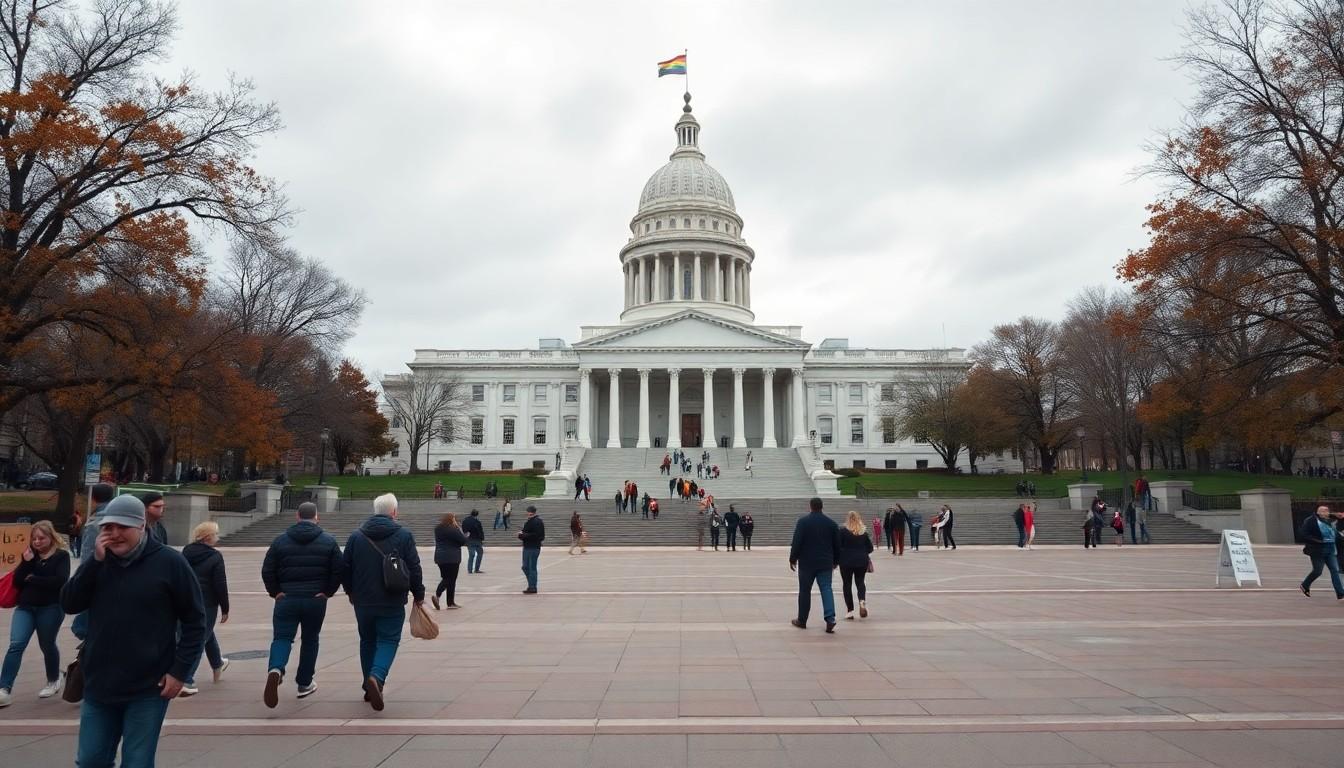
Voters sent a mixed message on trans rights in the 2026 US midterm elections. Many candidates targeted by anti-trans campaign ads won, while ballot measures restricting transgender students’ sports participation passed in several states. The contrast matters: election results can turn on who’s standing for office, but voters may respond differently when asked to decide a single policy question.
Essential Takeaways
- Campaign attacks didn’t guarantee wins: Many Democrats targeted over their support for trans rights won, including Sherrod Brown and James Talarico.
- Ballot measures went the other way: Voters in Arizona, Colorado, Nebraska and Washington approved restrictions on transgender girls’ participation in girls’ school sports.
- Missouri rejected a healthcare restriction: Voters turned down a proposal that would have restricted gender-transition treatment for minors and repealed abortion rights.
- Representation made history: Jaelynn Scott became Washington’s first openly transgender legislator and the first Black transgender person elected to a US state legislature.
- Some Democrats faced criticism: LGBTQ+ advocates challenged campaign messaging and positions on trans students from Ohio Democrats Marcy Kaptur and Amy Acton.
Anti-trans campaign ads couldn’t guarantee victory
The 2026 midterms delivered an awkward result for politicians who leaned heavily on attacks over trans rights: many of the Democrats they targeted won. That’s the clearest tension in the results. A campaign ad can put an issue in front of voters, but it doesn’t mean that issue will decide their vote.
The Associated Press, in reporting published by The Washington Post, estimated that Republicans spent $183 million on transgender-related attacks against Democrats through 25 October, with about 217,000 television spots. Texas drew particular attention, as Republican-backed groups targeted Senate candidate James Talarico over his positions on transgender healthcare and sport. The report noted that claims in those ads were disputed.
The spending did not translate into a win for the attacks’ intended targets: Talarico won, as did Ohio Sen.-elect Sherrod Brown, among other Democrats targeted over their support for trans people. The scale of the advertising was striking, but the election results suggest that repetition alone couldn’t make the issue decisive.
Ballot questions told a different story
But the ballot results were less reassuring. Voters in Washington and Colorado approved restrictions on transgender girls’ participation in girls’ school sports, while Arizona expanded existing restrictions and Nebraska added a sports ban to its state constitution, the Associated Press reported.
The details varied. Arizona’s Proposition 318 also covered access to bathrooms and other private spaces, while Nebraska’s Measure 442 set rules for designating school sports as male, female or co-educational. Missouri voters, meanwhile, rejected Amendment 3, which would have restricted gender-transition treatment and surgery for minors while also repealing abortion rights.
So the picture isn’t a simple national verdict. The Associated Press noted that views can differ by state and by how a ballot question is framed. Candidates and policies aren’t always judged in the same way, and these results show why it matters to look beyond a single headline.
Trans representation rose as restrictions passed
Washington offered the election’s sharpest contrast: voters approved Initiative 638, restricting transgender girls’ participation in girls’ school sports, while Jaelynn Scott won a seat in the state legislature. OPB, republishing reporting by the Washington State Standard, described Scott as Washington’s first openly transgender legislator and the first Black transgender person elected to a US state legislature.
Scott said she didn’t want to be treated as a single-issue representative. Her priorities include LGBTQ+ and transgender rights, alongside tax reform, housing and criminal justice, with attention to working people and people living in poverty, OPB reported. That breadth matters: representation is about who gets a voice, but also about the full range of issues they bring to public life.
The same election could produce a historic win for a trans candidate and a restrictive policy measure. Scott said she believed some people who voted for her may also have backed Initiative 638, and hoped a legal challenge would stop it taking effect. That uneasy overlap is a reminder that political progress rarely arrives in a neat, uninterrupted line.
Democratic candidates faced pressure from both sides
The campaign debate wasn’t confined to Republicans. Some Democrats also took restrictive positions on trans issues, drawing criticism from LGBTQ+ advocates who warned against assuming that voters would back a candidate simply because they were a Democrat.
The Washington Post reported on tension between Democratic campaign strategies and advocates’ expectations. In Ohio, Marcy Kaptur’s campaign promoted her vote to keep what it called “transgender ideology” out of schools, while Amy Acton said she didn’t support boys playing in girls’ sports. The Advocate reported that Equality Ohio lowered Acton’s rating from A to B after her comments; the supplied lead article also said the Human Rights Campaign declined to endorse Kaptur or Acton over their stances.
For advocates, the disagreement is about more than electoral tactics. Candidates may make choices they believe will help them win, but those choices can affect whether LGBTQ+ voters and campaign supporters feel represented. As the Washington Post’s reporting makes clear, there’s no easy way to balance campaign strategy with civil rights commitments.
What the results suggest about voter priorities
One possible explanation for the mismatch between campaign spending and candidate wins is that transgender issues ranked low against other concerns. The lead article cites an October Navigator Research poll in which Democrats and Republicans placed transgender issues last among 20 issues, including inflation, jobs, healthcare, housing and immigration.
A separate Navigator Research entry in the Trans Data Initiative’s polling archive found that 3 per cent of respondents in a national survey conducted from 21 to 24 August 2026 selected transgender issues among their top five priorities for the President and Congress. The archive’s question and dates differ from the October poll cited in the lead, so the findings shouldn’t be treated as interchangeable. Still, both point towards a familiar campaign challenge: a heavily advertised issue may not be the one voters most want politicians to tackle.
And the ballot results show why low priority doesn’t mean low consequence. Restrictions passed in several states, while Missouri rejected a proposed healthcare measure and trans candidates made gains. The practical lesson is to look at each race, ballot measure and state on its own terms, rather than treating one election night as a single verdict on trans rights.
The results are mixed, but the debate over representation and rights is far from settled.
Source Reference Map
Story idea inspired by: [1]
Sources by paragraph:
- Paragraph 1: Lead article only
- Paragraph 2: [3]
- Paragraph 3: [3]
- Paragraph 4: [2]
- Paragraph 5: [2]
- Paragraph 6: [2]
- Paragraph 7: [4]
- Paragraph 8: [4]
- Paragraph 9: [4]
- Paragraph 10: [5]
- Paragraph 11: [5], [6]
- Paragraph 12: [5]
- Paragraph 13: Lead article only
- Paragraph 14: [7]
- Paragraph 15: [2], [4], [7]