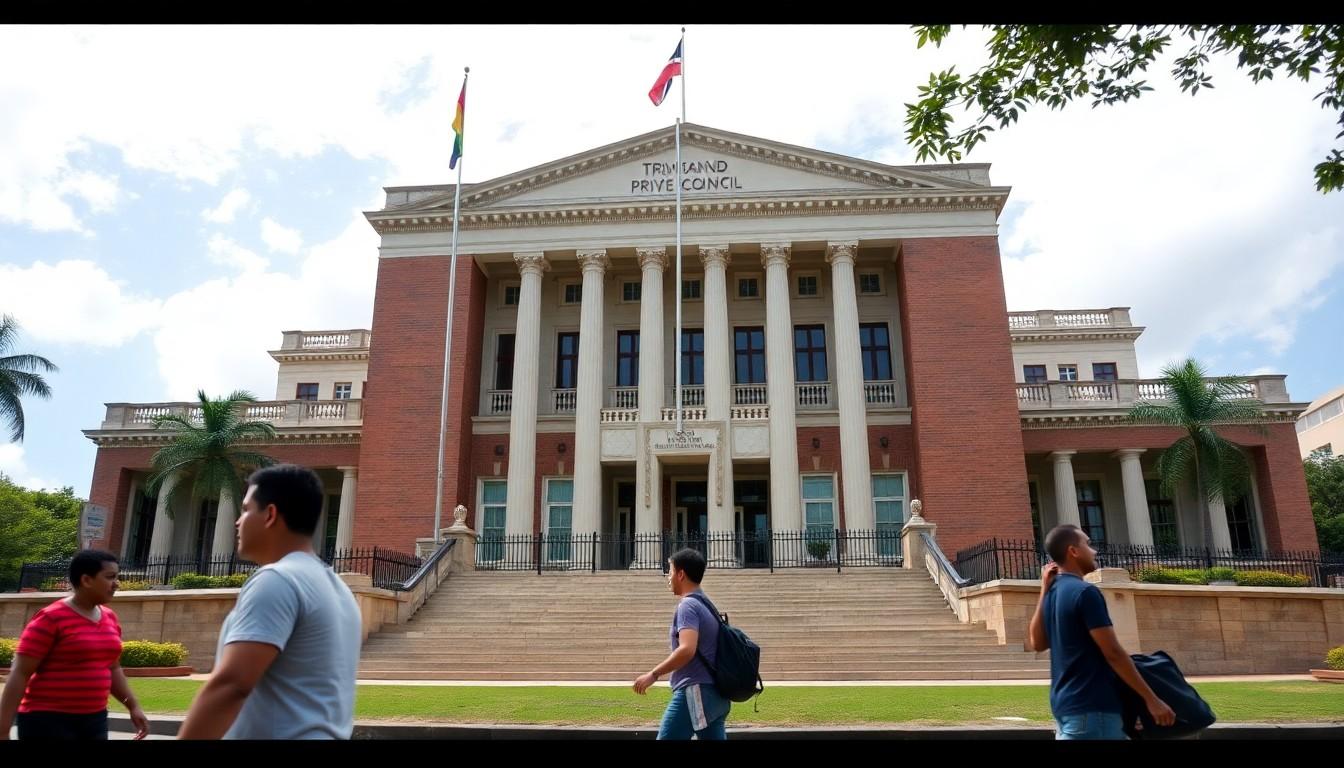
A landmark Privy Council ruling has ended the criminalisation of private, consensual same-sex relations between adults in Trinidad and Tobago. After an 11-year legal fight, Jason Jones is celebrating a major step for equality, while campaigners say the decision must now be followed by wider reforms to protect LGBTQIA+ people from discrimination.
Essential Takeaways
- A unanimous ruling: The Privy Council allowed Jason Jones’s appeal and found that sections 13 and 16 of the Sexual Offences Act 1986 infringe constitutional rights.
- The savings clause mattered: The Board concluded that the challenged provisions were new law, not protected pre-independence legislation.
- The legal win has limits: LGBTQIA+ organisations say discrimination in areas such as work, housing, education and healthcare still needs to be addressed.
- Reform is the next ask: Jones is urging Parliament to remove the Constitution’s savings clause, while advocates are calling for stronger equality protections.
The ruling is a landmark, but the work isn’t over
A long-running legal challenge has reached a decisive point: the Privy Council ruled unanimously for Jason Jones, finding that sections 13 and 16 of Trinidad and Tobago’s Sexual Offences Act 1986 infringe his constitutional rights. The provisions must be interpreted so they do not criminalise private, consensual sexual relations between adults of the same sex.
The Privy Council’s judgment explains that the 1986 law was new legislation, rather than simply a continuation of older laws protected by the Constitution’s savings clause. It also found that the criminal provisions were not reasonably justifiable under the Constitution’s rights protections.
That makes this more than a change in legal wording. The Board considered the effect criminalisation can have on privacy, identity and intimate relationships, and said the Attorney General had not established a sufficient justification for that interference.
Jones sees a personal victory and a step for democracy
Jones has described the decision as vindication after an 11-year legal battle. In comments reported by CNC3, he said he was relieved that the court had respected citizens’ human rights, and called the result a stepping stone in Trinidad and Tobago’s democratic development.
His point is that the ruling should not be seen as a victory for one person alone. TTT News also reported Jones framing the decision as significant for the wider LGBT+ community, while stressing that discrimination and social acceptance remain pressing concerns.
And there’s a practical reason not to treat decriminalisation as the finish line. Pride TT says LGBTQIA+ people continue to face stigma and unequal treatment in employment, education, housing, healthcare and public services, and is calling for explicit protections in the Equal Opportunity Act.
Why the Constitution’s savings clause became central
The case turned partly on whether the challenged provisions could be shielded from constitutional review as inherited law. The Privy Council’s press summary says sections 13 and 16 were new law, because the 1986 Act created a fresh, comprehensive system of sexual-offence law rather than merely reproducing earlier legislation.
That distinction is important: the Board did not accept that the provisions were protected simply because of their historical context. The judgment also considered a separate constitutional provision allowing limits on rights, but concluded that continued criminalisation was not reasonably justifiable.
The precise remedial order was still to be finalised, with the Board inviting further submissions. The Guardian’s local report said the Board had provisionally indicated that the High Court’s relief should be adopted, so the ruling’s legal reasoning is clear even as that final step remains.
The next battle may reach beyond one country
Jones says he wants to push for LGBTQ+ people to be free across the wider region, and pointed to the ruling’s possible implications for other jurisdictions. The Associated Press also placed the decision in a broader Caribbean context, where similar laws remain in some countries and courts elsewhere have recently invalidated them.
At home, Jones is urging Parliament to remove the savings clause, which protects certain pre-independence laws from constitutional challenge. He argues that it continues to constrain democratic reform, while the Privy Council’s decision in his case rested on its finding that the 1986 provisions were new legislation and therefore not protected by it.
Pride TT and Queer Corner Caribbean are also calling for a wider review of laws affecting LGBTQIA+ people. Their message is that removing criminal penalties matters deeply, but equal treatment in everyday life requires further legislative action.
Support and disagreement remain part of the picture
The ruling drew support from Tobago House of Assembly Deputy Chief Secretary Dr Faith Brebnor, who said everyone deserves decency, dignity and respect regardless of sexual orientation. Pride TT and Queer Corner Caribbean likewise welcomed the decision while pressing for broader protections.
Religious responses were not uniform. CNC3 reported that Archbishop Jason Gordon had previously opposed prison penalties for consenting adults, while maintaining the Catholic Church’s opposition to same-sex marriage. The Inter-Religious Organisation’s Dr Ellis Burris said same-sex relations were viewed as inconsistent with divine principles in different religious traditions, while also insisting that individuals should not be condemned.
That contrast reflects the debate around the ruling: the legal change protects private, consensual adult relationships from criminalisation, while questions about equality, belief and public policy remain part of the wider conversation.
The decision is a major legal milestone; the next test is whether wider protections follow.
Source Reference Map
Story idea inspired by: [1]
Sources by paragraph:
- Paragraph 1: [2], [3]
- Paragraph 2: [2], [3]
- Paragraph 3: [2], [3]
- Paragraph 4: [6]
- Paragraph 5: [6]
- Paragraph 6: Lead article only
- Paragraph 7: [3]
- Paragraph 8: [2], [3]
- Paragraph 9: [5]
- Paragraph 10: [4]
- Paragraph 11: Lead article only
- Paragraph 12: Lead article only
- Paragraph 13: Lead article only
- Paragraph 14: Lead article only
- Paragraph 15: Lead article only