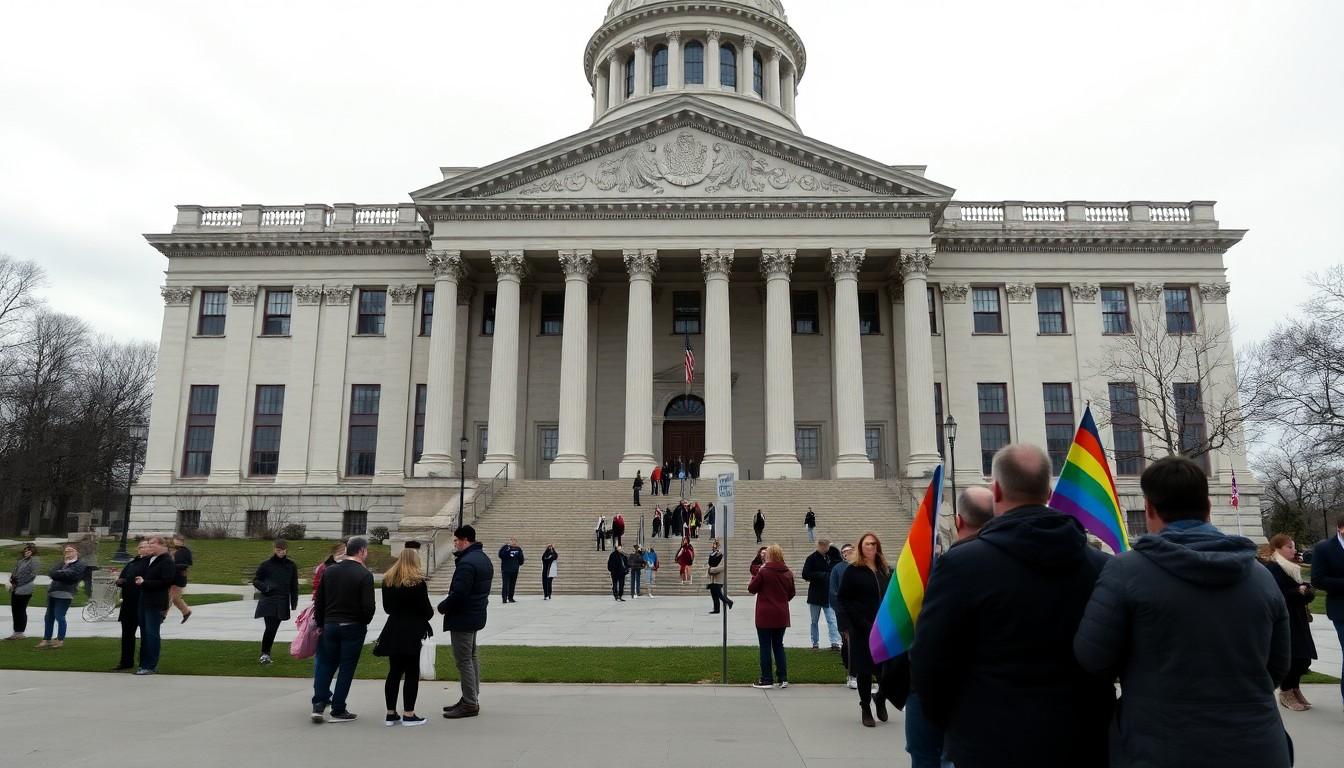
Photographs at Pennsylvania’s Capitol memorialised transgender people lost to violence and suicide, while lawmakers renewed calls for the state’s Fairness Act. The proposed law would explicitly protect people from discrimination based on sexual orientation and gender identity or expression. The debate connects a solemn remembrance with a practical question: what protections can the state put in place?
A memorial brings individual lives into focus
At the Pennsylvania Capitol, photographs gave a human face to a stark tally. The gathering honoured 55 transgender and gender-diverse people reported to have died through violence or suicide in the United States in the previous year, including four Pennsylvanians. The Pennsylvania Capital-Star reported that Amy Santiago spoke about her child, Auggie, who died by suicide in October after the family struggled to find a covered therapy appointment.
Santiago described a teenager who wanted to make the world better and helped others feel they belonged. Auggie had also begun coming out as trans and had an online community that knew her as Cass. The remembrance, held ahead of Transgender Day of Remembrance on 20 November, made room for grief alongside a call to remember the people behind the numbers.
Why the recorded toll may be incomplete
Transgender Day of Remembrance is observed each year on 20 November. The Associated Press explains that it began in 1999 in memory of Rita Hester, a transgender woman killed in Massachusetts, and now sits at the close of Transgender Awareness Week. Memorials and candlelight gatherings are among the ways people mark the day.
But a count is never the whole story. The Capital-Star reported that advocates warned the US and global tallies were likely undercounts. The Associated Press and Human Rights Watch have also described how deaths can be missed or misreported, including when a victim’s transgender identity is not recognised in official records or news coverage.
The Human Rights Campaign Foundation’s report is careful to present its figures as a documented minimum, not a complete account. It covers fatal violence, not every death, suicide or experience of violence. That distinction matters: a statistic can help show the scale of harm, but it cannot stand in for a person’s life or explain every circumstance.
The Fairness Act would address discrimination
At the Capitol gathering, lawmakers linked remembrance with their responsibility to protect residents. The Capital-Star reported that Representative Ismail Smith-Wade-El recalled six young transgender people dying in Lancaster County during his first year in office. He argued that some responsibilities could not simply be handed off to others.
The Fairness Act would amend Pennsylvania’s Human Relations Act to explicitly prohibit discrimination based on sexual orientation and gender identity or expression. The Capital-Star reported that the state House had passed the proposal in each of the previous two legislative sessions, and Democratic spokespeople said it would be a priority in the new session, when Democrats were set to hold majorities in both chambers.
For the later 2025–2026 session, the Pennsylvania General Assembly’s official page lists House Bill 300 as the Fairness Act proposal. Its recorded actions show referral to the House Judiciary Committee and subsequent committee and floor stages. Those entries document legislative progress, but they do not mean the bill became law.
Protections can take different legislative forms
The Fairness Act is not the only proposal relevant to Pennsylvania’s debate over protections. The Associated Press has reported on separate hate-crime bills approved by the state House, including a proposal to broaden the law on hate-based intimidation to cover characteristics such as gender identity, gender expression and sexual orientation.
The distinction is important. The Fairness Act concerns discrimination under the Human Relations Act, including in areas such as employment, housing and public accommodation. Hate-crime measures address offences and related policy. They may share a concern for safety and equal treatment, but they work through different legal routes.
Human Rights Watch also points to wider conditions that can heighten vulnerability, including poverty, housing insecurity and barriers to healthcare or identity documents that reflect a person’s gender. These factors don’t make every case the same, but they underline why counting deaths is only one part of understanding risk.
Remembrance asks what happens next
The Capital-Star reported that a spokesperson for Governor Josh Shapiro did not confirm his support for the Fairness Act, instead pointing to a forthcoming Democratic legislative agenda. That leaves the proposal’s prospects to the legislative process, rather than settling its future at the memorial.
There is a hard contrast in the event’s setting: photographs honoured people who were lost, while elected officials spoke about decisions still within their reach. Santiago’s appeal for community, support, freedom, kindness and love was personal, but it also echoed the broader question facing lawmakers: what does meaningful protection look like beyond a day of remembrance?
A memorial honours those lost; the next test is whether promised protections move forward.
Source Reference Map
Story idea inspired by: [1]
Sources by paragraph: