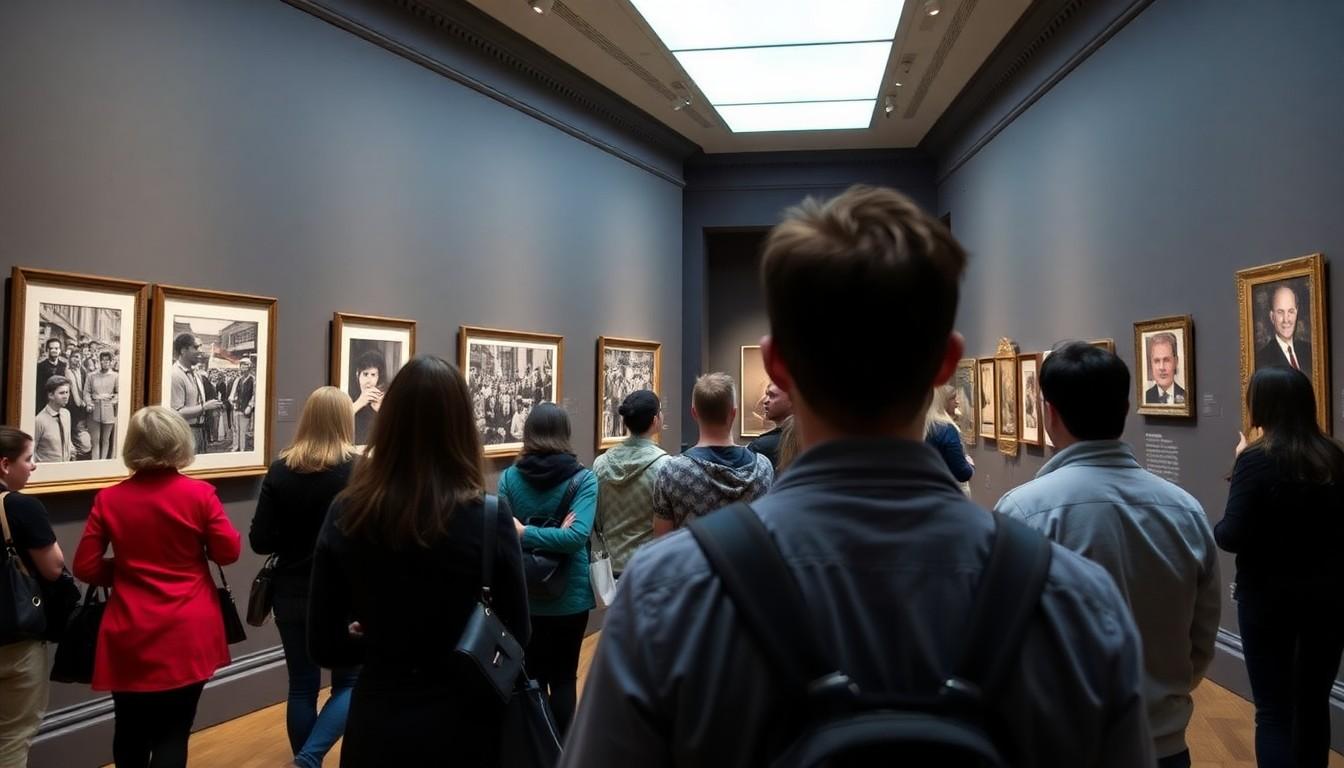
A song sung in defiance at a 1978 school party now echoes through a major National Portrait Gallery exhibition celebrating queer lives and activism. Tim Walker’s Fairyland: Love and Legends looks back at the people and communities behind that change, while raising a timely question: how does progress take root, and how can it endure?
A school-leaving song became a lasting act of defiance
At a Catholic boys’ school leaving party in 1978, Paul Mason and fellow pupils linked arms and sang Tom Robinson’s “Glad to Be Gay”. The gesture was meant to provoke the Salesian priests who had disciplined them. Decades later, seeing Robinson pictured in Tim Walker’s Fairyland exhibition gives that youthful rebellion a striking new frame.
The National Portrait Gallery show brings together portraits of activists, artists, performers and others whose lives trace queer identity, community and love. Walker spent five years making the photographs, pairing personal stories with imaginative visual settings. It’s a vivid way to look at social change: not as an abstract idea, but through people’s faces and histories.
Tudor styling points to a darker history
Fairyland opens with figures associated with early Pride activism styled like Tudor nobles. The reference reaches back to the Buggery Act of 1533, passed under Henry VIII, which made buggery involving a person or animal punishable by death.
The details matter because the exhibition’s celebratory atmosphere sits against a long record of legal oppression. Historic England identifies the Act as the first criminalisation of sexual activity between men in English law. The contrast between ornate Tudor dress and the law’s brutality makes the history difficult to overlook.
Pride grew from protest and community support
Britain’s queer activism took shape through both public protest and practical organising. Historic England says the Gay Liberation Front was founded at the London School of Economics in 1970, bringing together gay men and lesbians, including people committed to feminist aims and wider social change.
The first Gay Pride march in England followed in 1972, when around 2,000 people marched through London to Hyde Park. Activism also meant building places where people could find support: the UK’s first gay centre opened in Brixton in 1974, offering social activities and a telephone helpline. Visibility and mutual aid went hand in hand.
Portraits hold both celebration and loss
The exhibition moves through decades of campaigning, including the HIV epidemic, civil partnerships and contemporary transgender identity. Mason recalls seeing photographs of friends and a family member, and the parties in London hospital AIDS wards coloured by the knowledge that some patients might not live to see another Christmas.
That personal memory gives the exhibition’s wider story a human weight. The National Portrait Gallery describes Fairyland as an exploration of queer identity, community and love, but its visitor information also flags adult themes and explicit imagery in a designated final-room area. It’s a celebration, certainly, but not one that smooths away every difficult edge.
Progress took persistence, and it remains unfinished
Mason’s account argues that change came through determined activism, mutual support, coalition-building, role models and perseverance. That history is worth remembering alongside the present: homophobia, transphobia, violence and body shaming have not disappeared.
The experience of LGBT people in the Armed Forces shows how slowly legal change can travel. The UK Government says the military ban remained in place until 2000, despite the partial decriminalisation of private homosexual acts between adults in England and Wales in 1967. Later, an independent review led to a financial recognition scheme for people affected by the ban. The official scheme page reported more than £61.9 million in payments as of 26 October 2026, a dated figure rather than a final total.
Fairyland: Love and Legends is scheduled to run at the National Portrait Gallery from 9 October 2026 to 7 February 2027. Its portraits offer a powerful reminder that social change is made by people who organise, support one another and insist on being seen.
Progress is worth celebrating, and worth protecting.
Source Reference Map
Story idea inspired by: [1]
Sources by paragraph: