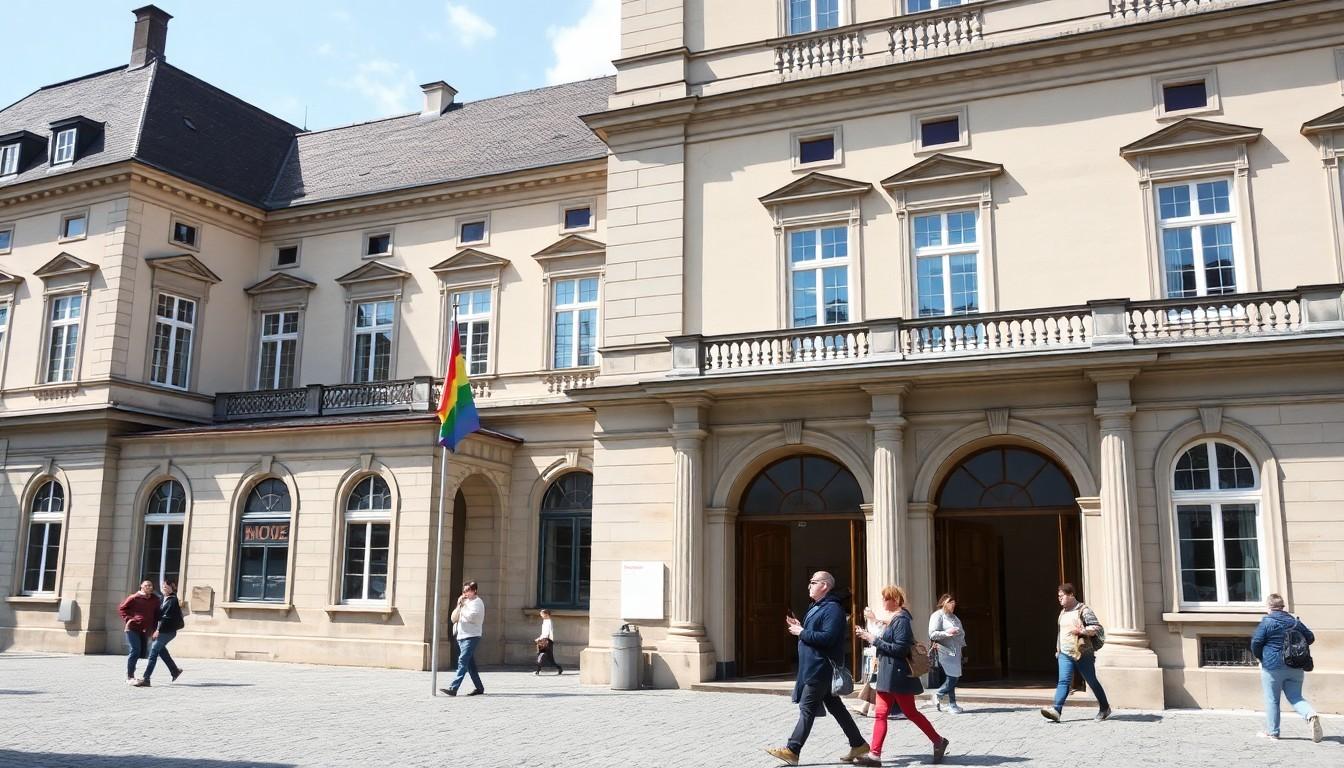
Visitors to Stuttgart’s Landesmuseum Württemberg can now explore familiar objects through queer perspectives, with a thoughtful exhibition design that makes overlooked stories easier to see. Set inside the Altes Schloss, the project links cultural history, identity and visual communication, giving the permanent collection a fresh, more inclusive rhythm.
Essential Takeaways
- A new lens on history: The project revisits the museum’s permanent collection through queer stories and interpretations.
- A central Stuttgart setting: The exhibition is presented at the Landesmuseum Württemberg in the Altes Schloss.
- Designed for clarity: Matter Of created the graphic and exhibition design using HAL Timezone by HAL Typefaces.
- More than labels: The approach encourages visitors to question familiar objects, symbols and historical assumptions.
- Part of a wider programme: The museum also presents displays covering clocks, scientific instruments, masterpieces and personal adornment.
Familiar objects, newly read
The most powerful museum changes don't always involve moving a single object. Sometimes, the shift comes from the question placed beside it, the story brought forward or the voice previously left out. At Stuttgart's Landesmuseum Württemberg, queer perspectives invite visitors to look again at the permanent exhibition with that kind of productive curiosity.
The project, titled Mehr als eine Realität, makes queer histories visible across a collection built to tell broader stories of cultural history. It isn't simply an additional display; it offers a different route through material already associated with established narratives.
That matters because museums can feel authoritative even when their interpretations are selective. A new reading doesn't erase the past, but it can make the picture more honest and considerably more interesting.
Why the Altes Schloss makes a strong setting
The exhibition is housed in Stuttgart's Altes Schloss, a historic building that already carries layers of memory. That setting creates a useful tension: visitors move through rooms shaped by old institutions while encountering interpretations that challenge the idea of a single, settled history.
The museum's wider programme ranges from clocks and scientific instruments to celebrated works and decorative traditions. Its displays show how objects can reveal technology, status, belief and everyday behaviour, which gives the queer-perspective project plenty of context.
According to the Landesmuseum Württemberg's exhibition information, the collection spans subjects that reward close looking. That makes the new approach feel less like a separate island and more like an invitation to reconsider the museum as a whole.
Design that guides without shouting
Matter Of created the graphic and exhibition design, with the project typeset in HAL Timezone, a typeface published by HAL Typefaces. The result places visual communication at the heart of the experience, rather than treating it as decoration around the objects.
Good exhibition design has a quiet job. It helps visitors understand where to look, how to move and why a particular detail matters, while leaving enough space for the object itself to breathe. In a subject as nuanced as identity and representation, that balance is especially important.
The museum's other exhibitions demonstrate how varied its material can be, from precision instruments to decorative objects. A coherent visual system can help those different stories feel connected without flattening their differences.
From symbols to social meaning
One of the most revealing parts of museum culture is the way ordinary details acquire importance. Clothing, adornment, symbols and displays of taste can say something about gender, status or belonging, but their meanings aren't always fixed.
The museum's presentation on what adorns men, for instance, points towards the relationship between decoration and social identity. Read alongside queer perspectives, such themes can prompt visitors to ask who was allowed to appear in particular ways, who was recorded and who was overlooked.
That doesn't require every object to carry a definitive label. In fact, the more useful experience may be an open question. The best museum visit leaves you noticing small things afterwards, from a portrait's pose to the confidence of a colour choice.
A more welcoming museum conversation
The project also reflects a wider movement in museums towards participation and interpretation rather than one-way instruction. Museum Pass listings for related exhibitions use an inviting language of looking, asking and understanding, which suits an approach built around curiosity rather than certainty.
For visitors, the practical advice is simple: allow more time than a quick circuit, read the contextual material and compare the new interpretation with the surrounding displays. If you're visiting with friends, it can be rewarding to pause on one object and ask what assumptions shaped its original presentation.
There is a human pleasure in discovering that a supposedly familiar collection still has surprises in it. Mehr als eine Realität suggests that inclusion isn't an optional extra added to history; it can change how the entire collection comes into focus.
A fresh question can make an old object feel newly alive.
Source Reference Map
Story idea inspired by: [1]
Sources by paragraph: