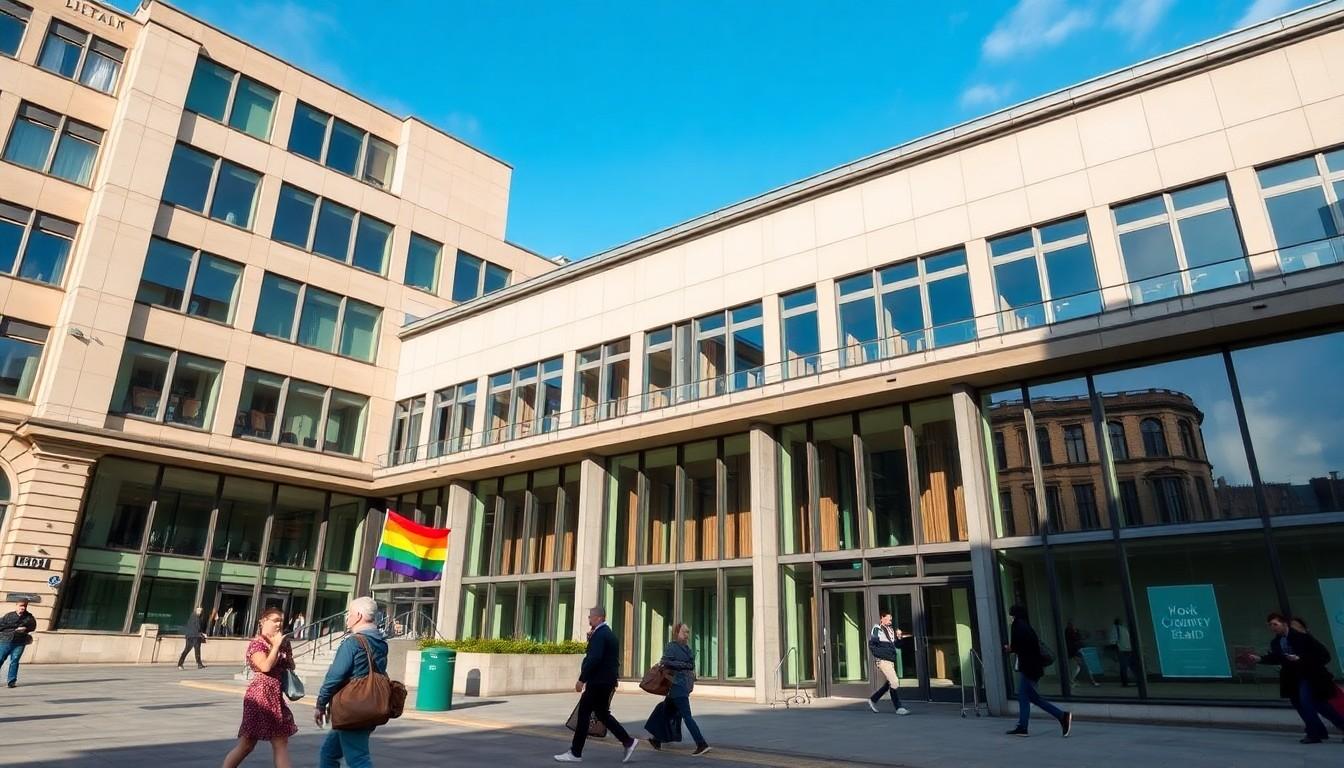
Readers are turning to a new oral history of bisexuality in Britain for a fuller account of queer life beyond familiar coming-out narratives. Martha Robinson Rhodes's Bisexuality and Beyond examines activism, memory and attraction across genders, showing why this overlooked history matters to scholars and general readers alike.
Essential Takeaways
- A timely intervention: The book reconsiders modern British queer history through bisexual experiences.
- Oral histories lead the way: New interviews sit alongside earlier archival testimony and published research.
- Identity isn't always linear: Many accounts move between labels, relationships and political circumstances.
- A sharper look at activism: The study exposes how some lesbian and gay movements excluded bisexual people.
- Useful beyond this subject: Its approach could help historians study identities that resist neat categories.
A missing chapter in Britain's queer history
The most striking argument in Bisexuality and Beyond is also the simplest: British queer history looks different when bisexual lives are placed at its centre. Rather than treating bisexuality as a footnote between heterosexuality and homosexuality, Martha Robinson Rhodes presents it as a perspective that unsettles the entire story.
According to the book's Oxford University Press listing, the 208-page hardback grew from Rhodes's doctoral research at the University of Birmingham. Its publication arrives during a wider expansion of LGBTQ+ oral history, when researchers are increasingly asking whose memories have been preserved and whose have slipped through the gaps.
That shift matters because older accounts of liberation can look remarkably tidy from a distance. The lived reality was often more complicated, especially for people whose attractions or identities didn't fit the political categories available to them.
Why bisexual activism was often pushed aside
Rhodes's research challenges the idea that radical lesbian and gay politics were automatically broad and inclusive. In late twentieth-century Britain, some movements built their sense of opposition around a stark divide between homosexuality and heterosexuality, leaving little room for people who experienced attraction across genders.
The book highlights a particularly revealing moment: in 1985, the London Lesbian and Gay Centre barred bisexual groups from using its premises. That decision shows how exclusion could happen not at the edges of queer politics, but within organisations that presented themselves as part of a liberation movement.
Book-news coverage from the Urania Institute places the title within current scholarship on bisexual communities and historical identity. The larger lesson is uncomfortable but valuable: movements can challenge one form of hierarchy while reproducing another. History is rarely as well behaved as its slogans.
Oral history captures identities in motion
The book's method is one of its strongest features. Rhodes combines interviews carried out between 2018 and 2020 with earlier testimony from the Hall-Carpenter archive, alongside material linked to psychotherapist Charlotte Wolff's pioneering 1977 study of bisexuality.
That mixture lets readers hear how people described attraction and identity across different decades. It also avoids forcing every interviewee into a single, polished explanation. Some stories are hesitant, fragmented or contradictory, but that isn't a weakness. It's often how real memory sounds.
Research shared through academic book platforms and related listings presents the work as a contribution to both sexuality studies and oral history. Its central methodological idea, using "multiple-gender-attraction" to include people who don't identify with the word bisexual, is especially useful. It leaves room for lives that are real but not neatly labelled.
The coming-out story doesn't fit everyone
Popular queer histories often rely on a familiar arc: secrecy, revelation, acceptance and a new public identity. Bisexuality and Beyond argues that this pattern doesn't describe many bisexual lives, where identity may shift with relationships, politics, age or circumstance.
The result can be a non-linear story rather than a dramatic announcement. Someone may have identified as straight, then gay, then straight again, or declined a fixed label altogether. For some people, the question of disclosure simply wasn't the organising force in their lives.
That finding connects with wider research into bisexual communities, including material catalogued by ResearchGate and book-news coverage from the Urania Institute. It also offers a useful reminder for anyone collecting personal histories: silence, uncertainty and refusal are meaningful responses, not empty spaces waiting to be filled.
What the book means for readers now
For specialists, the book offers a new framework for thinking about oral testimony and identity. For general readers, its appeal is more immediate: it shows how much can be missed when history is organised around only the most recognisable labels.
The international listings for the title, including those on Yes24 and Oxford Academic, underline its place as a substantial scholarly publication rather than a passing cultural commentary. At £88 for the hardback, it's clearly aimed primarily at libraries, researchers and serious students, but its arguments have relevance well beyond university shelves.
The most lasting impression is human rather than theoretical. People don't always live in straight lines, and their memories don't either. By taking those untidy accounts seriously, Rhodes makes modern British queer history broader, stranger and more honest.
It's a thoughtful reminder that the histories we inherit depend on who gets asked to speak.
Source Reference Map
Story idea inspired by: [1]
Sources by paragraph:
- Paragraph 1: [2], [3]
- Paragraph 2: [2], [6]
- Paragraph 3: [5], [7]
- Paragraph 4: [4], [2]
- Paragraph 5: [3], [5]
- Paragraph 6: [6], [7]
- Paragraph 7: [2], [4]
- Paragraph 8: [5], [3]
- Paragraph 9: [2], [6]
- Paragraph 10: [4], [5]
- Paragraph 11: [3], [7]
- Paragraph 12: [2], [4]
- Paragraph 13: [5], [6]
- Paragraph 14: [2], [3]