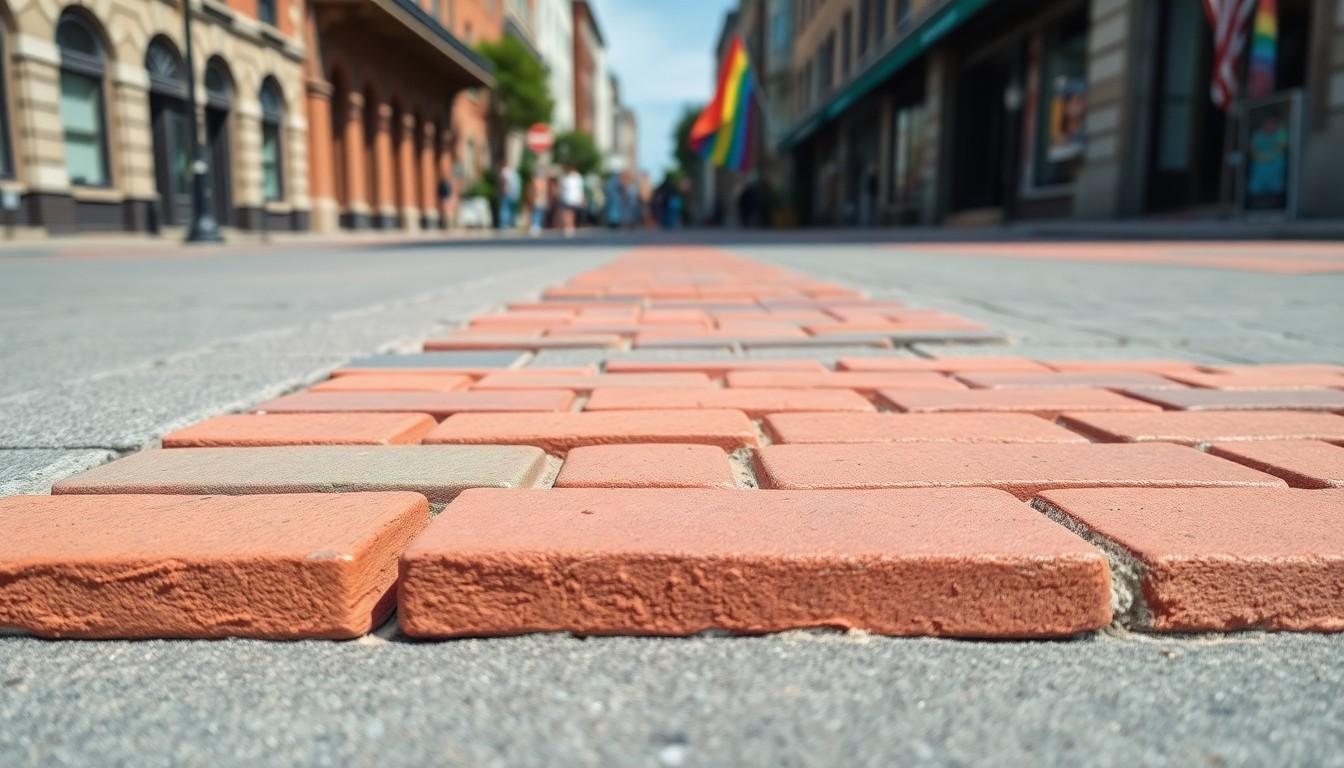
Shoppers and supporters are buying pieces of a dismantled Miami Beach rainbow crosswalk, helping Florida drag performer Miss Bouvèé raise more than $25,000 for Pride events in Key West and Naples. The colourful fundraiser has turned a bitter political dispute into a small, tangible piece of LGBTQ+ history that can travel far beyond Florida.
Essential Takeaways
- More than $25,000 raised: Sales exceeded the fundraiser's combined targets for Naples and Key West Pride.
- Fifty bricks sold quickly: Miss Bouvèé moved the first batch in just four days.
- The bricks were refreshed: They were cleaned, repainted and given a plaque marking their original location.
- The money has a practical purpose: Funds will support live entertainment and event security.
- A symbol became a keepsake: Buyers wanted something physical that represented protest, pride and community history.
A demolished crosswalk finds a second life
The rainbow crosswalk in Miami Beach didn't disappear quietly. After it was dismantled and replaced with plain black pavement, its bricks took on a new role as collectable reminders of a public LGBTQ+ symbol, according to CBS News.
Miss Bouvèé, whose real name is Eric Swanson, won the bricks at auction and decided not to treat them as ordinary building material. Instead, the Florida drag performer cleaned them, repainted them and prepared them for supporters who wanted to own a small part of the story. The result feels both inventive and poignant: a piece of street furniture transformed into a keepsake.
The Miami New Times reported that some bricks were used in a pedestrian area, while others were sold at auction. That split gave the material two very different futures, but both kept it connected to the city rather than sending it quietly into storage.
Why people wanted a piece of rainbow crosswalk history
The appeal was emotional as much as political. For many buyers, a brick offered something solid to hold on to at a time when visible LGBTQ+ symbols are being removed from public spaces.
Miss Bouvèé told the Miami New Times that people were excited to hold a piece of history, noting that bricks have previously been used in protests. Her point is a good one: a small object can carry a surprising amount of meaning when it has been part of a contested public place.
The response was immediate. Fifty bricks sold in four days, suggesting that supporters weren't simply donating to a cause. They were also choosing a physical reminder of solidarity, complete with a story that can be shared at home, in a garden or on a shelf.
The fundraiser is helping smaller Pride events
The money is headed towards Pride celebrations in Key West and Naples, where organisers can have a tougher time attracting large corporate sponsors. According to the Miami New Times, the funds will help pay for a live entertainment stage and security at both events.
That practical focus matters. Pride is often pictured as a huge, polished festival, but smaller celebrations still need the unglamorous essentials that make public events work safely. A stage, stewards and security may not be the most photogenic parts of a parade, yet they're what allow people to gather with confidence.
The fundraiser passed its original goals, raising more than $16,000 for Naples Pride and over $10,000 for Key West Pride, according to coverage from Them. For local organisers, that kind of direct support can be more useful than a one-off gesture from a national brand.
Florida's rainbow road dispute is part of a wider clash
The crosswalk's removal followed a Florida law signed by Governor Ron DeSantis in June 2025. The measure allowed the Florida Department of Transportation to remove road markings, signs and signals considered unrelated to traffic safety or control, Them reported.
The federal government then issued similar guidance. U.S. Transportation Secretary Sean Duffy directed states, Washington, D.C. and Puerto Rico to use consistent road markings, and later identified rainbow crosswalks as falling within that direction, according to the publication.
Supporters of the policy frame it as a question of road clarity. Critics see it as an attempt to erase LGBTQ+ visibility from shared public spaces. Either way, the debate has made an ordinary crossing unusually loaded. A road surface that once guided pedestrians became a battleground over who gets to be represented in public.
A clever idea with a hopeful message
Miss Bouvèé hopes the project encourages other drag performers and supporters to find creative ways to back local Pride celebrations. PinkNews and the Urania Institute both highlighted the wider fundraising story as an example of turning a politically charged object into community support.
There's a useful lesson here for anyone organising an event with limited resources. Fundraising doesn't always need to look like a standard donation page or a corporate sponsorship drive. A distinctive object, a clear purpose and a strong local connection can give supporters a reason to take part.
A rainbow crosswalk may have been removed from the street, but its bricks are now travelling elsewhere. That's a neat reversal, and perhaps the most satisfying part of the story: an effort to reduce visibility has produced dozens of portable reminders that the community is still present.
It's a small brick, but it now carries a much bigger message.
Source Reference Map
Story idea inspired by: [1]
Sources by paragraph:
- Paragraph 1: [2], [3]
- Paragraph 2: [3], [4]
- Paragraph 3: [2], [5]
- Paragraph 4: [2], [4]
- Paragraph 5: [2], [6]
- Paragraph 6: [2], [3]
- Paragraph 7: [2], [5]
- Paragraph 8: [2], [3]
- Paragraph 9: [2], [4]
- Paragraph 10: [2], [5]
- Paragraph 11: [2], [3]
- Paragraph 12: [2], [4]
- Paragraph 13: [2], [5]
- Paragraph 14: [2], [6]
- Paragraph 15: [2], [3]