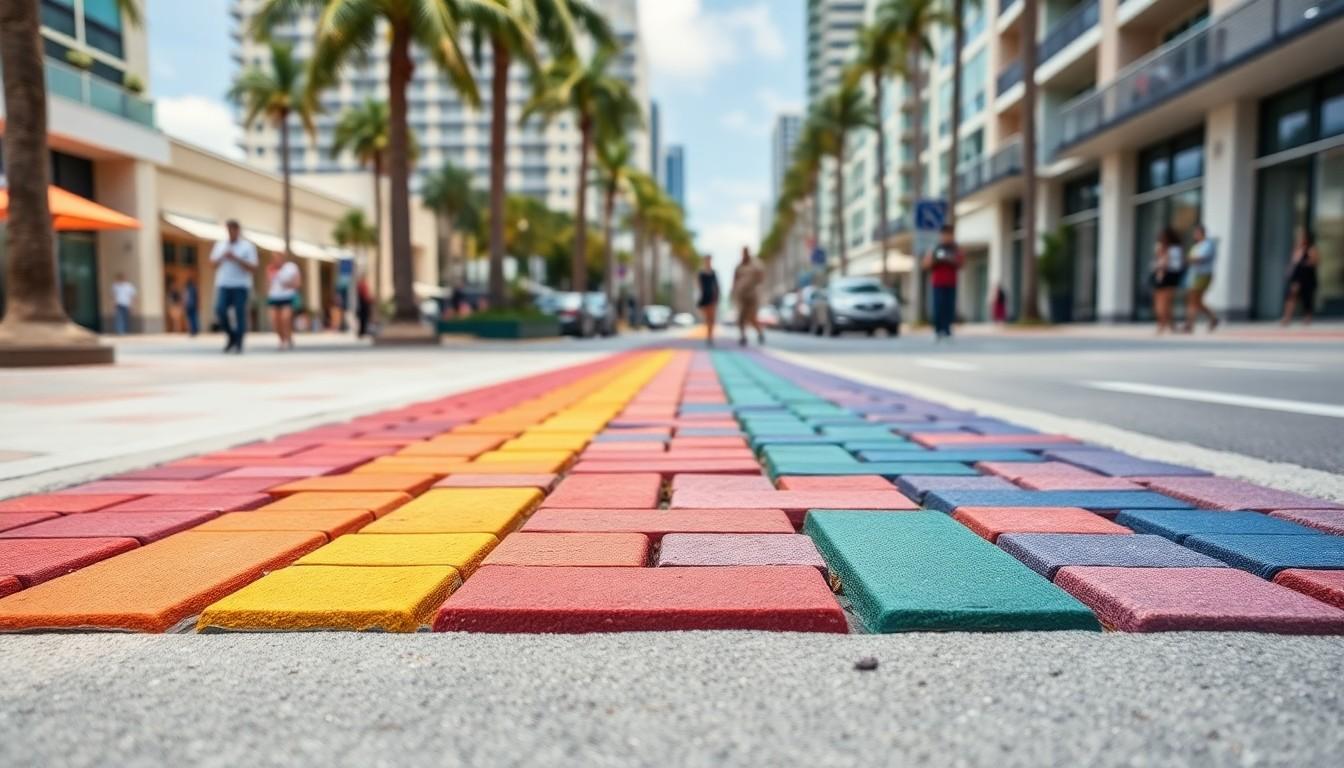
A demolished rainbow crosswalk has taken on a new life as a grassroots fundraiser in Miami Beach, where drag performer Miss Bouvee is selling salvaged bricks to support LGBTQ+ organisations. The unusual keepsake turns a political flashpoint into a practical show of solidarity, proving even a small piece of pavement can carry plenty of meaning.
Essential Takeaways
- A symbolic sale: Salvaged crosswalk bricks are being sold as Pride keepsakes.
- A charitable purpose: Proceeds will support LGBTQ+ organisations and community work.
- A political backdrop: The fundraiser follows the destruction of a rainbow crossing in Florida.
- A personal touch: Each brick represents visibility, resistance and local queer history.
- A wider message: Supporters are turning an act of removal into something constructive.
One rainbow crossing, many emotions
A rainbow crosswalk is usually a bright, cheerful detail in an urban landscape. In Miami Beach, though, its removal turned a familiar symbol of welcome into a flashpoint, leaving behind something far more potent than plain paving.
According to CBS News Miami, drag performer Miss Bouvee helped transform the salvaged bricks into fundraising items after the crossing was destroyed. The idea has a pleasing bit of poetic justice: what was meant to erase a visible sign of LGBTQ+ inclusion is now helping fund the community it represented.
The bricks aren't polished souvenirs in the conventional sense. Their appeal lies in the roughness, the history and the story attached to them. For supporters, that sturdy, ordinary feel is precisely the point.
From political gesture to practical support
The crosswalk controversy sits within Florida's increasingly tense debate over LGBTQ+ visibility and public funding. The Advocate reported that money raised through the sale will benefit Pride-related organisations, offering direct support at a time when community groups are facing pressure.
That practical element matters. Symbolic gestures can attract attention, but donations help pay for services, events, advocacy and spaces where people can feel safe. A small brick won't solve a funding crisis, of course, but many small contributions can still add up.
It also gives supporters a way to participate beyond posting online. Buying a keepsake is tangible, conversational and, frankly, rather more memorable than another social media graphic.
Why the bricks have struck a chord
The fundraiser works because it combines humour with defiance. There's something wonderfully cheeky about taking a piece of a removed rainbow crossing and giving it a new home, perhaps on a bookshelf, desk or garden wall.
PinkNews described the bricks as part of a fundraising effort linked to the Miami Beach controversy, while other coverage highlighted their role as reminders of LGBTQ+ visibility. They aren't valuable because of the material itself. They're valuable because they carry a moment that many people would rather not see forgotten.
That emotional connection is familiar in activist fundraising. Posters, badges and scraps of demolished landmarks often become small, physical records of a larger struggle. This time, the keepsake comes with a particularly Florida twist: sun, spectacle and a dash of drag performance.
What buyers should know before ordering
Anyone interested in purchasing one should check the organiser's official sales information, including price, delivery arrangements and the precise organisations receiving proceeds. Charity-linked merchandise can vary in how funds are distributed, so transparency is worth looking for.
It's also sensible to treat the brick as a display item rather than a construction material. Clean it gently, avoid harsh chemicals and place it somewhere stable. The rough edges may be part of its character, but they can still scratch furniture or floors.
Most importantly, buyers should see the purchase as a donation with a story attached. The keepsake is nice, but the community funding is the real prize.
A small object with a bigger future
Coverage from LGBTQ+ media and community-focused outlets suggests the fundraiser has resonated because it refuses to end the story at demolition. Instead, the bricks have become a way to preserve memory while directing attention and money towards LGBTQ+ groups.
Miss Bouvee's project also points to a broader pattern in queer activism: when public symbols are challenged, communities often respond by making their own symbols more personal, portable and difficult to erase. A rainbow painted on a road can disappear. A story carried into homes is harder to remove.
For supporters, that may be the most satisfying part. The pavement is gone, but the message has travelled.
A discarded brick has become a small, sturdy reminder that visibility can be rebuilt.
Source Reference Map
Story idea inspired by: [1]
Sources by paragraph:
- Paragraph 1: [2], [3]
- Paragraph 2: [4], [5]
- Paragraph 3: [6], [7]
- Paragraph 4: [2], [4]
- Paragraph 5: [3], [5]
- Paragraph 6: [4], [6]
- Paragraph 7: [5], [7]
- Paragraph 8: [2], [3]
- Paragraph 9: [4], [5]
- Paragraph 10: [6], [7]
- Paragraph 11: [2], [4]
- Paragraph 12: [3], [5]
- Paragraph 13: [6], [7]
- Paragraph 14: [2], [3]
- Paragraph 15: [4], [5]
- Paragraph 16: [6], [7]