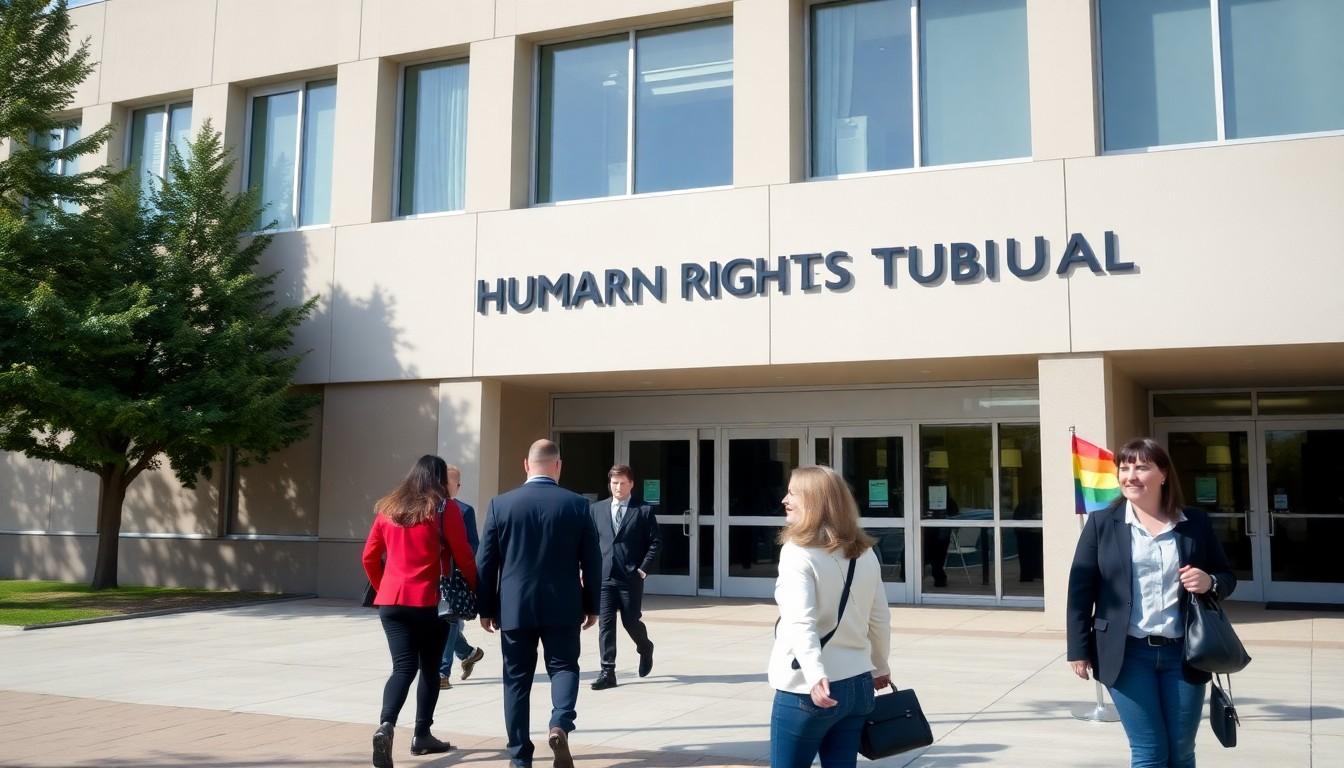
A local dispute over a rainbow crosswalk has grown into a closely watched Alberta Human Rights Tribunal case, with Benita Pedersen defending a flyer she says was meant to warn parents and prompt public debate. The hearing has now turned on expression, medical evidence and the limits of human rights law.
Essential Takeaways
- The dispute began locally: Pedersen is defending a complaint linked to a flyer opposing a proposed rainbow crosswalk.
- The hearing became wider: Witnesses discussed free expression, discrimination, gender transition and medical risk.
- Both sides called evidence: The complainant’s witnesses described harm from negative messaging, while defence witnesses challenged the idea that the flyer amounted to hate.
- A constitutional question remains: Pedersen’s lawyers are challenging part of Alberta’s Human Rights Act.
- The next step is arguments: Oral submissions are scheduled for December 2026, according to the Justice Centre for Constitutional Freedoms.
A crosswalk dispute becomes a major free-speech test
What started as a familiar municipal argument - whether a public rainbow crosswalk should go ahead - has become something much heavier. The Alberta Human Rights Tribunal has heard evidence about political campaigning, public identity and the consequences of medical transition, all stemming from one printed flyer.
Pedersen told the tribunal that her aim was to encourage political action and alert parents to what she believes are risks connected with gender transition. The Justice Centre for Constitutional Freedoms, which is supporting her legal defence, says the material did not incite hatred. That distinction is now central to the case.
Earlier reporting by the Justice Centre described the complaint as an unusual use of Alberta's human rights process, because the dispute concerns political expression rather than a conventional workplace or services complaint. The case has attracted attention partly because a modest piece of local campaigning has raised a much bigger question: how far can public criticism go before it becomes legally actionable?
Testimony brought sharply different experiences into the room
The defence called two women who said they had transitioned and later returned to living as women. They described complicated personal histories, including childhood trauma, mental health struggles and substance misuse, while also discussing their experiences with testosterone and the effects they associated with starting or stopping treatment.
A psychiatrist and an endocrinologist also gave evidence about possible long-term consequences of cross-sex hormones. Their testimony touched on fertility, cardiovascular health and the prospect of lifelong treatment. The medical evidence was presented by the defence as support for Pedersen's argument that parents deserve access to cautionary views.
That doesn't settle the wider medical debate, of course. But it explains why the hearing moved well beyond the wording of a flyer. As the Justice Centre's case summary indicates, the tribunal was asked to consider not only whether people felt hurt or threatened, but also whether controversial claims about healthcare can be part of legitimate democratic discussion.
The complainant's side focused on impact and discrimination
Witnesses supporting the complaint described the effect they said negative public messaging had on transgender people. One researcher referred to survey findings about discrimination and the distress some people experience after hearing hostile or dismissive comments.
The tribunal also heard that bullying at a Westlock high school predated the flyer. That detail matters because it complicates the question of causation. If hostility already existed, the tribunal must consider what the leaflet changed, if anything, and whether it intensified an existing problem.
There were tense moments, too. One witness acknowledged confronting Pedersen with shouting and strong profanity when she attempted to deliver the flyer. The episode illustrates just how personal the disagreement became, even before lawyers began arguing over statutory powers and constitutional boundaries.
A political rivalry has become part of the legal story
The complainant, Laurie Hodge, and Pedersen had also contested the same municipal by-election. Hodge acknowledged during cross-examination that Pedersen was the only person against whom she had pursued a human rights complaint who was also a political opponent.
That doesn't by itself prove improper motivation, and the tribunal will have to assess the evidence carefully. Still, the political connection gives the case an extra layer. A flyer distributed during a public disagreement can look very different depending on whether it's viewed as community advocacy, electioneering or personal attack.
Previous coverage from the Justice Centre and True North Canada highlighted that unusual overlap between local politics and human rights proceedings. For readers, it's a useful reminder that public disputes rarely arrive in neat categories. A campaign message may be political, personal and socially consequential all at once.
What happens next could affect Alberta expression cases
Pedersen's lawyers are also challenging the constitutional validity of section 3 of the Alberta Human Rights Act. They argue that the provision reaches into an area reserved for federal criminal law, including laws dealing with hate speech. Alberta's Attorney General has indicated that the province will intervene to defend the provision.
The tribunal is due to hear oral arguments in December 2026. Until a decision is released, the case shouldn't be treated as a ruling on the flyer, gender-transition policy or rainbow crosswalks generally.
Even so, the outcome could influence how Albertans understand the boundary between offensive expression and prohibited discrimination. For a dispute that began with paint on a road and paper at people's doors, that's an impressively large legal shadow.
It's a small-town controversy with national questions attached.
Source Reference Map
Story idea inspired by: [1]
Sources by paragraph: