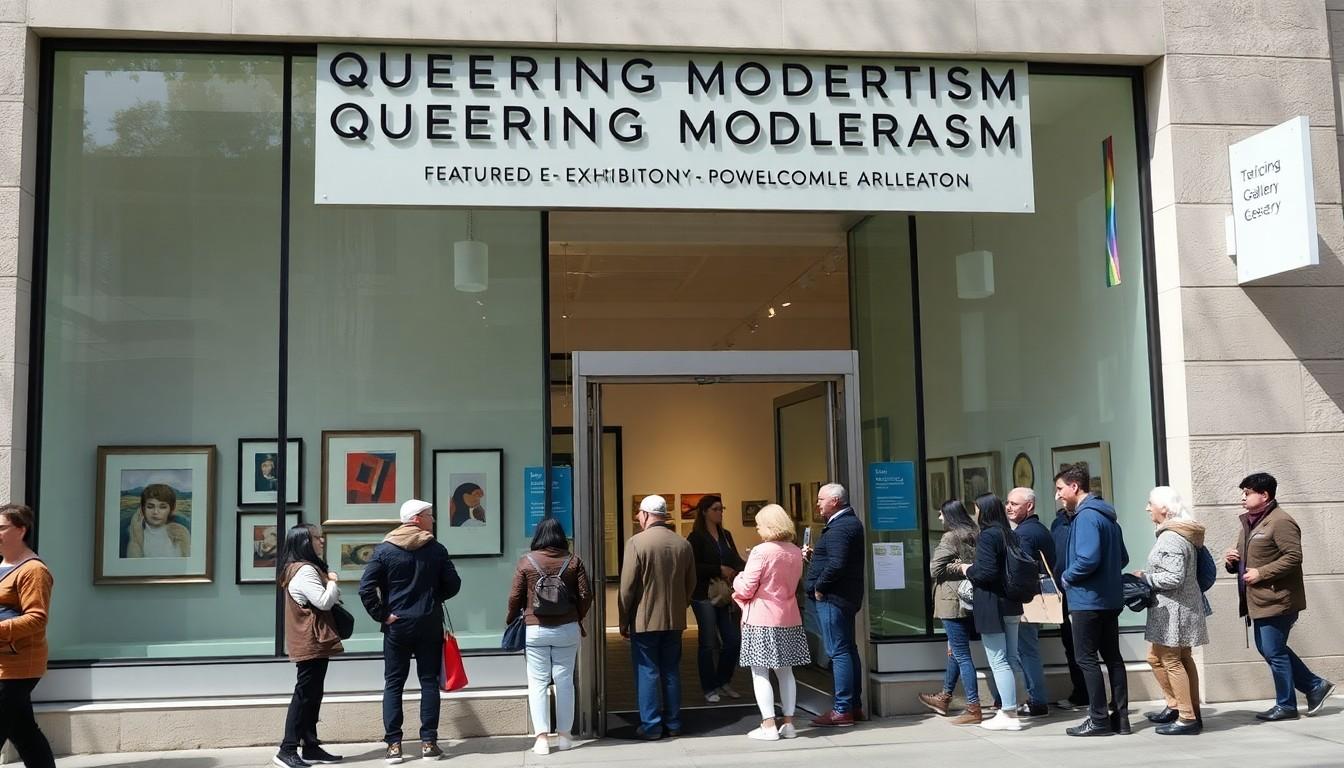
Visitors to Frieze Masters in London are being invited to see 20th-century Modernism through a queer lens, with paintings, photographs and sculpture revealing coded desire, fluid identity and overlooked international stories. The result is a thoughtful, sometimes unsettling strand that asks who gets remembered, how artists survived censorship, and what the canon leaves out.
Essential Takeaways
- A fair-wide history: Queering Modernism is threaded across Frieze Masters rather than confined to one room.
- Coded expression: Artists often used mythology, religious imagery, portraits and bodies to signal identities that couldn't safely be stated.
- A global view: The presentation reaches beyond Europe and the US, including artists from Iran, Brazil and Colombia.
- Portraits carry intimacy: Works by Glyn Philpot and Lotte Laserstein show how portraiture could challenge race, gender and social hierarchy.
- Memory matters: The Aids crisis and family rejection left many queer artists' archives and careers vulnerable to disappearance.
Modernism looks different through a queer lens
Modernism is usually presented as a story of rupture: artists abandoned realism, embraced abstraction and responded to an industrialising, rapidly changing world. At Frieze Masters, however, curator Anke Kempkes adds another layer, showing how sexuality, gender and coded identity shaped that supposedly familiar history.
The fair's Queering Modernism: Visual Languages of the 20th Century thread stretches from the early 1900s to the emergence of queer Postmodern art in the 1980s. According to The Art Newspaper, its strength lies in showing not one style, but a web of visual strategies, from intimate portraiture to grotesque mythological figures. [5]
That makes the experience feel less like a tidy survey and more like a trail of clues. A glance, a pose, a body or a familiar myth can suddenly carry a second meaning.
When desire had to hide in plain sight
For artists working under censorship or criminalisation, direct depictions of same-sex desire could be dangerous. Mythology and religious stories offered a useful disguise, allowing artists to borrow established characters and narratives while quietly reshaping their meaning.
Kempkes describes this tradition as a culture of innuendo and the known secret, in which viewers who understood the visual language could recognise what wasn't being openly declared. Frieze's coverage of the project places this approach within a broader reconsideration of how Modernist artists used familiar symbols to disrupt conventional ideas about identity. [2]
Narcissus is one enduring example. A figure associated with self-regard and reflection, he also became a flexible vehicle for exploring the body, desire and self-fashioning. It is a reminder that queer readings aren't always about finding a single hidden answer. Often, they're about noticing how unstable an image has been all along.
From Tehran to Rio, this is a properly global story
One of the presentation's most compelling features is its reach beyond the usual Euro-American Modernist narrative. Bahman Mohassess, represented by Ab-Anbar Gallery, brings an Iranian perspective shaped by political violence, exile, sexuality and the grotesque.
His paintings, collages and sculptures include damaged, mythological bodies that seem caught between performance and catastrophe. The Art Newspaper reports that his fauns and minotaurs became increasingly charged with homoeroticism during the 1970s and 1980s, while also confronting authoritarianism, war and alienation. [5]
Ismael Nery offers another route into the story. Working in Brazil during the 1920s and 1930s, he developed an androgynous, mystical language that challenged fixed categories of gender. Frieze's wider guide to the fair presents this kind of cross-border perspective as central to the 2026 programme, rather than a decorative addition to it. [3]
Portraits turn private relationships into public statements
Portraiture is another quiet engine of Queering Modernism. Glyn Philpot's King Balthazar, shown by Agnews, depicts Henry Thomas, a Jamaican-born sitter who became a central figure in the artist's life and practice. The biblical title complicates the portrait further, bringing race, status and representation into the same frame.
Nearby, Lotte Laserstein's Portrait of Louis Hahne reflects a different kind of displacement. Laserstein painted it after fleeing Nazi Germany, having been helped to escape by two gallerists. Together, the works show how portraits can preserve affection, alliance and resistance, not simply appearance.
According to The Art Newspaper, mutual portrait-making could operate as an intimate currency between artists and their companions. [5] That feels especially significant in a period when conventional family structures often excluded queer people, while chosen relationships carried practical and emotional weight.
What happens when recovery enters the market?
A major art fair can bring lost or neglected histories into view, but it also puts them inside a commercial setting. That tension isn't ignored here. The participating galleries are selling works, yet their involvement can also help reconstruct careers that were damaged by censorship, illness, family rejection or simple historical neglect.
The work of Colombian artist Luis Fernando Zapata makes the stakes particularly clear. Diagnosed HIV positive in the mid-1980s, he explored mortality and transcendence before his death. His sarcophagus works, including Sarcofagi N° 9, appear less like sealed tombs than vessels for transformation.
The curated programme at Frieze Masters is designed to question how art history is assembled, and its organisers argue that the market can sometimes support preservation as well as consumption. [4] Still, viewers may reasonably hold both thoughts at once: a rediscovery can be culturally valuable, and the price tag can still feel uncomfortable.
The Aids crisis remains a crucial endpoint
The decision to trace the story into the 1980s matters because the Aids crisis cut through queer artistic communities, ending lives and interrupting careers. Many artists died without direct heirs, leaving studios, archives and reputations exposed to dispersal.
Ruth Bernhard's photographs, presented by Galerie Albrecht, add a more sensual and contemplative note. Her images of female bodies can be read through a queer perspective, but the gallery is careful not to reduce them to that label. Their quiet staging and evident respect resist voyeurism, making the photographs feel intimate rather than sensational.
That balance is important. A queer lens should open an artwork up, not flatten it into a category. Frieze's programme suggests a future in which Modernism is understood as more geographically varied, emotionally complicated and bodily aware than the old textbook version. [4]
The most moving thought here is that visibility isn't only about putting an artist on a wall. It's also about protecting the relationships, archives and meanings that allow the work to survive.
Explore the fair with an eye for the stories Modernism once kept quiet.
Source Reference Map
Story idea inspired by: [1]
Sources by paragraph: