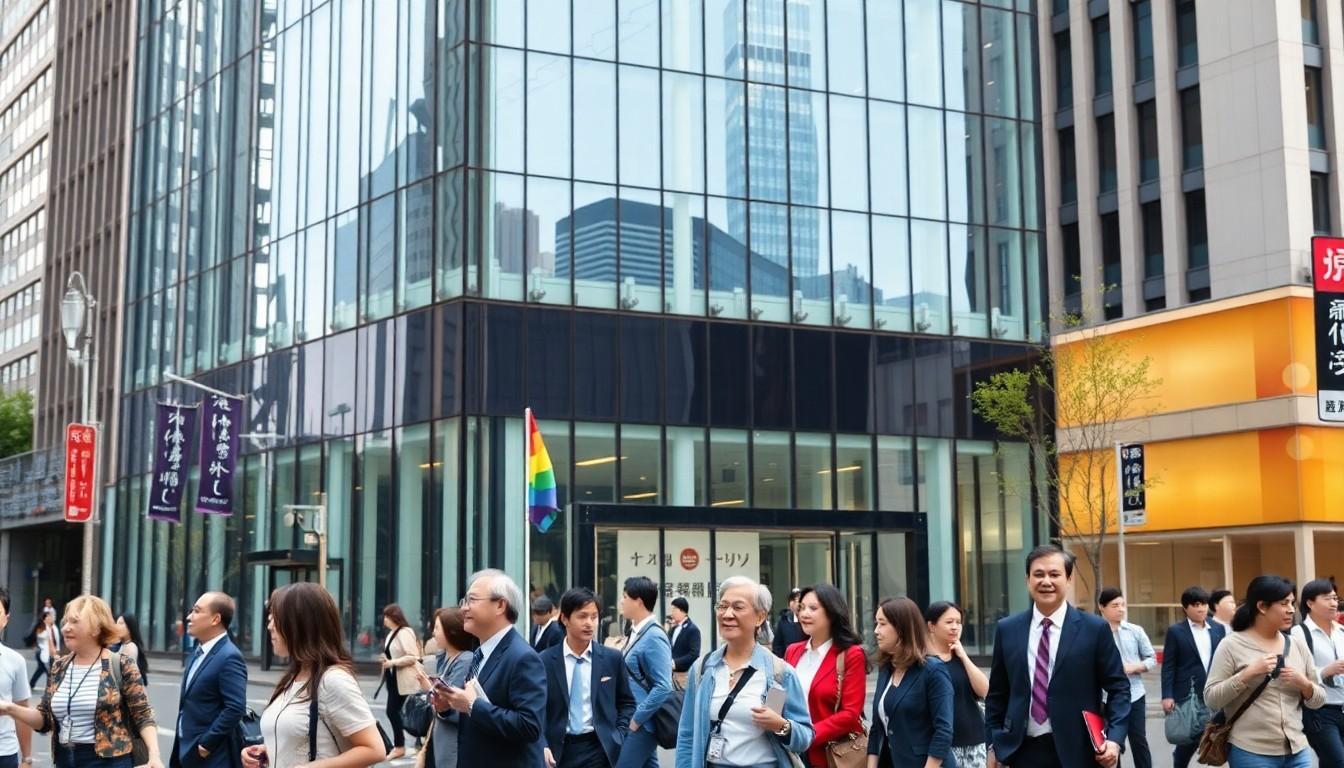
Japan’s LGBTQ inclusion debate is taking on a sharper economic edge, with a new briefing estimating that discrimination could cost the country up to $101.5 billion a year. The warning arrives as employers face labour shortages, the population shrinks and workers still report uneven protection, benefits and workplace support.
Essential Takeaways
- Potential cost: Exclusion is estimated to cost Japan between $37.3 billion and $101.5 billion annually.
- Health is the biggest factor: Poorer health outcomes account for the largest share of the projected burden.
- Workplace gaps remain: Many companies have LGBTQ policies, but employees' experiences aren't consistently inclusive.
- Legal uncertainty matters: Local partnership schemes have expanded, yet they don't offer the same protection as marriage.
- Talent is at stake: Inclusion could help employers attract, retain and support skilled workers in a shrinking labour market.
The price of exclusion is more than a headline
The headline figure is eye-catching, but the report's argument rests on several economic pressures rather than one single bill. Open for Business estimates that LGBTQ exclusion could represent between 0.87% and 2.38% of Japan's gross domestic product, depending on the assumptions used.
Health-related effects make up the largest portion, with estimated annual costs ranging from $25.1 billion to $75.1 billion. Cardiovascular disease is identified as the biggest individual contributor, alongside depression, suicide, self-harm and HIV/AIDS.
Those figures are modelled estimates, not a national spending statement or a guarantee that one new law would recover the entire sum. Still, they offer a useful way to view discrimination: not simply as a social concern, but as something that can affect wellbeing, productivity and employers' costs. The Open for Business briefing sets out that wider economic case.
Why Japan's shrinking workforce changes the conversation
Japan's demographic outlook gives the argument extra urgency. The country's population is expected to fall from roughly 125 million in 2020 to fewer than 87 million by 2070, leaving businesses competing more fiercely for a smaller pool of workers.
That makes retention increasingly valuable. A workplace where people can be open about their identity, access equal benefits and progress without bias is more likely to keep experienced staff, particularly when changing jobs isn't a simple answer for everyone.
There is also a talent paradox. The report cites Japan's strong ranking for talent appeal but a much weaker position for talent readiness. In plain English, the country may attract interest without fully converting that interest into a confident, supported workforce. Inclusion won't solve the demographic crunch on its own, but excluding people is hardly a clever way to ease it.
Corporate policies look stronger than everyday experiences
Japan's larger employers have made visible progress. According to the Open for Business briefing, 80% of the 931 organisations assessed through the 2025 PRIDE Index achieved its top Gold rating, while hundreds of companies had publicly backed marriage equality by mid-2026.
But a polished policy document doesn't always translate into a comfortable Monday morning. Workplace research cited by The Japan Times found that many employees still reported no concrete LGBTQ measures, while other studies recorded discrimination linked to sexual orientation or gender identity.
Only around one-third of surveyed professionals said they felt comfortable disclosing their identity at work. That gap between corporate pledges and lived experience is the crucial detail. A rainbow logo may be visible, but employees tend to notice quieter things first, such as whether managers act fairly, benefits cover their families and complaints are taken seriously.
Marriage equality affects businesses, too
Japan has no nationwide same-sex marriage recognition, although local partnership systems now cover a large share of the population. Those schemes can provide practical recognition, but they don't consistently deliver the legal certainty associated with marriage.
The missing protections can affect inheritance, taxation, medical decisions, social security and survivor benefits. For companies, the complications may appear in spousal benefits, relocation arrangements, family leave and the treatment of employees' partners.
Public opinion is moving faster than national law. The briefing cites 2026 polling showing 67% support for marriage equality, while 82% backed teaching about sexual diversity in schools. Meanwhile, the Supreme Court's Grand Bench is considering marriage equality challenges, keeping the issue firmly in the national spotlight.
Wage gaps reveal a quieter economic loss
The report also puts a price on unequal earnings. Open for Business estimates that LGBTQ workers account for about $175 billion of Japan's earned income, then applies an estimated wage gap of 7% to 15% to calculate potential annual losses of $12.3 billion to $26.3 billion.
That range draws on OECD research rather than a complete national salary survey, so it should be treated as an estimate. Even so, it points employers towards familiar questions: are recruitment decisions consistent, are promotion routes transparent and are transgender employees more likely to be pushed into insecure or lower-paid work?
The practical lesson is fairly straightforward. Businesses should look beyond compliance language and check pay, progression, benefits and staff retention by experience where privacy and data protection allow. In a tight labour market, losing people because the workplace feels unsafe is an expensive habit.
Inclusion is becoming a competitiveness question
The briefing finds a positive statistical relationship between stronger LGBTQ legal protections, talent competitiveness and life satisfaction. It also makes an important qualification: correlation doesn't prove that legal reform alone causes better economic results.
That caution is welcome. Japan's population decline, productivity challenges and labour shortages have many causes, and no single equality measure can fix them. But the broader point still lands. When employers and policymakers remove barriers for a section of the workforce, they widen the number of people who can participate fully.
For Japanese companies, that means treating inclusion as part of good workforce management rather than a decorative extra. For policymakers, it means considering how legal uncertainty shapes people's health, earnings and decisions about where they can build a secure life.
A stronger inclusion strategy won't reverse Japan's demographic decline overnight, but it could help make the remaining workforce healthier, fairer and more resilient.
It's a small shift in perspective, but a significant one: equality is also an economic infrastructure issue.
Source Reference Map
Story idea inspired by: [1]
Sources by paragraph:
- Paragraph 1: [2], [6]
- Paragraph 2: [2], [7]
- Paragraph 3: [2], [4]
- Paragraph 4: [2], [5]
- Paragraph 5: [2], [3]
- Paragraph 6: [2], [7]
- Paragraph 7: [2], [3]
- Paragraph 8: [2], [5]
- Paragraph 9: [2], [3]
- Paragraph 10: [2], [4]
- Paragraph 11: [2], [4]
- Paragraph 12: [2], [7]
- Paragraph 13: [2], [4]
- Paragraph 14: [2], [3]
- Paragraph 15: [2], [7]
- Paragraph 16: [2], [4]