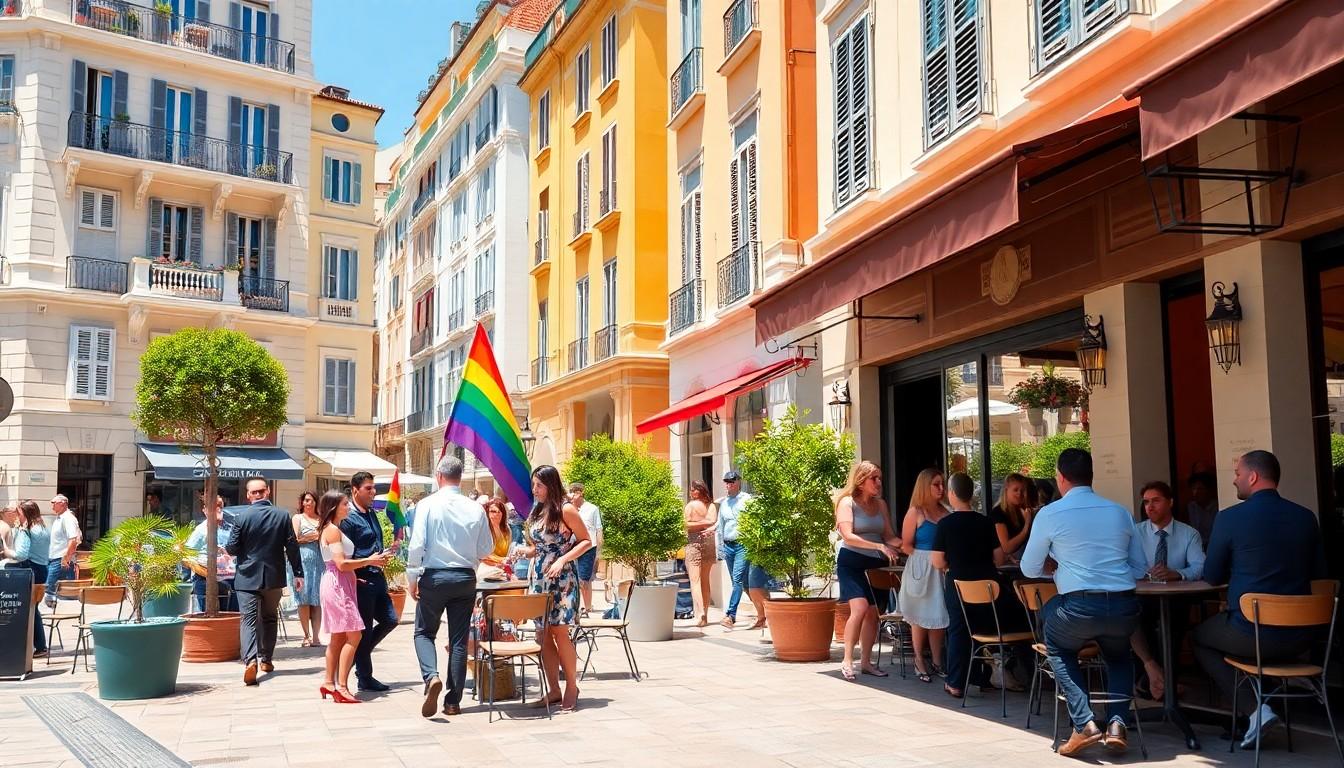
Travellers planning a Monaco Grand Prix trip or Riviera escape often wonder where the Principality's LGBTQ scene is concentrated. The answer is surprisingly simple: there isn't a traditional gay district. In this tiny, international destination, queer life is shaped less by one neighbourhood and more by friendships, events, hospitality, advocacy and the wider Côte d'Azur.
Essential Takeaways
- No dedicated quarter: Monaco doesn't have a clearly defined gay neighbourhood or permanent LGBTQ hub.
- Small but connected: Its compact size and international workforce make social circles overlap quickly.
- Community still matters: Mon'Arc-en-Ciel and Monaco Pride have helped create visibility and opportunities to meet.
- Rights are developing: Civil partnerships exist, but legal equality and protections still have gaps.
- Look beyond the map: LGBTQ visitors are more likely to connect through events, restaurants, beaches, apps and local networks.
Monaco's size changes the whole idea of a gay district
The strongest argument against a traditional gay neighbourhood is physical. Monaco covers a little over two square kilometres, so there simply isn't much room for the kind of sprawling LGBTQ quarter found in larger cities.
The Principality's social geography is also wider than its borders suggest. Many people who work there commute from Beausoleil, Cap-d'Ail, Roquebrune-Cap-Martin, Menton, Nice and across the Italian border. That makes Monaco feel less like a self-contained city and more like one glamorous, tightly packed part of the Riviera.
For visitors, this matters. A map showing no rainbow-lined street doesn't mean there is no LGBTQ community. It means the community isn't organised around one address. GayOut and Mapa Gay list LGBTQ-friendly places and resources, but neither points to a single equivalent of London's Soho or Paris's Marais. (According to GayOut and Mapa Gay.) [2], [7]
Queer life here is dispersed, not absent
In Monaco, meeting people may happen at a restaurant, a beach, a cultural event, a private gathering or through friends of friends. The setting can feel polished and international, but the social mechanics are often familiar: someone knows someone, and introductions travel quickly.
That can be a blessing and a limitation. The lack of a dedicated venue may feel refreshingly integrated, especially for visitors who prefer ordinary bars and cafés to a nightlife circuit. But travellers wanting an obvious, walk-in LGBTQ scene may need to do more homework before arriving.
Travel directories and Riviera guides describe Monaco's LGBTQ life as relatively low-key, with connections often extending into nearby French cities. In practical terms, that means Nice and the surrounding coast can broaden the choice of events, nightlife and community spaces when Monaco itself feels quiet. (Travel information from GayOut and Angloinfo supports this wider-Riviera picture.) [2], [4]
Pride gives the community a visible moment
Monaco may not have a permanent gay district, but it hasn't been without LGBTQ visibility. Monaco Pride and local organisations have created occasions for people to meet, celebrate and make their presence harder to overlook.
That more intimate scale is part of the appeal. Instead of a huge city-wide spectacle, Pride in Monaco can feel closer to a concentrated gathering, where conversation matters as much as the parade or photographs. It's less about claiming an entire neighbourhood and more about showing that LGBTQ people are part of everyday life in the Principality.
Trip by Trip's coverage of Monaco Pride 2026 highlights the event's role in bringing visibility to a community that doesn't have a permanent geographic centre. For visitors, checking the latest Pride calendar or local organisation updates is more useful than searching for a fixed gay street. [6]
Progress has arrived, but equality isn't complete
Monaco's social atmosphere and legal framework shouldn't be treated as the same thing. The Principality introduced the civil solidarity contract, known as the contrat de vie commune, giving cohabiting couples a legal route to formalise their relationship. However, it isn't identical to marriage and doesn't provide every related right.
Wider questions around discrimination, family rights, gender identity and protection from anti-LGBTQ abuse remain part of the conversation. Summaries of Monaco's legal position note progress, but also underline that protections are not as comprehensive as in some neighbouring European countries. (Wikipedia's overview of LGBTQ rights in Monaco and Angloinfo's guide both reflect this distinction.) [3], [4]
So visitors should keep two thoughts in mind at once. Monaco can be socially welcoming and cosmopolitan, while its laws continue to develop. That nuance is more helpful than either calling the destination entirely progressive or dismissing it outright.
How to find LGBTQ-friendly experiences in Monaco
If you're planning a trip, start with current event listings rather than expecting a permanent gay nightclub. Search for Monaco Pride, Mon'Arc-en-Ciel activities, cultural programmes and LGBTQ-friendly venues, then check opening times and event details directly before travelling.
It also pays to widen the search to the French Riviera. Nice, in particular, offers a larger population and more established nightlife, while nearby towns can be reached by train or road. For a Monaco Grand Prix or yacht-show visit, booking early is sensible anyway, since accommodation and transport become especially pressured.
And about the fantasy of finding a wealthy gay partner: Monaco is a destination, not a dating vending machine. Expensive cars and yachts may be visible, but they don't reveal someone's intentions, personality or availability. A genuine social connection remains a much better travel souvenir than a logo-heavy anecdote.
The real answer is that LGBTQ people are everywhere
Monaco's LGBTQ scene is easiest to understand when you stop looking for a single district. Its community appears through networks, events, friendships and ordinary places, with the wider Riviera filling in the gaps when the Principality feels too small.
That model won't suit everyone. Some travellers want a lively, obvious queer neighbourhood, while others appreciate being able to move through a destination without needing a dedicated label over the door. Monaco offers more of the latter, alongside a community that continues to build visibility and press for stronger protections.
The best approach is to arrive curious, check current local information and keep your plans flexible. The rainbow may not be painted on one particular street, but that doesn't mean it isn't part of the landscape.
A small principality can still offer a meaningful LGBTQ experience, especially when you look beyond the map.
Source Reference Map
Story idea inspired by: [1]
Sources by paragraph:
- Paragraph 1: [2], [7]
- Paragraph 2: [2], [4]
- Paragraph 3: [6]
- Paragraph 4: [3], [4]
- Paragraph 5: [2], [4]
- Paragraph 6: [3], [4]
- Paragraph 7: [2], [4]
- Paragraph 8: [6], [7]
- Paragraph 9: [2], [4]
- Paragraph 10: [3], [4]
- Paragraph 11: [2], [4]
- Paragraph 12: [6], [7]
- Paragraph 13: [2], [4]
- Paragraph 14: [3], [4]
- Paragraph 15: [2], [7]
- Paragraph 16: [6], [7]
- Paragraph 17: [2], [4]
- Paragraph 18: [2], [3]
- Paragraph 19: [6], [7]
- Paragraph 20: [2], [4]
- Paragraph 21: [3], [4]
- Paragraph 22: [2], [7]
- Paragraph 23: [6], [7]
- Paragraph 24: [2], [4]
- Paragraph 25: [2], [3]
- Paragraph 26: [6], [7]
- Paragraph 27: [2], [4]